
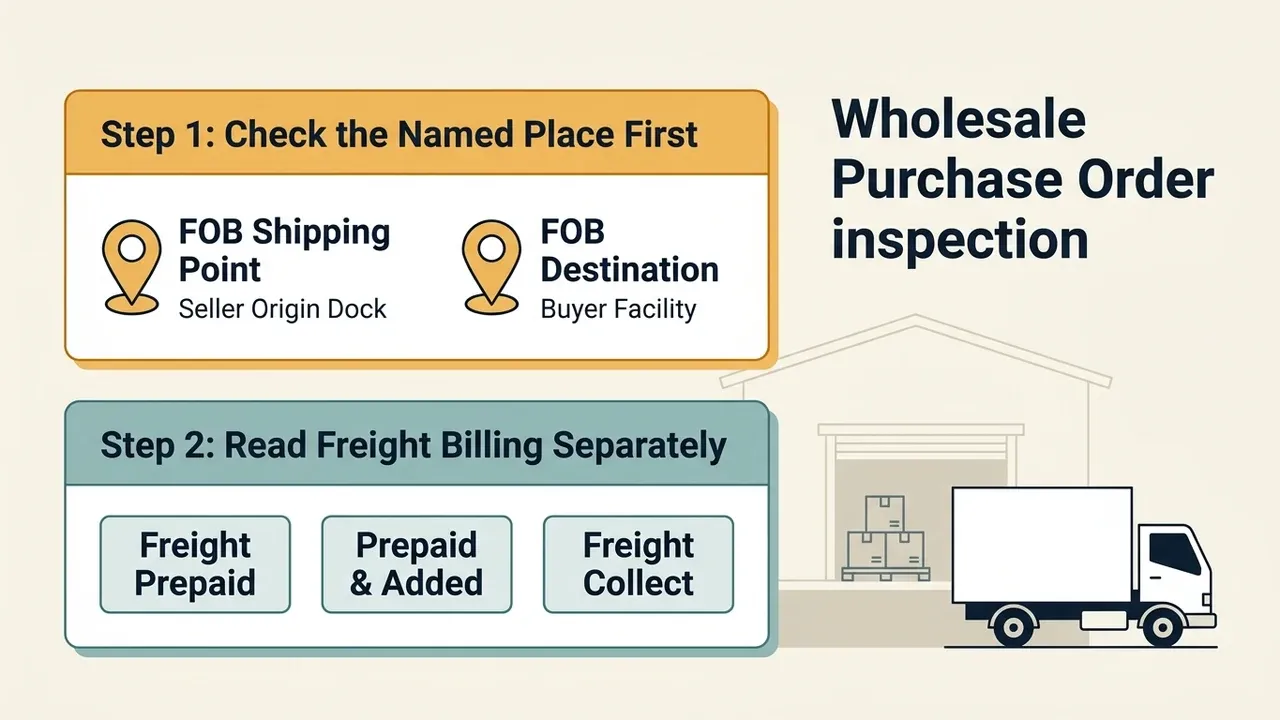
Under model Uniform Commercial Code (UCC) section 2-319, the acronym FOB stands for free on board at a named place and operates as a delivery term on a domestic wholesale order even when printed beside a stated price. Comparing FOB shipping point vs FOB destination (also written FOB origin vs FOB destination), bare FOB place of shipment requires the seller to bear the expense and risk of putting the goods into the possession of the carrier, and where that contract does not require delivery at a particular destination the risk of loss passes to the buyer when the goods are duly delivered to the carrier, whereas bare FOB place of destination requires the seller at its own expense and risk to transport the goods to that place and there tender delivery. Payment modifiers such as freight prepaid, freight collect, or freight prepaid and added to invoice answer who pays the carrier and who bears the freight charge, so FOB destination is not automatic free shipping, and that domestic destination term is not an Incoterms DDP term under which the seller clears import customs and pays import duties and taxes.
Start at our distribution and logistics hub for how outbound transport fits into a wholesale order, use our dock receiving and exception-note guide for delivery-receipt notations and formal carrier claims, and use calculating import landed cost when an international quote requires customs duties and port-to-warehouse math.
FOB Shipping Point vs FOB Destination Under the Model UCC
Model UCC sections 2-319, 2-504, and 2-509 alongside model UCC section 2-401 (passing of title) allocate delivery duties, no-breach transit risk, and passing of title according to whether the contract names the shipment point or the destination, unless the parties agree otherwise. Note that Freight on Board is neither defined by the UCC nor mentioned in Incoterms and has been rejected in U.S. courts as a recognized industry term, so sales contracts should avoid that expansion.
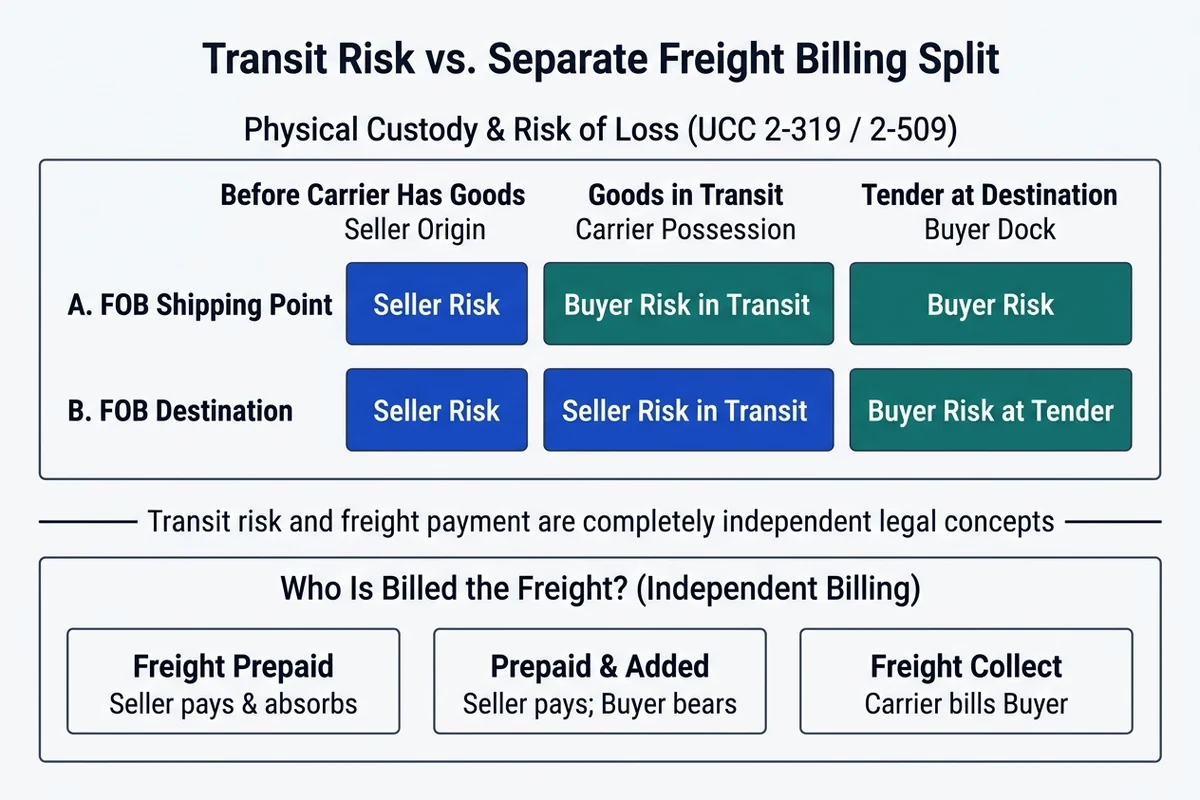
Under UCC section 2-319, when the term is FOB the place of shipment, the seller bears the expense and risk of putting the goods into the carrier’s possession and must ship in accordance with section 2-504: put the goods in the possession of a carrier and make a transportation contract reasonable having regard to the nature of the goods and other circumstances of the case, obtain and promptly deliver or tender in due form any document necessary to enable the buyer to obtain possession of the goods or otherwise required by the agreement or by usage of trade, and promptly notify the buyer of the shipment (failure to notify the buyer or to make a proper transportation contract is a ground for rejection only if material delay or loss ensues), and the buyer must seasonably give any needed instructions for making delivery. Bare FOB place of shipment covers carrier possession rather than loading inside the conveyance; under section 2-319, seller expense and risk for loading the goods on board arise when the contract adds FOB vessel, car or other vehicle, with the buyer naming the vessel on an FOB vessel term.
Under UCC section 2-509 (titled Risk of Loss in the Absence of Breach), a carrier shipment contract that does not require delivery at a particular destination passes risk of loss to the buyer when the goods are duly delivered to the carrier even if shipped under reservation, whereas a destination contract passes risk when the goods are duly tendered at destination while in the carrier’s possession so as to enable the buyer to take delivery. Under the model UCC passing-of-title rules, each provision on the rights, obligations, and remedies of the seller, the buyer, purchasers, or other third parties applies irrespective of title except where the provision refers to title, title cannot pass before the goods are identified to the contract, any retention or reservation by the seller of title in goods shipped or delivered to the buyer is limited in effect to a reservation of a security interest, and unless otherwise explicitly agreed title passes at the time and place of shipment when the contract does not require delivery at destination, or on tender there when the contract requires delivery at destination. Both delivery and risk provisions yield to a contrary agreement of the parties, and non-carrier pickups where goods are not held by a bailee pass risk under section 2-509 on buyer receipt from a merchant seller (or otherwise on tender), as covered in will-call warehouse pickup rules.
| Contract question | Bare FOB place of shipment (UCC 2-319) | Bare FOB place of destination (UCC 2-319) | Model UCC statutory qualifier |
|---|---|---|---|
| Seller physical delivery duty | Put goods into carrier possession at shipment place and ship per section 2-504 | Transport goods at seller expense and risk to destination and tender delivery | Subject to unless otherwise agreed under section 2-319 |
| Loading on board conveyance | Covered when contract adds FOB vessel, car or other vehicle under section 2-319 | Bare destination term requires transport and tender at that place; on-board loading is added only when the contract also says FOB vessel, car or other vehicle | Buyer names the vessel if the term is FOB vessel |
| Risk of loss without breach | Passes to buyer when duly delivered to carrier under section 2-509 | Passes to buyer when duly tendered at destination under section 2-509 | Subject to contrary agreement and breach rules under section 2-509 |
| Passing of legal title | Passes at time and place of shipment under model UCC title rules | Passes on tender at destination under model UCC title rules | Applies after identification unless otherwise explicitly agreed |
| Bill of lading reservation | Does not keep transit risk on seller under section 2-509 | Seller already holds risk until due tender at destination | Title retention after shipment is limited to a security interest |
How Do Freight Prepaid, Collect, and Added Terms Change Billing?
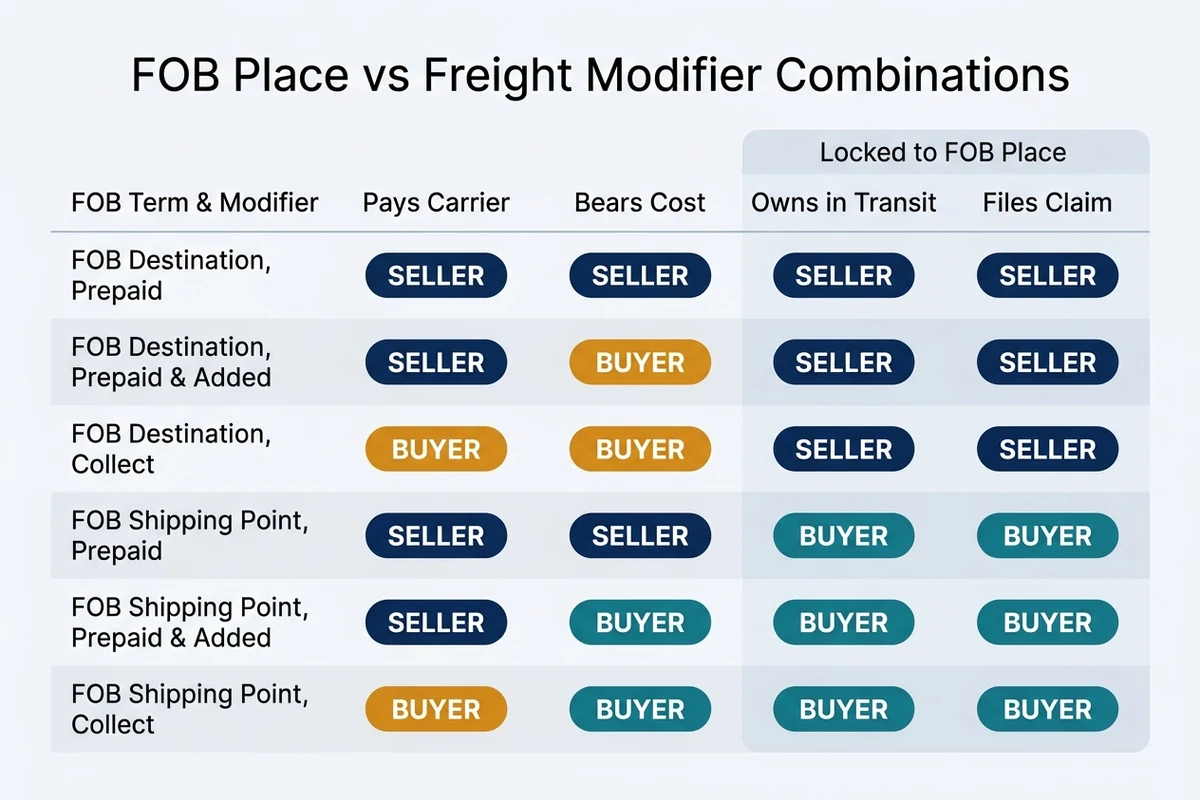
Adding freight prepaid, freight prepaid and added to invoice, or freight collect to a purchase order specifies who pays the carrier and who ultimately bears the transportation charge while keeping in-transit ownership tied to the named FOB place. In North American domestic shipping, bare FOB origin (also called FOB shipping point) leaves the buyer responsible for freight costs and liability during transport once the sale is complete at the seller’s shipping dock, while bare FOB destination leaves the seller responsible for freight costs and liability during transport because the sale is complete at the buyer’s doorstep; Cornell University’s buying manual pairs either named place with freight prepaid, freight prepaid and added, or freight collect.
Cornell University Buying Manual 803A (FOB Terms and Responsibilities, revised March 1, 2012), a university purchasing policy rather than a statutory rule for every private wholesaler, separates four distinct columns across six combinations: payment of freight charges, who bears freight costs, who owns the goods in transit, and who files a claim. Across all three FOB Destination rows in Cornell’s table, the seller owns the goods in transit until delivered and files any carrier claim, even when the seller adds prepaid shipping to the invoice or when the carrier bills the buyer freight collect (with FOB Destination, freight prepaid designated as Cornell’s preferred university terms). Across all three FOB Shipping Point rows the buyer owns the goods in transit and files any claim, with title passing at the vendor’s dock on the freight-prepaid row and the added-to-invoice row, and passing when the carrier signs for the goods at the vendor’s location on the freight-collect row, including on the freight-prepaid row where the who-bears column lists the seller.
| Purchase order combination (Cornell Manual 803A) | Payment of freight charges | Who bears freight costs | Owns goods in transit | Who files freight claim |
|---|---|---|---|---|
| FOB Destination, freight prepaid (Cornell’s preferred terms) | Seller | Seller (pays and absorbs freight) | Seller (title passes when delivered) | Seller |
| FOB Destination, freight prepaid and added to invoice | Seller | Buyer (added to seller invoice) | Seller (title passes when delivered) | Seller |
| FOB Destination, freight collect | Buyer (carrier bills buyer) | Buyer | Seller (title passes when delivered) | Seller |
| FOB Shipping Point, freight prepaid | Seller | Seller (pays and absorbs freight) | Buyer (title passes at vendor dock) | Buyer |
| FOB Shipping Point, freight prepaid and added to invoice | Seller | Buyer | Buyer (title passes at vendor dock) | Buyer |
| FOB Shipping Point, freight collect | Buyer (carrier bills buyer directly) | Buyer | Buyer (passes when carrier signs at vendor location) | Buyer |
Who Owns Damaged Goods in Transit and Pays the Invoice?
When a carrier damages or loses freight in transit in the absence of seller breach, the party holding in-transit risk and ownership absorbs the transit exposure and pursues recovery from the carrier. Under the University of Texas purchasing handbook section on transfer of ownership and FOB (last revised February 21, 2012), FOB terms on a physical delivery answer three separate questions: when title passes, who is responsible in transit, and who files freight claims.
For FOB Origin (Shipping Point), that university handbook states that the university takes ownership as soon as the vendor releases the goods to the carrier, that the university is required to pay for the goods in full if the goods are damaged in transit, and that the university files any necessary freight claim, and the handbook does not recommend this freight term, especially for equipment or delicate items. For FOB Destination (that university’s preferred term), replacement of transit-damaged items is at the vendor’s expense and the handbook delays university ownership until delivery and acceptance, whereas bare model UCC section 2-509 transfers risk upon due tender at destination while in the carrier’s possession. Because a delivery-receipt exception note is evidence rather than a formal claim by itself, follow the inspection and claim steps in carrier receiving and freight claims.
How Do Federal FAR Clauses Define FOB Origin and Destination?
Federal Acquisition Regulation (FAR) section 47.303 (per FAC 2026-01, effective 03/13/2026, listing standard delivery terms in 47.303-1 through 47.303-16 and referencing 47.300 for cost-reimbursement contracts) governs federal government supply contracts rather than private wholesale purchase orders. When a wholesale distributor supplies a federal agency, the solicitation’s FAR clause defines the exact origin or destination obligations:
Under FAR 47.303-1 (clause 52.247-29), f.o.b. origin means free of expense to the Government, delivered on board the indicated type of conveyance of the carrier, or of the Government if specified, at a designated point from which line-haul transportation service, as distinguished from switching, local drayage, or other terminal service, will begin, and the same term also includes delivery to the carrier’s wharf or freight station, to a U.S. Postal Service facility, or, when the solicitation states it, to a Government-designated point in the same city or commercial zone, with the contractor responsible for loss or damage occurring before delivery to the carrier, for loss or damage resulting from improper packing and marking, and for loss or damage resulting from improper loading, stowing, trimming, blocking, or bracing when the contractor loads the shipment. Under FAR 47.303-3 (clause 52.247-31), f.o.b. origin, freight allowed keeps those origin delivery places and deducts an allowance for freight, based on applicable published tariff rates or Government rate tenders between the points specified in the contract, from the contract price, while under FAR 47.303-4 (clause 52.247-32), f.o.b. origin, freight prepaid means that same origin delivery, and the cost of transportation, ultimately the Government’s obligation, is prepaid by the contractor to the point specified in the contract. Under FAR 47.303-6 (clause 52.247-34), f.o.b. destination means free of expense to the Government, delivered on board the carrier’s conveyance at a specified delivery point where the consignee’s facility is located, with supplies delivered to the consignee’s wharf when the destination is a port city and the supplies are for export, or otherwise to the warehouse unloading platform or receiving dock, at the contractor’s expense, and the contractor is responsible for loss or damage occurring before receipt by the consignee at the delivery point specified in the contract; when a motor carrier is used, supplies are delivered to the truck tailgate at the consignee’s unloading platform, except when the supplies meet Item 568 of the National Motor Freight Classification for heavy or bulky freight, in which case the consignee performs unloading, including movement to the tailgate, with assistance from the truck driver if requested.
How Do Accounting Books Record Inventory and Freight Costs?
Introductory merchandising accounting course notes place in-transit goods according to the shipping term and separate inbound product freight from outbound selling expense on bare FOB terms. In Cerritos College ACCT 101 lecture handouts by Prof. Johnson (Chapter 4 on merchandising operations and Chapter 5 on inventories and cost of sales) and San Antonio College Student Learning Assistance Center merchandising notes (2004), bare FOB shipping point places goods in the buyer’s inventory when shipped, whereas bare FOB destination leaves those goods out of the buyer’s inventory until they arrive at the destination; under standard North American accounting practice, goods in transit under FOB destination remain on the seller’s balance sheet rather than the buyer’s because the risks and rewards of ownership change at the destination, while title typically passes with risk of loss and may transfer at a different time or event than the FOB shipping term.
In those handouts for the bare terms, where the Cerritos notes call FOB shipping point the most common case and FOB destination not as common, a buyer under bare FOB shipping point debits freight to Merchandise Inventory against cash or accounts payable, and those notes also name Transportation In as freight costs on merchandise shipped FOB shipping, included in the cost of goods sold calculation. Under bare FOB destination, the seller debits Delivery Expense or Transportation out (a selling expense) against cash or accounts payable.
Domestic UCC FOB vs Incoterms FOB, DAP, and DDP
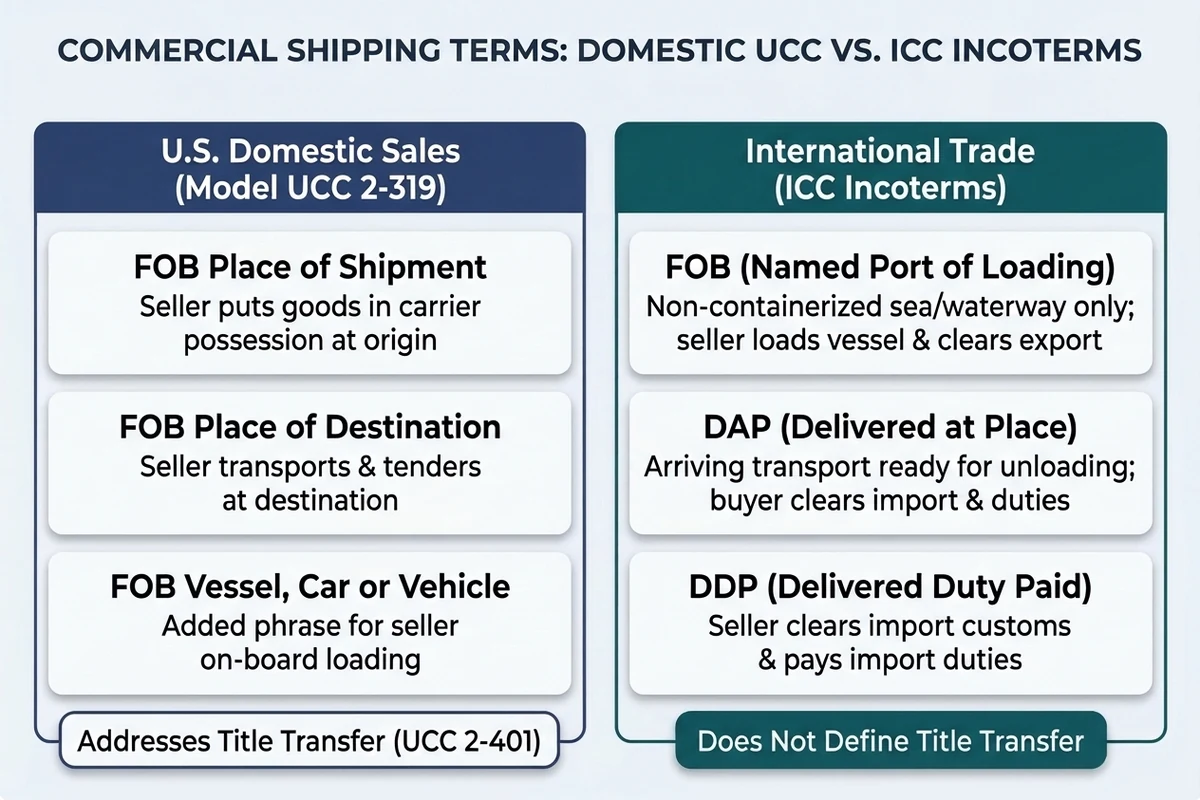
Domestic North American FOB terms under model UCC section 2-319 often carry a meaning inconsistent with International Chamber of Commerce (ICC) Incoterms, which the International Trade Administration (Trade.gov) describes as 11 international rules clarifying tasks, costs, and delivery risk transfer points without defining when title passes from the seller to the buyer, listing the contract price, or setting the method or timing of payment. In Incoterms 2020 (which kept 11 rules while replacing 2010’s Delivered at Terminal, DAT, with Delivered at Place Unloaded, DPU), seven rules apply to any mode of transport and four apply only to sales that solely involve transportation by water, and those rules are not to be used for containerized freight, other combined transport methods, or transport by road, air, or rail.
Within that four-rule water group, Incoterms FOB means Free on Board (named port of loading) for non-containerized sea or inland waterway shipments: the seller bears costs and risks until goods are loaded on board the buyer-designated vessel and arranges export clearance, while the buyer pays the cost of marine freight transportation, bill of lading fees, insurance, unloading, and transportation from the arrival port to the destination. By contrast, Trade.gov lists DAP (Delivered at Place) and DDP (Delivered Duty Paid) in the any-mode group: under Incoterms DAP, the seller places goods at the buyer’s disposal on arriving transport ready for unloading at destination while the buyer completes customs clearance in the importing country, including customs duties and taxes, and bears the unloading cost at the final destination, whereas under DDP the seller clears import customs, obtains required authorizations, and pays import duties and taxes without responsibility for unloading. Although Incoterms can be adopted for domestic or international contracts (applicable to both since the 2010 revision), Trade.gov notes that contracts should explicitly identify the Incoterms rule and edition, such as Incoterms 2010, Incoterms 2020, or FOB New York (Incoterms 2020); for import duty and warehouse cost buildup under CIF, DAP, or DDP, use how to calculate landed cost.
What Purchase Order Checklist Prevents FOB Disputes?
Checking the named FOB location separately from the freight-billing phrase before releasing a purchase order prevents invoice holds, carrier billing surprises, and misrouted damage claims. Pair this purchase-order checklist with mode comparison in LTL versus full truckload shipping and load measurements in wholesale pallet shipping preparation before booking domestic transport.
| Purchase order checklist item | What to read on the quote and purchase order | Operational check and linked workflow |
|---|---|---|
| Named place after FOB | Confirm whether FOB names the seller’s shipping point or the buyer’s destination facility, and avoid writing Freight on Board | Determines where delivery performance completes and where no-breach transit risk shifts under UCC 2-319 and 2-509 |
| Freight prepaid, collect, or added words | Read whether carrier charges are freight prepaid, freight prepaid and added to invoice, or freight collect | Separates carrier bill payment and ultimate freight cost absorption from in-transit ownership |
| Destination shipping cost check | Do not treat FOB destination as free shipping until verifying whether prepaid freight is absorbed or added to the invoice | Prevents unexpected freight line items on FOB destination invoices or collect carrier bills |
| Goods invoice vs transit loss | On an FOB shipping point order, do not refuse the seller’s goods invoice solely because freight was damaged in carrier transit | Buyer holds transit risk after due carrier delivery and recovers through the carrier claim instead |
| Loading and dock claim file | Add FOB vessel, car or other vehicle if seller on-board loading is required, and record specific delivery-receipt exceptions | Follow our receiving and claim file guide for pickup terms and the formal freight claim file |
| Cross-border Incoterms and duties | Do not treat domestic FOB destination as DDP; specify the exact Incoterms rule and edition (such as Incoterms 2020) on imports | Build import clearance, duty, and inland delivery math in our import landed-cost worksheet guide |
Sources
- Model Uniform Commercial Code on Legal Information Institute: UCC Section 2-319 FOB and FAS Terms, UCC Section 2-504 Shipment by Seller, UCC Section 2-509 Risk of Loss in the Absence of Breach, and UCC Passing of Title
- International Trade and Shipping Definitions: International Trade Administration Know Your Incoterms, Wikipedia FOB (shipping), and Wikipedia Incoterms
- Federal Acquisition Regulation Supply Terms (FAC 2026-01, effective 03/13/2026): FAR 47.303 Standard delivery terms, FAR 47.303-1 f.o.b. origin, FAR 47.303-3 f.o.b. origin, freight allowed, FAR 47.303-4 f.o.b. origin, freight prepaid, and FAR 47.303-6 f.o.b. destination
- University Purchasing Policies: Cornell University Buying Manual 803A FOB Terms and Responsibilities (revised March 1, 2012) and University of Texas Purchasing Handbook on Transfer of Ownership and FOB (revised February 21, 2012)
- Merchandising and Inventory Accounting Handouts: Cerritos College ACCT 101 Chapter 5 Handout, Cerritos College ACCT 101 Chapter 4 Handout, and San Antonio College Student Learning Assistance Center Merchandising Notes (2004)