

Planning a full-truckload wholesale order requires reconciling trailer interior dimensions, pallet orientation, vertical carton stacking limits, and highway axle weight regulations before booking a carrier or releasing a purchase order. Misjudging rear door clearance, carton overhang, or tandem axle weight distribution causes costly dock rework, damaged cartons, or rejected deliveries at retail receiving facilities.
Use the calculation framework below to verify floor spots, unit-load height, and legal payload before tendering freight. For broader logistics planning, start at our distribution and logistics hub, review pallet preparation in palletized wholesale freight preparation, coordinate dock scheduling in dock appointment and receiving procedures, and evaluate mode economics in less-than-truckload versus full-truckload shipping.
| Planning Dimension | Primary Calculation Variables | Referenced Industry Sources | Operational Bottleneck to Check |
|---|---|---|---|
| Trailer Floor Spots and Door Clearance | Interior length and width, swing-door versus roll-door aperture, straight versus turned or pinwheel orientation, and single versus double stacking | Premier Trailer Leasing, IIHS, MigWay, ShipEx Logistics | Roll-up doors reduce rear entry clearance and interior length; carton overhang or narrow trailer walls block sideways and pinwheel rows |
| Pallet Footprint and Structural Capacity | Plan dimensions, stringer versus four-way block entry geometry, fork-arm and pallet-jack vertical clearance, and deck load capacity | International pallet specifications, CHEP, PECO Pallet, Virginia Tech market data | Two-way pallets permit fork/pallet-truck entry from two opposite directions only (ISO 6780:2003 3.10), so side entry with pallet jacks is not available. |
| TI/HI Carton Build and Box Compression | Cases per tier, tiers high, retailer receiving height caps, purchase order and ship notice matching, and corrugated compression losses | SPS Commerce, 8th & Walton, Wolf Packing, Virginia Tech packaging studies | Pallet overhang, interlocking layer rotation, panel misalignment, and high warehouse humidity reduce bottom-layer box compression strength |
| Legal Payload, Axle Spacing and Securement | Interstate gross and tandem axle caps, tractor-trailer tare weight, weigh-out versus cube-out breakpoint, Bridge Formula axle spacing, and tiedown working load rules | Federal highway weight regulations, FHWA, FMCSA cargo securement rules, AAA Cooper Transportation | Dense commodities reach legal gross or tandem axle weight limits before filling trailer floor spots; short inner-bridge axle spacing violates federal bridge limits |
Dry Van Interior Dimensions, Door Clearances, and Pallet Floor Layouts
Wholesale buyers calculating how many pallets fit on a truck must separate nominal exterior trailer measurements from actual usable interior length, wall-to-wall width, and rear door frame clearance.
- According to IIHS, a dry van trailer is a fully enclosed semitrailer designed for freight, and Fruehauf offers 53-foot dry van trailer models with walls made from composite and aluminum.
- In Premier Trailer Leasing’s 53’ x 102” Dry Van - Plate specification sheet, overall length is 53’, overall width is 102.36”, interior width is 101.5”, overall height is 13’-6”, and inside height is 110” for both Swing Door and Roll Door configurations.
- In Premier Trailer Leasing’s 53’ x 102” Dry Van - Plate specification sheet, the Swing Door configuration provides 52’-6” interior length, 110” door opening height, and 98-5/16” door opening width, whereas the Roll Door configuration reduces interior length to 52’-1.5”, door opening height to 105”, and door opening width to 93-5/16”.
- Premier Trailer Leasing’s Dry Van - Plate specification sheet lists logistics posts on 48” center, a gross vehicle weight rating of 68,000 lbs., a floor weight rating of 20,000 lbs., Great Dane empty trailer weights of 13,700 lbs. (+/-3%) with swing doors and 13,900 lbs. (+/-3%) with roll doors, and Hyundai empty trailer weights of 14,000 lbs. (+/-3%) with swing doors and 14,200 lbs. (+/-3%) with roll doors.
Because fleets operate trailers from multiple manufacturers with varying wall liner thicknesses and door hardware, dispatchers and warehouse planners also use planning dimensions to estimate usable floor length, interior width, and cubic volume:
- MigWay states typical 53-foot dry van dimensions of 53 ft exterior length, 102 in (8 ft 6 in) exterior width, 13 ft 6 in exterior height with tractor, 52 ft 5 in to 52 ft 8 in interior length (planning number 52 ft 6 in / 630 in), 98 to 101 in interior width (planning number 99 in), 108 to 110 in interior height (planning number 108 in / 9 ft), about 98 in swing-door opening width, 108 to 110 in swing-door opening height, and 14,000 to 15,000 lbs empty trailer weight.
- MigWay calculates that a 53-foot dry van holds about 3,800 to 3,900 cubic feet of usable space, where 52.5 ft length multiplied by 8.25 ft (99 in) width and 9 ft height equals about 3,898 cubic feet (with online figures ranging from 3,400 to 4,000 cubic feet).

Once usable interior length and width are established, the number of pallet floor spots depends on pallet footprint dimensions, loading orientation, and whether the cargo can be double-stacked:
- In a 53-foot dry van, 48 x 40 in GMA standard pallets loaded straight (48 in side along trailer length, two across and 13 deep) fit 26 pallets single stack or 52 pallets double stack; loaded turned (40 in side along trailer length) they fit 30 single stack or 60 double stack; and loaded in a pinwheel pattern (mixed straight and turned) they fit 28 single stack or 56 double stack.
- In MigWay’s 53-foot dry van pallet capacity table, 48 x 48 in pallets loaded straight fit 26 single stack or 52 double stack, while 42 x 42 in and 40 x 40 in pallets loaded straight each fit 30 single stack or 60 double stack.
- MigWay notes that pallet counts assume pallets with no overhang and a trailer at least 98 inches wide inside; turned 48x40 pallets sit 96 inches across, and freight hanging over the pallet edge can drop the count by a full row.
- Comparing single-stacked straight 48x40 pallet capacity across equipment types, a 53-foot dry van (about 52 ft 6 in interior length) holds 26 pallets, a 48-foot dry van (about 47 ft 6 in interior length) holds 24 pallets, and a 26-foot box truck (about 26 ft interior length) holds 12 pallets.
Choosing between straight lengthwise loading, sideways turned loading, and alternating pinwheel patterns requires balancing extra floor spots against dock labor time and in-transit carton stability:
- According to ShipEx Logistics, pinwheel pallet loading rotates every other 48” x 40” GMA pallet 90 degrees to alternate lengthwise and crosswise orientations, and can often increase 53-foot dry van floor capacity from roughly 26 pallets to 28-30 pallets depending on overhang and interior width, but usually slows dock loading speed by 20-30% (dropping throughput from 45-55 pallets/hour with straight loading to 30-40 pallets/hour when pinwheeling).
- ShipEx Logistics states that straight loading pallets with the 48” side running front to back leaves about 4-6 inches of air space on either side, that loads above 84” height need extra wrap, corner boards, or caps for stability, and that turned pallets expose different carton faces to lateral forces during braking and cornering (citing beverage pallets at 1,000-1,100 pounds experiencing higher corner crush and label damage unless braced).
Pallet Footprints, Pooled Block Pallet Capacities, and Entry Clearances
Whether a warehouse crew can turn or pinwheel pallets inside a trailer depends on international pallet dimensional specifications, fork entry geometry, and the structural load capacities of pooled or white-wood pallets:
- ISO 6780:2003 specifies the principal dimensions and tolerances for new single-deck and double-deck, reversible and non-reversible flat pallets, of all entry types and made of any material, related to their transportation and handling by pallet trucks, fork-lift trucks and other appropriate equipment.
- Under ISO 6780:2003 Clause 3.2 and Clause 3.3, pallet length (L) is the deck dimension in the direction of stringers or stringerboards (expressed first, or the longer deck dimension if those members are not present), and pallet width (W) is the deck dimension at right angles to the length.
- Under ISO 6780:2003 Clauses 3.9, 3.10, and 3.11, a four-way pallet permits entry of fork arms of fork-lift trucks, pallet trucks and pallet stackers from all four directions; a two-way pallet permits entry from two opposite directions only; and a partial four-way pallet permits four-way entry of fork-lift trucks and two-way entry of pallet trucks and pallet stackers.
- ISO 6780:2003(E) Table 1 specifies three rectangular plan dimension sizes for flat pallets: 1 200 × 800 mm (47,2 × 31,5 in), 1 200 × 1 000 mm (47,2 × 39,4 in), and 1 219 × 1 016 mm (48 × 40 in).
- ISO 6780:2003 Table 2 specifies three square plan dimension sizes for flat pallets: 1 067 × 1 067 mm (42 × 42 in), 1 100 × 1 100 mm (43,3 × 43,3 in), and 1 140 × 1 140 mm (44,9 × 44,9 in).
- ISO 6780:2003(E) Clause 4.2.1 and Table 3 specify minimum vertical entry clearances under the top deck for pallet trucks of 100 mm for high profile pallets, 95 mm for standard profile pallets, and 89 mm for low profile pallets, while Clause 4.2.2 requires at least 50 mm vertical clearance for fork-lift trucks (or 55 mm in certain European countries).

In North American grocery, retail, and wholesale distribution, pooled wood block pallets from CHEP and PECO Pallet alongside industry-specific footprints govern unit-load weight capacities, empty pallet backhaul stacking, and rack span support:
- The CHEP North America Pooled Wood Block Pallet has external dimensions of 48 inches length, 40 inches width, and 5.6 inches height, with window/pallet entry dimensions of 14.6 inches width by 3.5 inches height on the 48 in side and 12.5 inches width by 4.2 inches height on the 40 in side.
- The CHEP Block Pallet is designed using the Pallet Design System to carry 2,800 lbs in normal operating circumstances with a uniformly distributed load, can be block stacked up to 5 unit loads high not to exceed 10,000 lbs, and empty pallets can be stacked 19 high in a trailer (570 pallets per truck load).
- The PECO GMA (48”x40”) Block Pallet (Decks w/ Clinch) has external dimensions of 48.00” x 40.00” x 5.56” [1,219mm x 1,016mm x 141mm], is constructed with 26 boards and 138 fasteners per pallet, and can be heat-treated to comply with ISPM-15 phytosanitary standards.
- Each PECO 48” x 40” Block Pallet is rated at 2,800 lbs. capacity, supporting an edge-racked 40” [1,016mm] width across a 34” [864mm] or 36” [864mm] span and an edge-racked 48” [1,219mm] width across a 44” [1,118mm] span.
- The PECO 48x20 Half Block Pallet (Decks w/ Clinch) measures 48.00” x 20.00” x 5.56” [1,219mm x 508mm x 141mm], weighs 28 lbs. [12.7 kg], and is rated at 1,400 lbs. [635 kg] capacity.
- According to Virginia Tech’s pallet market summary (Table 2, Gerber), 80% of packaged goods in the US are shipped on pallets (Raballand and Aldaz-Carroll, 2007), and in 2016 the 48 x 40 in. grocery pallet held a 35% share of US newly produced wooden pallet production, followed by 48 x 48 in. (drums, 6%), 42 x 42 in. (chemical, 5%), 48 x 45 in. (automotive, 5%), 40 x 48 in. (military, 4%), and 48 x 42 in. (chemical/beverage, 3%).
TI/HI Pallet Calculation, Retailer Height Caps, and Corrugated Compression Limits
After determining how many pallet footprints fit on the trailer floor, shippers calculate total cases per truckload using TI/HI configuration rules, retail receiving height caps, and barcode labeling rules:
- In TI/HI pallet configuration notation, TI (Tier) is the number of cases that fit on a single layer of the pallet, HI (High) is the number of layers stacked vertically before reaching safe weight or height limits, and TI x HI equals the total cases per pallet.
- Retailers like Walmart and Target specify TI/HI requirements in their purchase orders (EDI 850), and the Advance Ship Notice (EDI 856 or ASN) must accurately reflect the physical TI/HI on the truck; if the ASN declares a 10x5 configuration but the receiver finds an 8x6 configuration, the mismatch triggers a compliance defect.
- In 8th & Walton’s TI/HI calculation example, TI is the number of cases making up a tier on a pallet and HI is the number of tiers on the pallet, so a pallet holding 6 cases on a layer stacked 5 high has a TI/HI of 30, and for stability at least two straps should be applied to each side of the pallet with heaviest boxes stacked on the bottom first.
- In SPS Commerce’s retailer pallet comparison table, Walmart, Target, and Amazon (FBA) all require 48” x 40” GMA pallets, with maximum pallet heights (including the pallet) of 60” for Walmart, 60” for Target, and 72” (non-stackable) or 48” (stackable) for Amazon (FBA).
- For pallet strapping prior to stretch wrapping, SPS Commerce states that polypropylene strapping is used for general freight up to 1,500 pounds, polyester strapping offers high tensile strength for loads that may settle or compress during long-distance hauls, and steel strapping is used for extremely heavy, non-compressible loads like beverages or building supplies.
- For Wolf Packing pallet labeling, each logistics unit uses a unique 18 digit license plate (Serial Shipping Container Code) and 128 barcode with application identifiers (00, 01, 14, 10 lot number, 11 production date, 15 best, 17 expiration) and mandates a minimum grade of 1.5 (equivalent to ANSI C) under ISO/IEC 15416.
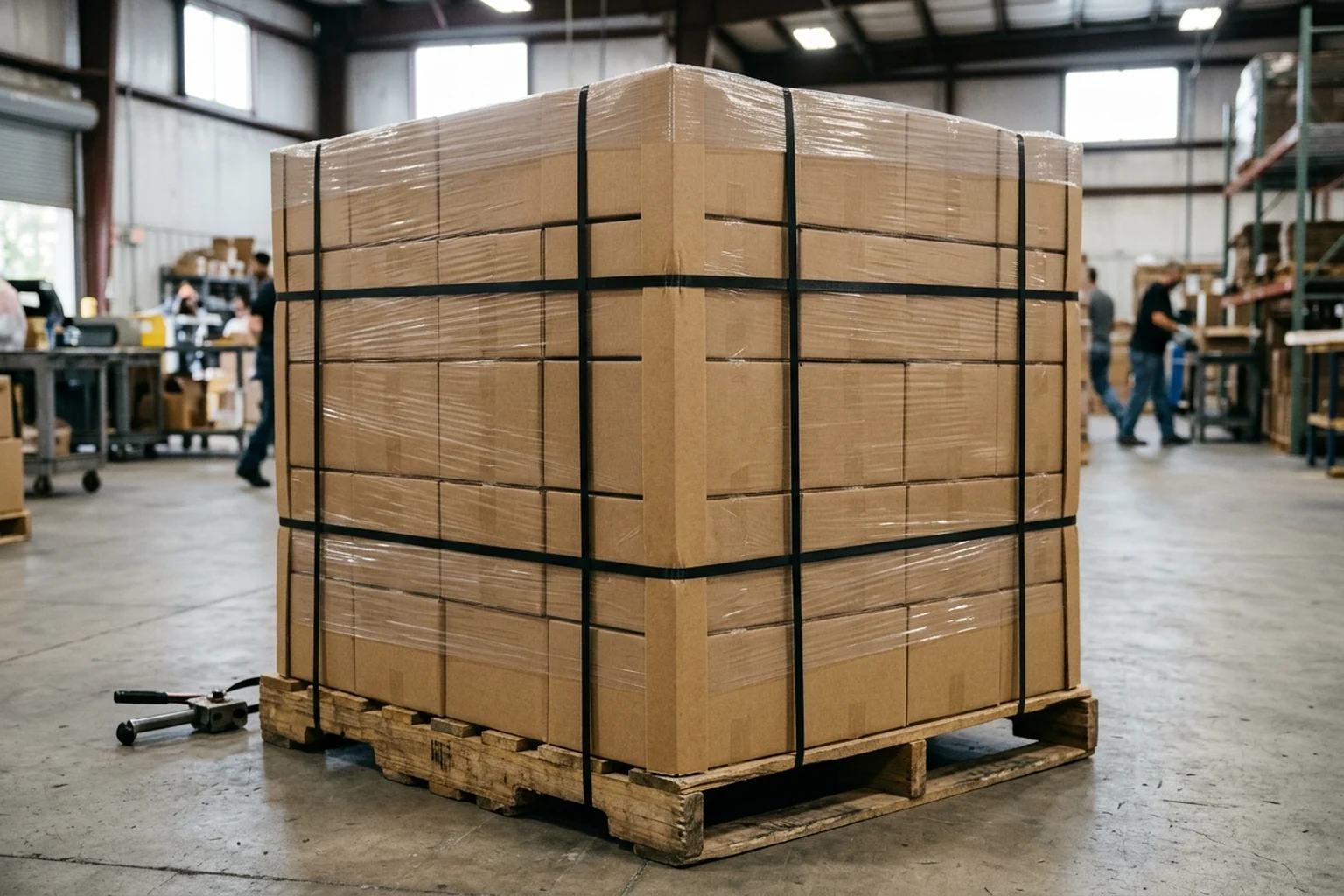
Stacking cartons higher on a pallet or double-stacking unit loads inside a trailer exposes bottom-tier corrugated boxes to vertical compression stresses that are heavily influenced by pallet overhang, stacking alignment, warehouse humidity, and deckboard stiffness:
- In Virginia Tech’s CPULD study (performed on behalf of the Fibre Box Association and ICPF under the TAPPI 804 compression test standard on nominal 32 ECT C-flute and nominal 48 ECT BC-flute corrugated boxes), effective box compression strength decreases as pallet overhang increases, and adjacent-side overhang has a unique effect most likely related to loss of additional box corner support compared with single-side overhang.
- As documented in Virginia Tech’s unit-load compression literature review, box corners provide 2/3 to 3/4 of a corrugated box’s compression strength (Maltenfort, 1988) and become unsupported when a box overhangs a pallet, resulting in a 36% loss of compression strength in Ievans (1975) and a 30% reduction in compression strength due to overhang in DiSalvo (1999).
- In unit load stacking patterns, column stacking vertically aligns boxes and layers to provide more vertical compression strength, whereas an interlocking pattern rotates adjacent layers 90 or 180 degrees to provide more unit load stability during truck braking, railcar coupling, or forklift handling (Laundrie, 1986).
- In Virginia Tech’s unit-load compression review, interlocking boxes within a unit load compromises box compression strength between 39-45% compared to column stacking (Kellicut, 1963; Ievans, 1975), while stacking 3 boxes with a half-inch misalignment of width and length panels results in a 27-29% loss in box compression strength (Ievans, 1975; Singh, Singh, & Saha, 2011a) and misaligning one panel of the center box in a stack of 3 causes a 35% strength reduction (Kellicut, 1963).
- Environmental humidity and load duration also reduce corrugated box stacking strength: a relative humidity change from 50% to 90% in a warehouse results in more than a 50% loss of box compression strength (Whitsitt and McKee, 1972), and for a box to survive under dead load for a month (35.6 days), only loads up to 58% of its static box compression strength can be placed on top (Kellicutt and Landt, 1958).
- In Virginia Tech’s experimental evaluation using ASTM D642 compression testing at 0.5 in./minute, pallet top deck stiffness (varying deckboard thickness from 0.375 in. low stiffness to 0.75 in. high stiffness) produced a 27-37% increase in box compression strength for asymmetrically supported boxes on high-stiffness decks, while pallet performance is evaluated using laboratory standards ISO 8611, ASTM D1185, and AIAG RC-9.
Federal Axle Weight Limits, Bridge Formula Math, and Weigh-Out vs. Cube-Out Breakpoints
A trailer that has open floor spots or vertical headroom can still reach its legal highway weight ceiling if the product is dense, making payload and axle-group calculations essential before finalizing pallet counts per truck:
- Under the 80,000 lbs federal Interstate gross vehicle weight limit, subtracting about 18,000 to 20,000 lbs for a sleeper tractor with fuel and driver and about 14,000 to 15,000 lbs for an empty 53-foot dry van leaves about 42,000 to 45,000 lbs of remaining legal payload.
- On a typical five-axle tractor-trailer, federal axle limits of 20,000 pounds on a single axle and 34,000 pounds on a tandem axle group work out in practice to about 12,000 lbs on the steer axle, up to 34,000 lbs on the drive tandem, and up to 34,000 lbs on the trailer tandem; sliding trailer tandems shifts roughly 250 pounds per hole, while most states cap kingpin-to-rear-axle distance at about 41 feet and California caps it at 40 feet.
- Dividing 45,000 pounds of payload by 26 pallets gives a weigh-out versus cube-out break point of about 1,730 pounds per pallet; loads heavier than that weigh out before filling the floor, whereas lighter loads cube out (such as furniture, insulation, and packaging filling the trailer at 15,000 to 20,000 lbs, while beverages, canned goods, and paper weigh out with the floor half empty at 44,000 lbs).
Federal regulations on the National System of Interstate and Defense Highways and the National Network establish the statutory ceilings for gross vehicle weight, single and tandem axles, bridge formula spacing, and exterior trailer width and length:
- Under 23 CFR § 658.17(b), (c), and (d), on the National System of Interstate and Defense Highways, the maximum gross vehicle weight shall be 80,000 pounds (except where lower weight is dictated by the bridge formula), the maximum gross weight upon any one single axle is 20,000 pounds, and the maximum gross weight on tandem axles is 34,000 pounds.
- Under 23 CFR § 658.17(e), gross weight on two or more consecutive axles on an Interstate highway may not exceed the Bridge Gross Weight Formula W = 500(LN/(N-1) + 12N + 36), except that two consecutive sets of tandem axles may carry a gross load of 34,000 pounds each if the overall distance between the first and last axle is 36 feet or more, and total gross vehicle weight shall in no case exceed 80,000 pounds.
- Under 23 CFR § 658.17(n), a commercial vehicle utilizing a certified, functional auxiliary power or idle reduction technology unit (APU) may be allowed up to an additional 400 lbs. total in gross, axle, tandem, or bridge formula weight limits (not to exceed 400 lbs. or the weight certified, whichever is less).
- FHWA’s Bridge Formula Weights guidance (FHWA-HOP-19-028, referencing 23 USC 127) defines Single-Axle Weight as the total weight on one or more axles whose centers are spaced not more than 40 inches apart (20,000 pounds limit), and Tandem-Axle Weight as the total weight on two or more consecutive axles whose centers are spaced more than 40 inches apart but not more than 96 inches apart (34,000 pounds limit).
- In FHWA’s Bridge Formula check for a five-axle tractor-semitrailer carrying 12,000 pounds on axle 1 and 17,000 pounds on each of axles 2 through 5 (80,000 pounds total gross weight across L = 51 feet for N = 5 axles), if the inner bridge distance between axle 2 and axle 5 is only L = 35 feet (N = 4 axles, actual weight 68,000 pounds), it violates the Bridge Formula maximum of 65,500 pounds because the 34,000-pound tandem exception requires at least 36 feet between axles 2 and 5.
- Under 23 CFR § 658.15(a), no State shall impose a width limitation of more or less than 102 inches, or its approximate metric equivalent, 2.6 meters (102.36 inches), on a vehicle operating on the National Network (except Hawaii’s 108-inch width maximum under section 416(a) of the STAA).
- Under 23 CFR § 658.13(b) and (c), on the National Network no State shall impose a length limitation of less than 48 feet on a semitrailer operating in a truck tractor-semitrailer combination or less than 28 feet on a semitrailer or trailer in a twin combination, nor prohibit trailers or semitrailers of dimensions in actual and lawful use in the State on December 1, 1982.
In addition to highway weight and dimensional rules, shipments must satisfy federal cargo securement performance criteria and account for carrier tariff rules covering pallet tare weight in density calculations, capacity load thresholds, and Bill of Lading reweigh variances:
- Under 49 CFR § 393.102, cargo securement tiedown assemblies and attachment devices must not exceed breaking strength under 0.8 g forward deceleration, 0.5 g rearward acceleration, and 0.5 g lateral acceleration, nor exceed working load limit under 0.435 g forward deceleration, 0.5 g rearward acceleration, and 0.25 g lateral acceleration; cargo is considered to meet performance requirements if immobilized or in contact with (or sufficiently close to) walls of adequate strength or other articles in a sided vehicle so it cannot shift or tip.
- Under 49 CFR § 393.106(b), (c)(2), and (d), cargo must be firmly immobilized or secured on or within a vehicle by structures of adequate strength, dunnage, dunnage bags, shoring bars, tiedowns or a combination; articles placed beside each other and secured by transverse tiedowns must be in direct contact or prevented from shifting towards each other; and the aggregate working load limit of tiedowns used to secure an article or group of articles must be at least one-half times the weight of the article or group of articles.
- Under AAA Cooper Transportation Rules Tariff Item 491 Paragraph 6, when articles are consolidated with pallets, platforms, racks, skids, or similar devices that form part of the shipping package, those components are included in the calculation of shipment density (total shipment weight divided by total cubic feet).
- Under AAA Cooper Transportation Rules Tariff Item 390, a shipment meets the definition of Capacity Load (Loaded Full Visible Capacity) on a 28-foot trailer when the quantity of freight is greater than or equal to 20,000 pounds regardless of linear feet or cubic capacity, or when it fills 20 linear feet or greater of the trailer; under Item 970 Section 2, a carrier reweigh applies when the weight variance exceeds 200 pounds or is at least 50 pounds and greater than 10 percent of the stated Bill of Lading weight.
Pre-Shipment Truckload and Pallet Planning Checklist
Copy the verification table below into your logistics planning file and complete each row before approving a full-truckload purchase order or dispatching a carrier.
| Planning Stage | Verification Field | Evidence to Record in the Shipment File | Action if Unverified or Out of Spec |
|---|---|---|---|
| Trailer Equipment Check | Door style, interior width, and door opening height | Carrier equipment confirmation specifying swing-door versus roll-door dry van clearance | Adjust top-tier carton height or floor row layout before staging pallets at the dock |
| Pallet Footprint and Entry | Four-way block versus two-way stringer construction | Pallet specification sheet showing footprint dimensions, entry windows, and deck load capacity | Restrict two-way pallets to straight lengthwise loading or re-palletize onto four-way pallets |
| TI/HI and Retail Compliance | Cases per layer, layers high, and barcode label grade | Purchase order and ship notice matching physical TI/HI configuration and receiving height cap | Restack non-conforming pallets before sealing the trailer so physical tiers match the ship notice |
| Corrugated Stack Integrity | Flush edge alignment, column stacking, and strapping | Dock inspection confirming zero pallet overhang, aligned box corners, corner boards, and strapping | Eliminate carton overhang and add edge protectors or strapping before double-stacking unit loads |
| Payload and Axle Balance | Total gross freight weight Including pallet tare weight | Bill of Lading weight calculation comparing unit-load gross weight against legal payload and tandem limits | Reduce pallet count per trailer when unit loads hit the weigh-out threshold before filling floor spots |
| Cargo Securement Audit | Wall contact, shoring bars, dunnage bags, and tiedowns | Loading dock sign-off verifying immobilized contact across rows and rear load lock placement | Install dunnage bags, shoring bars, or transverse tiedowns to prevent lateral or forward shifting |
Common Questions
How does a roll-up rear door change usable space in a dry van trailer compared with swing doors?
In Premier Trailer Leasing’s dry van specification sheet, a roll-door configuration reduces usable interior length as well as rear door opening height and door opening width compared with a swing-door configuration, even though both trailer types share the same overall exterior length, overall width, and interior ceiling height. Buyers loading tall or wide unit loads near the rear threshold should verify the trailer door type before finalizing pallet height and floor layout.
When does pinwheel pallet loading make sense versus straight or turned loading?
MigWay’s capacity table shows higher pinwheel/turned counts than straight loading; ShipEx notes pinwheeling can often raise floor spots from roughly 26 to 28-30 when width and overhang allow. However, ShipEx Logistics notes that pinwheeling usually slows dock loading throughput compared with straight loading and that turning pallets exposes different carton faces to lateral braking and cornering forces.
Why can an interlocking carton pattern reduce vertical stacking strength compared with column stacking?
As documented in Virginia Tech’s unit-load compression studies, column stacking aligns box corners directly above one another for vertical compression strength, whereas rotating adjacent layers in an interlocking pattern transfers top load from corners onto box sidewalls. While interlocking improves unit-load stability during braking and forklift handling, it reduces vertical box compression capacity compared with aligned column stacks.
How do carrier tariffs treat pallet tare weight and Bill of Lading weight variances during reweigh inspections?
Under AAA Cooper Transportation’s rules tariff, pallets, platforms, racks, and skids consolidated with freight are included in total shipment weight and cubic volume when calculating shipment density, and carrier reweigh adjustments apply when the weight variance against the stated Bill of Lading weight exceeds the tariff’s pound or percentage thresholds.
Sources
- International Organization for Standardization Flat Pallets for Intercontinental Materials Handling
- CHEP North America Pooled Wood Block Pallet Specification Sheet
- PECO Pallet Block Pallet Specifications and Load Ratings
- Premier Trailer Leasing Dry Van Trailer Specifications
- Insurance Institute for Highway Safety Fruehauf Dry Van Trailer Report
- MigWay Dry Van Dimensions, Pallet Count and Weight Guide
- ShipEx Logistics Pinwheel Pallet Loading Guide
- Legal Information Institute Federal Interstate Highway Weight, Width and Length Regulations
- Federal Highway Administration Bridge Formula Weights Guidance
- Legal Information Institute Federal Motor Carrier Safety Administration Cargo Securement Rules
- SPS Commerce Pallet Building, TI/HI and Retail Compliance Guide
- 8th and Walton TI/HI Palleting Guide for Suppliers
- Wolf Packing Pallet Label and Barcode Documentation
- Virginia Tech Center for Packaging and Unit Load Design Overhang and Box Compression Studies
- AAA Cooper Transportation Rules Tariff Documentation