
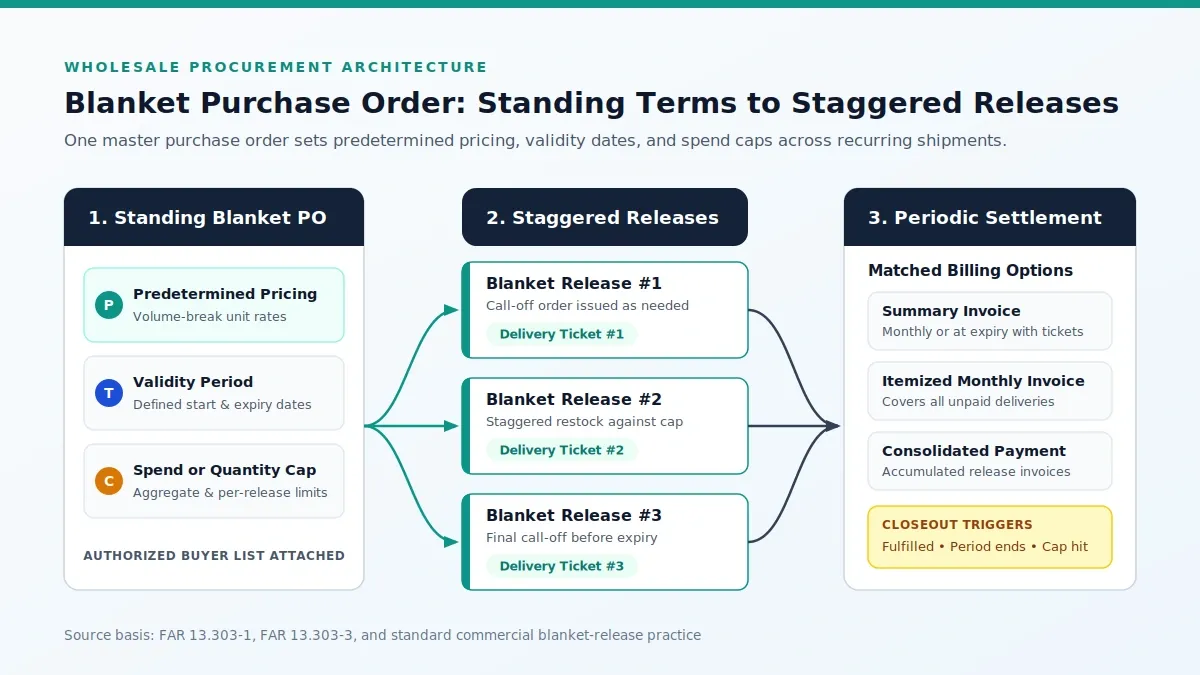
Also called a blanket order or call-off order, a blanket purchase order (BPO) is the standard wholesale mechanism for buying recurring expendable SKUs or ongoing maintenance services when you want volume-break pricing without taking an entire year’s inventory in one drop. Instead of re-quoting and approving a separate purchase order for every restock, your purchasing team draws down pre-agreed terms through individual release orders as demand materializes.
For the broader purchasing sequence before negotiating standing orders, start at our wholesale buying hub. Pair standing agreements with supplier minimums in wholesale MOQ rules, structure multi-period quotes using our wholesale RFQ template, and align billing cycles with wholesale payment terms.
What Is a Blanket Purchase Agreement (BPA) and How Does a Blanket Order Work?
Under Federal Acquisition Regulation (FAR) 13.303-1, a blanket purchase agreement (BPA) is a simplified method of filling anticipated repetitive needs for supplies or services by establishing charge accounts with qualified sources of supply. In commercial wholesaling, a blanket order works through the same standing-order structure to handle recurring expendable goods over a set period.
Rather than negotiating and approving a new purchase order every time stock runs low, the buyer and supplier agree upfront on item descriptions, predetermined pricing, a validity window, and an aggregate ceiling. As operational demand arises, the buyer issues individual release orders, commonly called blanket releases, along with matching invoice items until the contract is fulfilled, the order period ends, or the predetermined maximum order value is reached. Blanket orders or call-off orders are also used for recurring services such as maintenance and repair, where inventory holding benefits do not apply but emergency repairs or on-call maintenance can be arranged quickly at guaranteed rates.
Public procurement rules highlight two governance principles that also protect private wholesale buyers. First, FAR 13.303-1(b) states that BPAs should be established for use by an organization responsible for providing supplies for its own operations or for other offices, installations, projects, or functions, while FAR 13.303-1(c) makes clear that using a BPA does not exempt an organization from keeping obligations and expenditures within available funds. Second, FAR 8.405-3 expresses a preference for establishing multiple-award BPAs where practicable rather than relying solely on a single-award BPA, giving buyers competition and supply continuity across recurring call-offs.
How Does a Blanket Purchase Order Differ From a Standard, Planned, or Contract PO?
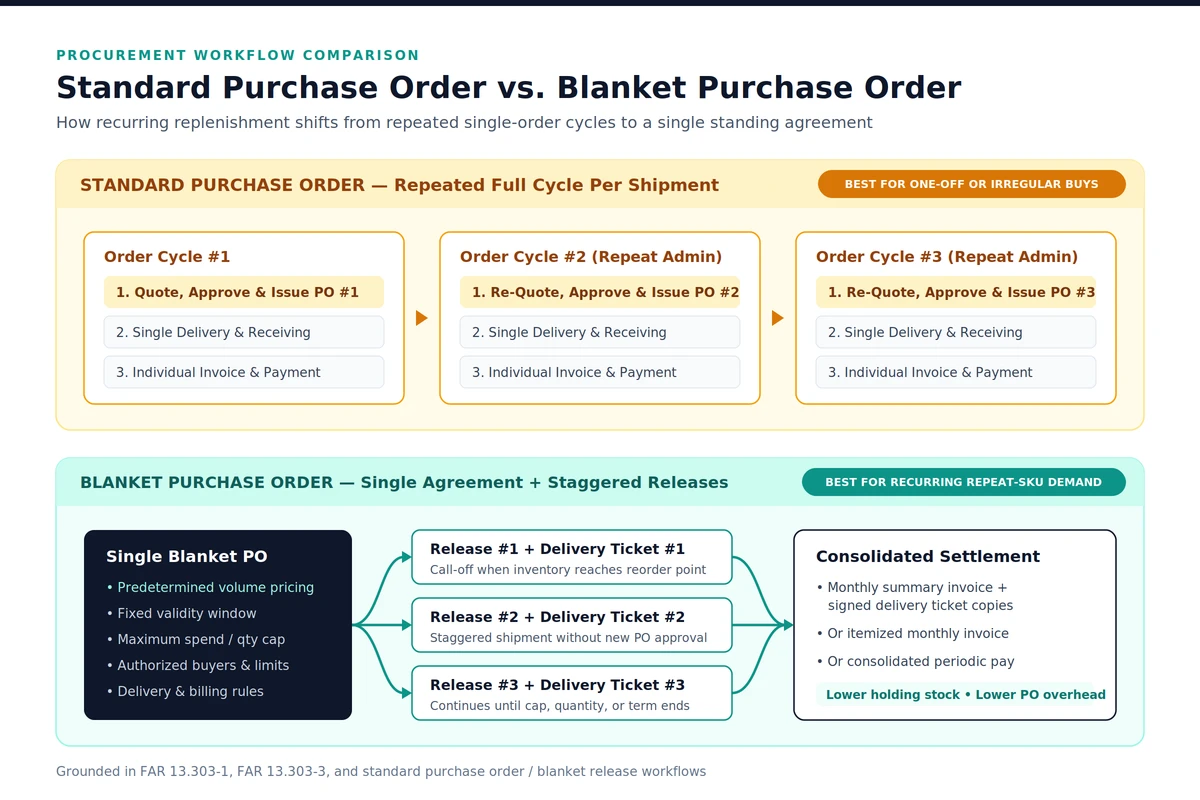
A standard purchase order specifies exact types, quantities, and agreed prices for a single discrete buy, whereas a blanket purchase order covers staggered deliveries over a set period at predetermined prices. A planned purchase order (PPO) records a long-term single-supplier commitment fulfilled via separate individual POs, while a BPA obligates the buyer only for authorized purchases actually made.
Choosing the wrong instrument creates avoidable administrative friction or unintended liability. Use a standard purchase order for one-off or irregular buys where the SKU, quantity, and delivery date are fixed upfront. Use a blanket purchase order when recurring demand for repeat SKUs or ongoing services justifies pre-negotiated volume breaks without taking all inventory in one drop. Use a planned purchase order when you are committing long-term purchasing volume to one supplier while issuing separate individual purchase orders to specify quantities over time. Use a BPA framework when multiple authorized buyers need a charge-account structure with strict per-purchase limits and zero obligation beyond actual authorized call-offs.
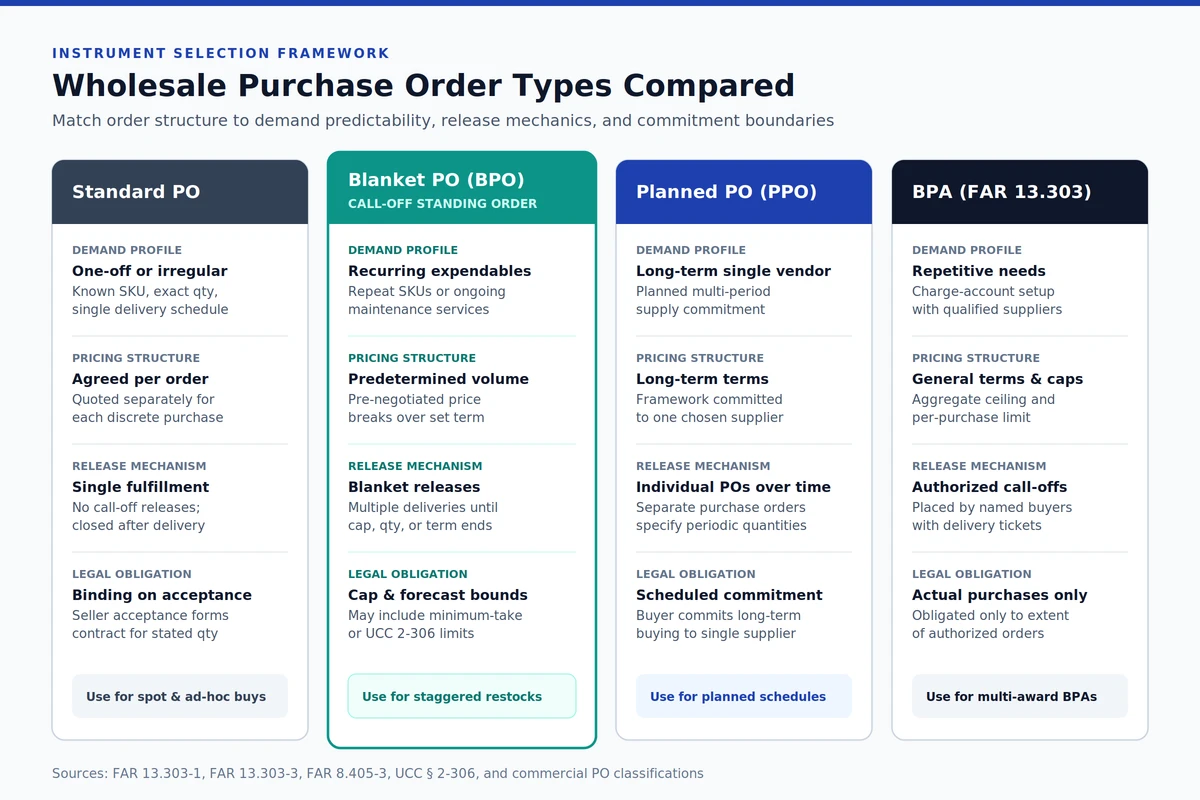
| Comparison criterion | Standard purchase order (PO) | Blanket purchase order (BPO) | Planned purchase order (PPO) | Blanket purchase agreement (BPA) |
|---|---|---|---|---|
| Demand pattern (order frequency) | Single one-off or irregular purchase | Recurring expendable goods or repeat services over a set period | Long-term recurring need from a single supplier | Anticipated repetitive needs for supplies or services |
| Pricing basis (rate structure) | Agreed price per discrete order | Predetermined volume-break pricing for the term | Long-term single-supplier commitment terms | Pre-agreed supply terms within an aggregate ceiling |
| Fulfillment trigger (release unit) | Single delivery against the PO | Staggered blanket releases or call-off orders | Separate individual POs specifying quantities over time | Authorized purchases accompanied by delivery tickets |
| Obligation boundary (buyer liability) | Binding for stated quantity upon seller acceptance | Fulfilled up to quantity, term end, or maximum order value; may include minimum-take terms | Long-term commitment to buy from a single supplier | Obligated only to the extent of authorized purchases actually made |
| Best wholesale use case (scenario) | Ad-hoc restocks, spot buys, or fixed-quantity shipments | Predictable repeat SKUs where staggered drops lower stock holding | Single-source long-term supply scheduled via periodic POs | Multi-department or multi-award charge-account purchasing |
Is a Blanket Purchase Order Legally Binding Like a Contract?
Issuing a purchase order does not by itself form a binding contract; when no prior master contract exists, the seller’s acceptance of the order creates the contract between buyer and seller. Because purchase orders for goods are regulated under the Uniform Commercial Code (UCC) or similar law, seller acceptance is commonly accompanied by terms and conditions of sale that establish additional legal conditions.
Statute of Frauds and Written Confirmations Under UCC Section 2-201
Under UCC Section 2-201 subsection (1), a contract for the sale of goods at or above the statutory five-hundred-dollar threshold is not enforceable by way of action or defense unless there is a signed writing sufficient to indicate that a contract for sale has been made. A writing is not insufficient merely because it omits or incorrectly states an agreed term, but the contract is not enforceable under that provision beyond the quantity of goods shown in the writing.
Three statutory rules in UCC Section 2-201 directly affect wholesale blanket orders and release confirmations:
- Merchant written confirmation window (10 days): Under UCC Section 2-201(2), between merchants, a written confirmation sufficient against the sender satisfies the writing requirement against the recipient unless written notice of objection to its contents is given within 10 days after receipt.
- Specially manufactured goods exception: Under UCC Section 2-201(3)(a), an unwritten agreement can still be enforced for specially manufactured goods once the seller, before receiving notice of repudiation, makes either a substantial beginning of their manufacture or commitments for their procurement.
- Payment or acceptance exception: Under UCC Section 2-201(3)(c), an agreement is enforceable with respect to goods for which payment has been made and accepted or which have been received and accepted.
Open-Quantity Limits and Exclusive Dealings Under UCC Section 2-306
Because blanket orders frequently use estimated totals or requirements-style call-offs rather than a single fixed shipment quantity, UCC Section 2-306 sets strict good-faith guardrails. Under UCC Section 2-306(1), in an output or requirements contract, no quantity unreasonably disproportionate to any stated estimate—or, when no estimate is stated, to any normal or otherwise comparable prior output or requirements—may be tendered or demanded. Under UCC Section 2-306(2), an exclusive-dealing agreement for goods imposes, unless otherwise agreed, an obligation by the seller to use best efforts to supply the goods and by the buyer to use best efforts to promote their sale.
What Are the Advantages and Disadvantages of Blanket Purchase Orders?
Blanket purchase orders let wholesale buyers hold less stock at any given time, cut repetitive PO processing costs, and capture volume-break discounts while giving suppliers predictable ongoing orders and cash flows. Their main drawback is forecast risk: estimating usage is the hardest part of a blanket contract, and minimum-take terms can expose buyers if demand falls.
In practice, buyers supply historical usage forecasts and suppliers may attach a minimum purchase condition to protect their production or stocking commitment. For example, a supplier may require that 80% of the forecast quantity be purchased by the end of a one- or two-year contract. If end-customer demand slows mid-term, an unreviewed forecast leaves the buyer facing an end-of-term shortfall or excess stock.
Buyers and suppliers can reduce that risk by agreeing upfront on staged inventory levels rather than having the supplier stock the entire forecast at once. For instance, the parties can agree that the supplier keeps only 20% of the forecast quantity in stock during the first 6 months so both sides can review actual release velocity and adjust quantities appropriately. Pairing staged stock reviews with clear MOQ boundaries in wholesale MOQ rules prevents a multi-month blanket order from turning into dead inventory.
| Dimension | Buyer perspective | Supplier perspective | Practical risk control |
|---|---|---|---|
| Inventory & storage (stock holding) | Avoids holding more stock than necessary at any one time | Must decide how much safety stock to hold against buyer forecasts | Stage supplier stock (for example, holding 20% in stock for the first 6 months) and review velocity |
| Administration (order cycle effort) | Eliminates repetitive PO creation and approval overhead | Replaces repeated spot quoting with predictable release orders | Maintain a written authorized-buyer list and per-release value limits |
| Pricing & cash flow (commercial terms) | Captures volume-commitment and price-break discounts | Secures ongoing business and more predictable future cash flows | Document net unit pricing, discount start dates, and consolidated billing periods |
| Forecast & obligation risk (volume exposure) | May face minimum-take terms such as 80% of a one- or two-year forecast | Faces carrying risk if buyer releases fall sharply below forecast | State explicit obligation boundaries and keep call-offs aligned with UCC Section 2-306 estimates |
What Does a Blanket Purchase Order Example Include?
A complete blanket purchase order or BPA incorporates six core operational clauses modeled on FAR 13.303-3: a general description of supplies or services with validity dates and aggregate cap, an extent-of-obligation statement, a per-purchase dollar limit, an authorized purchaser list, minimum delivery ticket fields, and explicit periodic invoicing and discount-clock rules.
Using FAR 13.303-3 as a structural blueprint gives wholesale buyers a repeatable checklist that closes recurring operational gaps in private-sector blanket orders—especially unauthorized staff placing call-offs, mismatched receiving paperwork, and disputed early-payment discount windows.
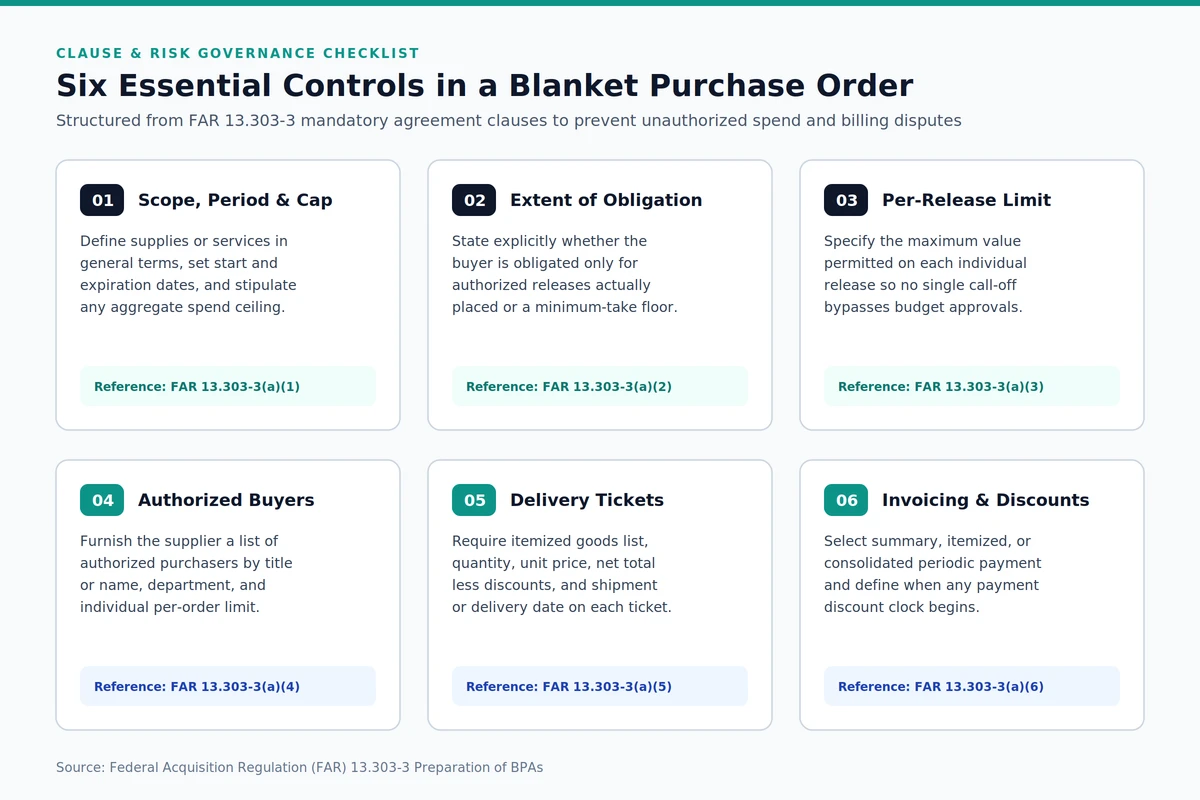
| BPO / BPA clause block | FAR 13.303-3 reference | Required elements to document in the agreement |
|---|---|---|
| Description, period, and aggregate cap | FAR 13.303-3(a)(1) | General description of supplies or services the supplier will furnish if and when requested during a specified validity period and within any stipulated aggregate amount |
| Extent of obligation | FAR 13.303-3(a)(2) | Explicit statement that the buyer is obligated only to the extent of authorized purchases actually made under the agreement (or explicit commercial minimum-take terms if negotiated) |
| Per-purchase limitation | FAR 13.303-3(a)(3) | Specific dollar limitation for each individual release or purchase placed under the agreement (referencing FAR 13.303-5(b) in federal practice) |
| Authorized purchasers list | FAR 13.303-3(a)(4) | Written list furnished to the supplier identifying authorized buyers by position title or individual name, organizational component, and per-purchase dollar limit |
| Delivery ticket requirements | FAR 13.303-3(a)(5) | Required on all shipments except newspapers, magazines, or periodicals: itemized list of supplies or services, quantity, unit price and extension less applicable discounts (unless automated systems omit ticket pricing and itemize on the invoice), and date of delivery or shipment |
| Invoicing and discount clock | FAR 13.303-3(a)(6) | Choice of monthly/expiration summary invoice with receipt copies of delivery tickets, monthly/expiration itemized invoice for unpaid deliveries without attached tickets, or accumulated individual invoices paid via consolidated periodic payment, with any discount period starting on the final date of the billing period or receipt date of invoices for accepted deliveries, whichever is later |
Before finalizing your blanket order billing terms, align the summary or consolidated payment cycle and discount clock with your supplier credit setup in wholesale payment terms and capture the exact item specifications from your wholesale RFQ template.
Frequently Asked Questions
What is the difference between a blanket purchase order and a blanket purchase agreement?
In commercial wholesale practice, the terms blanket purchase order, blanket order, call-off order, and blanket purchase agreement are often used interchangeably for a standing arrangement covering multiple staggered deliveries at predetermined prices. In federal procurement under FAR 13.303-1 and FAR 13.303-3, a blanket purchase agreement (BPA) specifically establishes a charge-account framework with qualified suppliers that obligates the buyer only to the extent of authorized purchases actually made.
When should a wholesale buyer use a standard PO instead of a blanket PO?
Use a standard purchase order when buying one-off or irregular items with known quantities and a single delivery schedule. Switch to a blanket purchase order when you have recurring demand for expendable goods or repeat SKUs and want volume-break pricing, lower on-hand inventory, and less repetitive purchase order administration.
Does issuing a blanket purchase order automatically create a binding contract?
No. Issuing a purchase order does not by itself form a contract; when no prior master contract exists, the seller’s acceptance of the order creates the binding contract. Under UCC Section 2-201, sales of goods at or above the statutory five-hundred-dollar threshold generally require a signed writing enforceable up to the stated quantity, subject to exceptions such as unobjected 10-day merchant confirmations, specially manufactured goods, and goods paid for or received and accepted.
What happens if my actual release quantities are much lower or higher than my blanket order forecast?
In an open-quantity or requirements arrangement, UCC Section 2-306(1) prohibits demanding or tendering quantities unreasonably disproportionate to a stated estimate or comparable prior requirements. Commercially, suppliers may also attach a minimum purchase condition, such as requiring 80% of a one- or two-year forecast. Staging supplier stock—for example, holding 20% in stock during the first 6 months to review and adjust quantities—helps protect both sides.
How are invoices handled under a blanket purchase order?
FAR 13.303-3(a)(6) outlines three practical billing options: submitting a summary invoice at least monthly or at expiration supported by delivery ticket receipt copies; submitting an itemized invoice at least monthly or at expiration for unpaid deliveries without attached tickets; or accumulating individual delivery invoices for one consolidated periodic payment, with any discount period starting on the later of the billing period end date or the receipt date of invoices for accepted deliveries.
Sources
- Federal Acquisition Regulation (FAR) on Acquisition.gov: FAR 13.303-1 General (Blanket Purchase Agreements) and FAR 13.303-3 Preparation of BPAs
- Uniform Commercial Code on Legal Information Institute (Cornell LII): UCC Section 2-201 Formal Requirements; Statute of Frauds and UCC Section 2-306 Output, Requirements and Exclusive Dealings
- Procurement Reference Overviews: Wikipedia: Blanket order and Wikipedia: Purchase order