
A direct wholesale buy is a narrow fact: the company that makes the goods is the company that sells them to you. Everything else people attach to that phrase — a lower unit, a skipped warehouse, a skipped broker — is a separate line on the same order.
Account papers beside a closed folder. The photograph does not show a completed filing or a named supplier.
Put the seller’s name on the invoice first
Use manufacturer, distributor, wholesaler, and broker to separate production from stock ownership. Then apply it to this order. If the invoice names a master distributor, you are buying from that distributor. The factory can still be the maker. Those are two rows, and only the seller row decides whether the purchase is direct.
| Check | What counts as evidence | Dominant failure mode and prevention |
|---|---|---|
| Who sells | Legal name on the invoice and the quote | Treating a brand site as the seller. Prevent it by matching the payee to the maker before you compare prices. |
| Who makes this item | The line that names the producing facility for this SKU, not a factory photo | One company makes one line and resells another. Prevent it by asking the role for this item only. |
| Resale papers | Certificate accepted for the state where the taxable resale happens | A missing certificate, so the supplier charges tax or refuses the account. Prevent it with the resale-certificate guide. |
| Credit file | Trade references and a bank letter when you want terms | Assuming terms are part of “direct.” Prevent it by reading how credit is granted and starting from the supplier’s prepaid rule. |
| Border | Importer of record, plus broker only if you hire one | A factory unit that omits duty, freight, and the bond. Prevent it with the landed-cost lines below. |
Rule of thumb: if the seller named on the invoice is not the maker of that SKU, the price is not a direct-from-manufacturer price, even when the unit is lower than a domestic wholesaler’s.
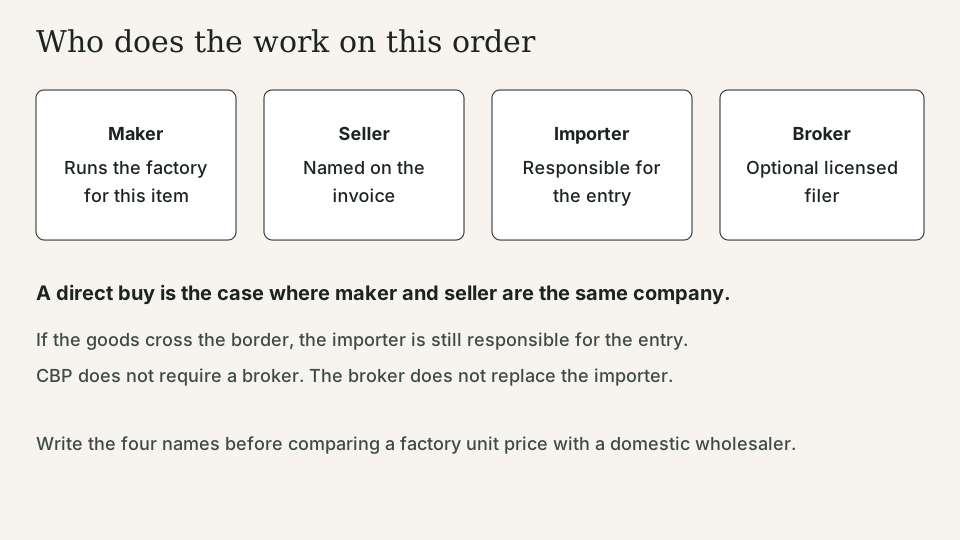
Maker, seller, importer, and broker are four jobs. Direct means the first two are the same company.
File the California seller’s permit as the seller’s own registration
CDTFA publication 73, Your California Seller’s Permit, says you need a seller’s permit if you are engaged in business in California and you intend to sell or lease tangible personal property that would ordinarily be subject to sales tax if sold at retail. The same publication says the requirement applies to both wholesalers and retailers. It also says the seller’s permit is not a business license. Ask the local license office for that document separately.
The permit is your registration as a seller in California. It is not the resale certificate you hand to your supplier, and it is not a national wholesale license. A factory in another state can still ask for the certificate that covers the resale you claim. The account-requirements guide lists the business identity suppliers ask for before they open the account.
Treat references and a bank letter as the credit file
A manufacturer that will ship before payment is extending credit. Trade references and a bank letter are how that seller checks the credit. They are not a form published by CBP or CDTFA for this purpose. If the account is prepaid, the letter is the wrong document to chase. The prepaid-account guide explains why new accounts usually start prepaid.
Keep the customs entry even when you skip the broker
CBP Knowledge Article 1169 states that there is no legal requirement to hire a customs broker to clear goods. Brokers are licensed to conduct CBP business for importers, including the paperwork and the CBP bond. The same article says the importer is always responsible for knowing CBP requirements and for making sure the importation complies. An express courier such as FedEx or DHL uses brokers as part of the courier service, and those brokers charge.
Buying from a foreign factory removes a domestic wholesaler. It does not remove the importer. Write the importer’s name on the order. If that name is the factory’s U.S. subsidiary, say so. If that name is you, the bond and the entry are yours whether or not you hire the broker.
Worked example: the factory unit is not the landed unit
Landed unit = (goods + freight + broker fee + duty) / units
Worked example, with stated inputs and no claim that these are current rates: goods 4,000, freight 600, broker fee 180, duty 220. The sum is 5,000. Spread over 200 units, the landed unit is 5,000 / 200 = 25. A factory unit of 20 is 5 below the landed unit. A domestic wholesaler at 24 can be the lower delivered price.
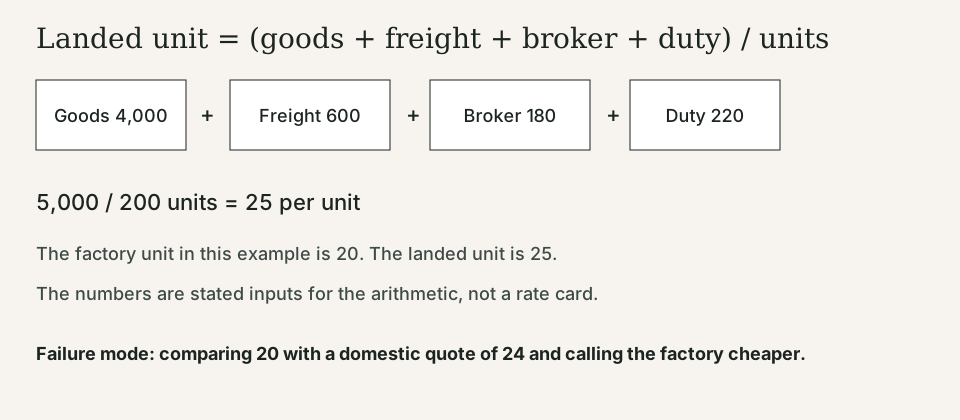
Add the four amounts, then divide by the unit count. A lower factory unit can lose to a higher domestic quote once freight and duty are in.
The landed-cost guide extends the same addition when insurance, drayage, or a pickup appointment belongs in the total. The wholesale buying hub is the place for the account, minimum, and payment guides that sit beside this one.
What “direct” still does not promise
A direct account can carry a higher minimum, a longer lead time, and a single ship-from point. None of those follows from the word manufacturer. Read them off the quote. The loss, when the word is doing the work the invoice should do, is a deposit paid to the wrong seller or a unit compared before duty.
Method and sources
Seller’s-permit rules come from CDTFA publication 73, and customs-broker guidance comes from CBP Knowledge Article 1169. The role split and the landed-cost arithmetic are editorial. Reviewed 20 October 2026.
Frequently asked questions
Does a factory website mean I am buying direct?
Only if that factory is the seller on the invoice. A distributor can show the same product photos and still be the company that invoices you.
Is a California seller's permit a wholesale license?
No. CDTFA publication 73 says both wholesalers and retailers who sell taxable tangible goods in California apply for a seller's permit, and that the permit is not a business license.
Do I have to hire a customs broker to buy from a foreign factory?
CBP says there is no legal requirement to hire a broker. The importer remains responsible for the entry. Express couriers use brokers as part of their service.
Sources
- Your California Seller's Permit — California Department of Tax and Fee Administration Accessed October 20, 2026.
- Do I need a Customs Broker to clear my goods? — U.S. Customs and Border Protection Accessed October 20, 2026.