

Key takeaways
- Name the stage before guessing the cause; each stage has its own record to check.
- An account number, a price list or a payment request does not by itself confirm credit, stock or dispatch.
- Record receiving differences at the level you could observe, and keep a receipt note separate from a formal claim.
- Clarify when the condition is clear, pause when identity or payment is unresolved, and walk away when the terms do not fit.
Fixing the wrong problem wastes the time you have to solve the real one, whether that means resending a whole account application for one missing document or buying extra cases to clear a pack rule. This guide sorts wholesale buying problems into six stages—account, minimum, quote, stock and timing, receiving, and invoice and payment—and gives each one a record to check and a question to ask before you escalate. The stages can overlap, and payment can fall due before the goods arrive, so use them to locate a problem rather than as a fixed sequence every order follows.
Start by naming the stage, not the cause. A declined application, a backorder and a short delivery can all feel like the same supplier failure, yet each is confirmed by a different document and can be handled by a different person. This guide gives the first move for each problem and points to the detailed wholesale buying guides for the full procedure.
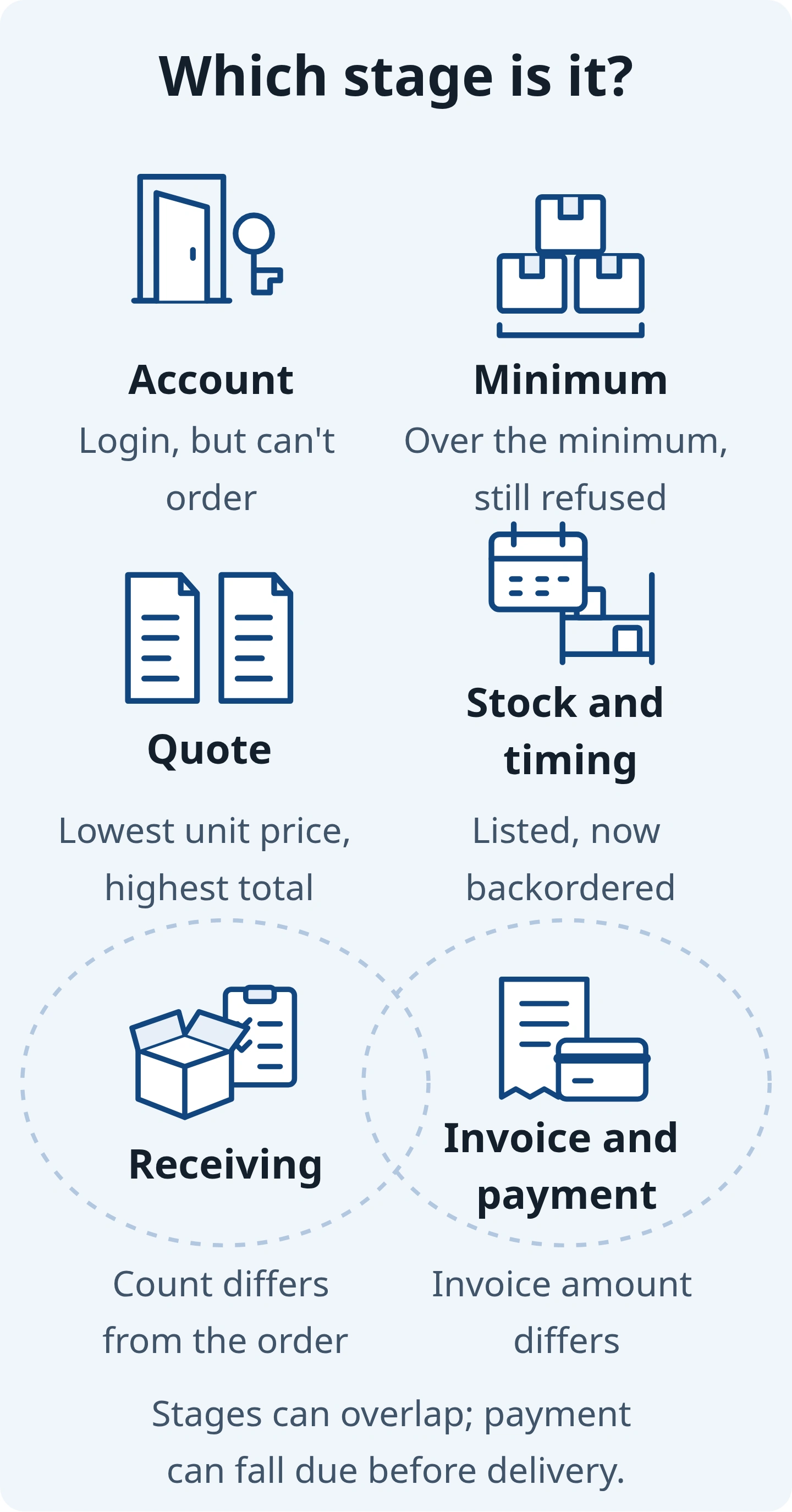
Jump to a stage; each section links its detailed guide: Account · Minimum · Quote · Stock and timing · Receiving · Invoice and payment
| Input or item | Typical value or source | Why it matters |
|---|---|---|
| Account status | The supplier’s written status or review notice | Shows which review—purchasing, tax documents or credit—is still open |
| Minimum rule | The quotation or listing showing order value, line quantity and case pack | Tells you which of the three minimums is blocking the basket |
| Quote basis | A dated or referenced quotation with units, quantity and delivery point | Lets two offers be compared on the same item, quantity and endpoint |
| Availability | A dated stock position confirmed for your order lines | Separates a price list or snapshot from stock that can be promised to you |
| Delivery record | Accepted order, packing list and the signed receiving record | Shows whether a gap is a shortage, an agreed split or a counting difference |
| Payment basis | Approved terms and the invoice; the receiving record once goods have arrived | Shows what is due, when, and whether the amount matches the order, the payment milestone and what arrived |
Find the stage that is blocking your order
Read across from the symptom you can see. The causes column lists possibilities to check against your documents. It is not a ranking of how often each cause occurs, and none is confirmed until the other party answers.
| Stage | What you see | Possible causes to check | First move |
|---|---|---|---|
| Account | A login or account number, but you cannot place an order | Purchasing approval, tax-document review or credit is still pending | Ask what the current status allows and which item is still open |
| Account | Application declined with a generic notice | Customer type, destination or product-line eligibility; a factual error; tax or credit review | Ask which requirement was not met before reapplying or changing channel |
| Minimum | Order value clears the minimum, but the basket is still refused | A per-SKU minimum or a full-case rule | Ask the seller to confirm the order, line and pack rules separately |
| Minimum | Meeting the minimum means buying far more than you need | A pack size or dollar threshold above your demand | Compare required units and cash with real demand; ask about trial or mixed orders |
| Quote | Lowest unit price, highest total | Different specification, unit, quantity, delivery point or unquoted charges | Put each offer on the same item, quantity and endpoint |
| Quote | Answers spread across several emails | Different document versions, or alternatives mixed with the requested item | Have the supplier consolidate the answers in one revised quotation |
| Stock and timing | Item was listed but is now backordered | The list showed prices or an old snapshot, not stock allocated to you | Ask for line-by-line confirmation and the event that reserves stock |
| Stock and timing | Paid, but no dispatch date | Payment triggered acceptance or production, not dispatch | Ask which milestone has been reached and what comes next |
| Receiving | Carton or item count differs from the order | A genuine shortage, an approved split or substitute, or counts taken at different levels | Record what you counted against the accepted order and packing list |
| Receiving | Crushed outer cartons, or damage found after unpacking | Transit, packaging or product damage, not yet established | Record specific observations and report through the route agreed for this order |
| Invoice and payment | Asked to prepay, or order on hold, when you expected terms | Credit not approved, limit used by open orders, or review pending | Ask for the approved terms, available limit and release requirement |
| Invoice and payment | Invoice amount differs, or new bank details appear | Unreconciled quantities, splits or charges; an unverified instruction | Check the invoice against the records that apply to it; pause a changed payment instruction and verify it independently |
Takeaway: The symptom tells you where to look; the record for that stage tells you what actually happened.
Your wholesale account is rejected or still pending
An account application can bundle several separate reviews: whether the supplier serves your type of business and destination, who you are, which tax documents it accepts, whether it extends credit and whether you can buy a particular product line. Finishing one review does not finish the others. A website login can let you save addresses or submit questions before the purchasing review is complete, and an account number can exist before tax documents or credit terms are approved.
The first question for a pending account is therefore narrow: what does the current status allow, and what exactly remains open? Record the milestone you need for the first order—access to pricing, permission to buy, tax-document acceptance or payment approval—rather than treating an acknowledgment as a go-ahead.
If the application is declined, do not guess the reason from a generic notice. Ask which requirement was not met and correct any factual error. A product-eligibility restriction will not be solved by sending more financial records, and a tax-document issue is not a credit decision. Ask whether a prepaid account or another route exists for your purchase. Reapplying with altered details to force approval is the wrong fix. The guide to what suppliers review before opening an account explains each review and what to prepare; if the open item is your resale paperwork, the resale certificate guide covers it separately.
A complete, accurate application can still be unsuitable when the supplier does not serve your market, customer type or destination. That is a fit problem rather than a paperwork problem, and finding another qualified supplier is the practical next step.
Common mistake: Treating an account number as approval for credit or tax-exempt purchasing. Purchasing access, tax-document acceptance and credit are separate statuses; ask about each one.
Takeaway: Ask what the current status allows and which single requirement is open, then fix that item instead of reapplying.
The minimum order is larger than your budget or demand
Three different rules travel under the label “minimum”: a dollar value for the whole order, a quantity for each line or SKU, and the case or pallet the goods are packed in. Waiving an order minimum does not mean a supplier will split cases; the two are separate rules. Freight charges do not necessarily count toward a dollar minimum, so ask what counts.
The symptom tells you which rule to check. If your order total clears the threshold but the basket is still refused, look for a line minimum or a case multiple; each color, size or finish can be its own SKU. If the minimum is reachable only by buying far more than you can sell, the problem is the size of the commitment. Write down four numbers—units you need, units you would have to buy, merchandise value and total cash due—so a low unit price does not hide the size of the purchase.
Then ask specific questions rather than “can you lower it?” Ask whether a paid sample or trial order exists, whether mixed SKUs count toward one minimum, whether the item ships from existing stock or a production run, and whether a different pack fits better. These are questions, not entitlements; a concession on one order is not a standing policy unless the supplier confirms it. Scheduled deliveries can spread out receipts, but smaller deliveries do not by themselves reduce the total you have committed to buy. The wholesale MOQ guide works through pack-size and price-break arithmetic in detail.
If the minimum still exceeds what you can sell, the supplier is unsuitable for this purchase even when it is legitimate and its price is attractive. Comparing another pack, product or channel is a normal outcome, not a failed negotiation.
Takeaway: Identify whether the order, the line or the pack is the constraint before asking the supplier to change anything.
The quotes do not compare like for like
A quotation with the lowest unit price can still produce the highest order total. Before ranking offers, put each one on the same basis: the exact item and specification, the unit of measure beside every quantity, the quantity available at that price and any case multiple, the delivery endpoint, and the freight, handling and other charges needed to reach it. Keep payment timing and lead time visible beside the total, because an earlier deposit or a longer wait is a different commitment even at the same price.
Give each exact item its own comparison row. If a supplier proposes a different model or version, record it as an alternative rather than silently treating it as the requested item. The quote comparison guide lists the variables to normalize, and the landed cost calculation shows how to add delivery and import charges for an imported order.
When answers arrive piecemeal across emails, purchasing and receiving can end up working from different versions. Have the supplier bring the answers together in one revised quotation, identified by date or reference, and keep the earlier version. Check whether its validity period covers stock as well as price; a price held for several days does not by itself reserve inventory. The request-for-quotation template helps you send the same clarification to every supplier.
Common mistake: Entering an unquoted freight or handling charge as zero. Leave it marked unknown until the supplier answers; a zero makes an incomplete offer look cheaper than a complete one.
Takeaway: Compare complete costs for the same item, quantity and delivery point, and keep unknown charges visibly unknown.
Listed stock is unavailable or the order is delayed
A price list states offered prices. Unless it explicitly includes an availability statement, it does not establish that the goods are in stock. A stock list is a snapshot taken at a particular time, and its columns can mean on hand, available to promise or on order; some of the quantity can already be allocated to other customers. An order confirmation is not, by itself, a confirmation of stock. That is how an order built from a price list can come back partly backordered without anyone having changed position.
The first move is to ask for line-by-line confirmation of the quantity that can be allocated to your order, and to ask what event reserves it: order acceptance, payment, credit approval or another step. Ask how long a hold lasts and whether it can be released if you miss a deadline. The price list versus stock list guide explains how to read timestamps, quantity fields and allocation.
When you have paid and still have no dispatch date, identify what the payment actually triggered. Prepayment can start order acceptance, production scheduling, stock reservation or dispatch, and those milestones are not interchangeable. A payment request alone does not prove the goods are packed or allocated. Ask in writing which milestone has been reached, which event comes next and which order lines are affected. If the supplier moves from “in our warehouse” to “sourcing from elsewhere,” ask for an updated stock position and dispatch estimate rather than continuing on the original assumption.
Stock readiness, dispatch, transit and a receiving appointment are four different milestones. Until you hold an order-specific confirmation, do not promise your own customer a delivery date based on a downloaded stock file.
Takeaway: Treat a list as a reason to ask, and treat only an order-specific confirmation as availability.
The shipment is short, incorrect or damaged
Prepare the receiver before the truck arrives. The receiving contact needs the purchase order, shipment references, expected package count, product identifiers and a note of any approved partial delivery, substitute or packaging change. Without that context, an agreed split shipment can be reported as a shortage.
At handoff, count at the level you can actually observe. Compare the number of pallets or packages with the shipment document, and note that the cartons or items inside wrapped pallets have not yet been counted. If a count differs, ask for clarification and record the observed difference before the handoff record is finalized; do not change a quantity just to make the paperwork balance.
Write condition notes as observations, not conclusions. “Two cartons on the top layer have crushed corners” is more useful than “damaged,” and it does not claim the contents are broken. Stay within safe inspection limits. Neither refusing every damaged shipment nor accepting everything is a reliable rule; give receivers a contact who can decide promptly under the instructions for that order.
After unloading, inspect concealed contents promptly under the seller’s and carrier’s procedures. Keep the goods linked to their shipment and batch identifiers, set affected items apart from saleable stock, and keep packaging and labels until you have instructions on disposal, return or repair.

Reporting an issue and filing a formal freight claim are different steps. A receipt notation, email or photograph does not necessarily complete a claim, and a concealed-damage notice requirement is different from a claim-filing deadline. Confirm who is entitled to file, which party receives the claim and which time limits apply to this shipment rather than borrowing another carrier’s deadline. The warehouse pickup and receiving guide covers the discrepancy file and claim steps. If the seller agrees to take goods back, the reverse logistics guide explains how to keep the return, inspection and credit records apart.
Common mistake: Assuming a note on the delivery receipt is a completed claim. Treat it as evidence, then confirm the formal route and deadline for this order.
Takeaway: Record what you could observe, link it to the accepted order and report it through the route that applies to this shipment.
The invoice or payment terms do not match
If you expected net terms and the supplier asks for prepayment or holds the order, check the credit status first. There is no universal rule that a set number of prepaid orders earns credit, and an approved purchasing account is not a credit approval. Ask which terms were actually approved, what the available limit is, whether open orders count against it and what is needed to release the order. Ask separately when payment is due and how it can be made; a supplier can approve a due date while restricting the method, or accept a method without extending credit.
When the invoice amount does not match, compare the records that apply to that invoice before raising it. For goods already received, that means three records: the accepted order, the receiving record and the invoice. A deposit or other invoice due before delivery has no receiving record yet, so check it against the approved terms and the evidence the agreement requires at that payment milestone instead of waiting for a receipt. Identify approved partial shipments and substitutions so they are not reported as errors. Raise real discrepancies promptly and ask how the disputed and undisputed amounts are handled under your terms. Do not silently deduct an amount or assume a pending complaint pauses every due date.

A message giving new bank details or a different payment recipient is a separate problem. Pause that payment step and confirm the change through contact details you obtained independently, not by replying to the same email thread. The wholesale payment terms guide covers due dates, deposits and credit limits, and the supplier red flags guide explains how to handle a changed instruction or pressure to skip checks.
Takeaway: Check an invoice against the order and receipt after delivery, or against the approved terms and milestone evidence before it, before disputing an amount, and verify any change in payment instructions independently.
Decide whether to clarify, pause or choose another supplier
Each problem above ends in one of three decisions. The table separates them by the condition that applies, not by how frustrating the delay feels.
| Decision | When it fits | What to do next |
|---|---|---|
| Clarify and continue | The requirement is specific and you can meet it: a missing document, a pack rule, an unquoted charge, a stock-reservation event | Ask one consolidated question, get the answer in writing and update the order record |
| Pause | Identity or payment details conflict, a payment instruction has changed, or you are pressed to skip identity or payment checks | Stop the affected step until the discrepancy is resolved through an independent route |
| Choose another supplier | The terms are clear but do not fit: a minimum above demand, a market or destination not served, credit not available on usable terms | Decline without accusing the supplier and compare another channel |
A real stock or price deadline can be inconvenient without being suspicious. The difference is whether the seller explains what expires and lets you make an informed decision, or insists that normal checks be skipped. If the evidence you need cannot be obtained in time, letting the opportunity expire is a legitimate outcome. A pause can end with the question resolved or with a decision not to proceed; spending time on a quotation does not oblige you to complete the purchase. To confirm who you are dealing with, use the checks for verifying a supplier’s identity.
Takeaway: Continue when the condition is clear and achievable, pause when identity or payment is unresolved, and walk away when the terms do not fit.
When this does not apply
This page is a general diagnostic aid for ordinary U.S. wholesale purchases. It does not determine legal liability, tax status or credit eligibility, and it does not replace the written terms of your order. Several situations need more than the first moves above:
- Imported or cross-border orders add customs, duty and international transport documents, so responsibilities and timelines differ from a domestic delivery. The domestic versus overseas supplier guide outlines those differences.
- Regulated, hazardous or specialist products can require handling, inspection or return procedures set by law or by the manufacturer.
- Disputed contracts, claims or tax questions need a qualified adviser or the relevant authority, especially when significant amounts or deadlines are involved.
- Unsafe deliveries, such as an unstable load or a hazard at the dock, call for the site’s safety procedure before any paperwork.
- A payment possibly sent to the wrong account needs immediate contact with your own financial institution, without waiting for the supplier’s investigation. Recovery is not guaranteed.
Takeaway: Use this page to locate the problem, and rely on the actual agreement and qualified advice when rights, safety or money already sent are at stake.
Keep one problem record per order
A short record for each problem keeps the next person, or the next order, from starting over. Keep it with the order documents:
- The stage and the symptom as observed, with the date.
- The record you checked and what it showed.
- The question you asked, who you asked and through which channel.
- The answer received, in writing where possible.
- The next action, who owns it and any deadline confirmed for this order.
- What to add to the next request so the issue is settled before ordering.
Before the next purchase, write those answers into the next purchase request using the request-for-quotation template. A condition agreed in the quotation request is easier to check than one first raised at the dock or on the invoice.
Takeaway: Write the answer to each problem into the next request, so it is settled before the order rather than after.
Frequently asked questions
Can I buy wholesale without an LLC?
An LLC is not a general precondition for buying wholesale; it is one way to structure a business, and a sole proprietorship is also a business. Whether a supplier accepts you depends on its account policy and product line, while tax-exempt buying for resale depends on your state's resale rules. Ask the supplier which business types it accepts before you apply.
What is MOQ and SKU?
MOQ, or minimum order quantity, is the smallest order a supplier accepts under a particular offer; a SKU, or stock-keeping unit, identifies one specific item. Each color, size or finish can be its own SKU with its own line minimum, so an assortment is not automatically one line. Ask whether a minimum applies to the whole order, each SKU or the case pack.
What is considered a low MOQ?
There is no universal threshold. A minimum is low for your business when the quantity you must buy and the total cash due fit your realistic demand, storage and budget. Compare the units you would have to buy with the units you need instead of relying on a figure quoted for another supplier or industry.
What are supplier payment terms?
Supplier payment terms state how much is due, when it is due, which conditions change the amount and how payment can be made. A label such as Net 30 gives a period but not always the event that starts it, such as invoicing, shipment or delivery. Ask for the explicit due date and treat the payment method as a separate question.
Who is responsible for freight damage?
Responsibility depends on the sales agreement, the transport arrangement and the law that applies to the shipment; a phrase such as customer pickup does not settle it on its own. Receiving notes and photographs record what happened but do not decide liability. Confirm who arranged transport, who is entitled to file a claim and which party should receive it.
What should I do if my shipment is lost in transit?
Report the missing shipment promptly through the channel set for that order, quoting the order and transport references that identify it. If the supplier arranged transport, coordinate through the supplier rather than sending overlapping requests to the carrier. Confirm who is entitled to file a claim, which carrier should receive it and which time limit applies to this shipment; an email or phone report is not necessarily a formal claim, and filing one does not guarantee payment.
Sources
- Wholesale Account Requirements — National Wholesalers Accessed October 10, 2026.
- Wholesale MOQ — National Wholesalers Accessed October 10, 2026.
- How to Compare Wholesale Quotes — National Wholesalers Accessed October 10, 2026.
- Price List vs Stock List — National Wholesalers Accessed October 10, 2026.
- Warehouse Pickup and Receiving — National Wholesalers Accessed October 10, 2026.
- Wholesale Payment Terms — National Wholesalers Accessed October 10, 2026.
- Wholesale Supplier Red Flags — National Wholesalers Accessed October 10, 2026.