Choosing a wholesale website by its product prices alone can leave you with stock you cannot resell through your intended channel or return under the order’s terms. Evaluate the seller, account eligibility, payment route and return conditions before comparing listings.
This guide helps a retailer decide whether a buying website fits a proposed order. Faire and Alibaba.com provide two examples of published platform policies, checked October 7, 2026. They are not a shortlist or a ranking, and National Wholesalers has not purchased through either platform.
| Input or item | Value or source | Why it matters |
|---|---|---|
| Your sales channel | Storefront, own website or other channel | Account access does not establish resale permission |
| Contracting seller | Order and invoice identity | Identifies who supplies the goods |
| Order requirements | Written specification and quantity | Makes a disputed delivery assessable |
| Payment route | Official order checkout and applicable terms | Determines which platform process applies |
| Buyer costs | Checkout, payment and membership terms | Separates goods from optional or conditional charges |
| Return scenario | Opening order, repeat order or damaged goods | Different reasons can trigger different procedures |
Classify the website before comparing it
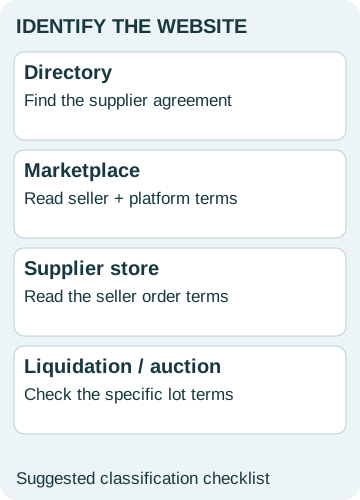
A directory, marketplace and supplier’s own shop perform different jobs. Identify what the site actually does with your order; the word “wholesale” does not settle that question.
| Website type | Seller identity | Access and payment checks | Return responsibility to establish |
|---|---|---|---|
| Supplier directory or lead service | Business you contact after discovery | Directory membership is separate from a supplier account; check where payment occurs | Ask the actual seller for its terms; do not assume the directory handles returns |
| Multi-seller marketplace | Brand or supplier named on the order, subject to platform terms | Buyer account approval and the eligible transaction route | Record the platform process and seller’s obligations separately |
| Supplier-operated store | Business identified by that store’s order terms | Its account requirements and checkout | That seller’s policy and any payment-provider process |
| Auction or liquidation channel | Seller identified for the particular lot | Lot conditions, bidding commitment and applicable charges | Read the lot-specific condition and remedy before bidding |
Use the manufacturer, distributor and wholesaler comparison to identify the counterparty’s role. For unfamiliar companies, run the separate supplier verification checks. A marketplace listing is one piece of that file.
Takeaway: Identify who sells the goods and what the website itself promises to do.
Check access, resale permissions and buyer costs
Check whether your business and intended use qualify before spending time building a basket. Account approval, a brand’s willingness to sell and permission to use a particular resale channel are separate questions.
Faire’s getting-started guide sets out eligible business uses and account verification. Its business eligibility policy excludes distributors and restricts third-party marketplace resale. That distinction matters if your plan is to supply other businesses rather than sell to consumers. Keep evidence of your store and sales channel with the wholesale account requirements file.
Alibaba.com’s Terms of Use address legal capacity, authorized business use and user responsibilities. Registration is not a product-specific authorization to import or resell goods. Use the authorized-distributor checks when branded inventory is involved.
Record buyer-facing costs in separate lines: goods, shipping, payment processing, optional membership and any order-specific charge. Faire’s public overview says retailer account creation and browsing are free and describes an optional paid Insider membership. Alibaba.com’s Trade Assurance overview says there is no additional protection fee, while certain payment methods incur transaction fees. Neither statement means the entire order ships free.
Common mistake: Putting a platform’s seller commission into your budget as though it were a published buyer surcharge. Check which party owes each fee.
Takeaway: Qualify the business, channel and costs independently; do not infer them from a sign-up button.
Compare the published policy, then inspect your order
Use official information as the starting point and the actual order screen for its applicable conditions. The two examples below show what to record, not which platform to choose.
| Check, reviewed October 7, 2026 | Faire | Alibaba.com |
|---|---|---|
| Commercial relationship | Connects brands with approved business buyers; identify the brand and applicable regional terms | Connects buyers and suppliers; identify the supplier and agreement for the order |
| Access | Business verification and permitted use/channel, as described in its buyer guides | Account and legal-capacity requirements in the Terms of Use; order and product requirements need separate checking |
| Buyer costs | Free account/browsing; paid optional membership and order charges need separate review | Trade Assurance has no separate protection fee; payment-method charges can apply |
| Payment protection or terms | Read the selected checkout option; deferred terms are eligibility-dependent | Official overview ties protection to the Trade Assurance online order and payment through Alibaba.com |
| Change-of-mind return | Qualifying orders, usually a first order with a brand; exclusions and account-specific window apply | Do not infer a universal change-of-mind right from Trade Assurance; read the actual order and applicable refund conditions |
| Problem with goods | Damaged/missing reporting follows a separate procedure | Compare the delivered goods with the online order’s agreed quality and shipment terms and use its dispute process |
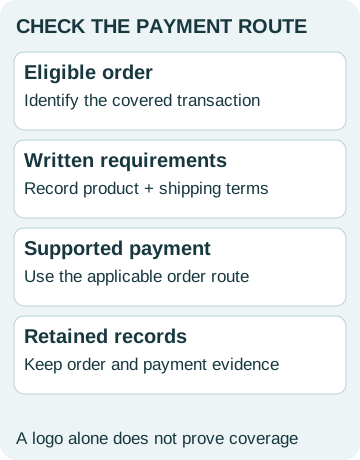
Alibaba.com’s buyer protection overview makes the online order and communication records central to refund resolution. Put measurable product requirements into the order rather than relying on a generic listing. The order-requirements template helps organize those inputs, and the payment-terms guide separates payment timing from delivery obligations.
Takeaway: A platform feature matters only when the specific order meets its conditions.
Assign each responsibility to a named party
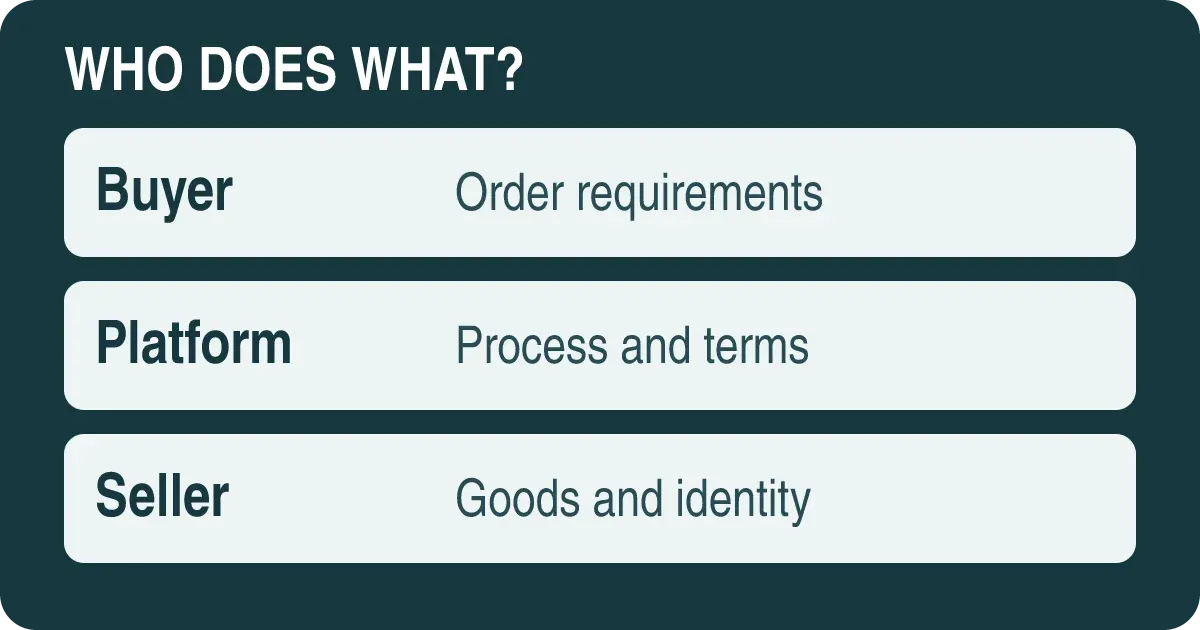
Write down the platform’s role alongside the seller’s and your own. This prevents a support badge from becoming an assumption that the platform has inspected the goods or accepted every commercial risk.
| Task | Evidence to obtain | Who to identify |
|---|---|---|
| Supply the agreed product | Seller identity, specification and order | Contracting seller |
| Process payment | Checkout route, payment receipt and terms | Platform or named payment provider |
| Arrange shipment | Delivery term, address and booking responsibility | Seller, buyer or logistics provider under the arrangement |
| Check incoming goods | Counts, condition and dated receiving record | Buyer’s receiving team or agreed inspector |
| Handle a problem report | Required form, evidence, deadline and response record | Seller and the platform process applicable to that order |
A claim needs more than the product’s name. Save the listing, agreed specification and messages about material changes. The receiving-document checklist explains the records to collect on arrival; the supplier red flags guide covers inconsistencies that deserve investigation before payment.
Takeaway: Keep the seller, payment and dispute records connected to one order number.
Separate ordinary returns from damaged or missing goods
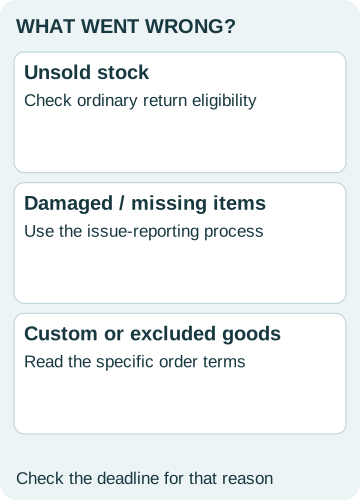
Identify the reason for the return before choosing a procedure. Unsold stock, an excluded customized product and a damaged shipment do not necessarily follow the same policy.
Faire’s April 7, 2026 returns policy describes qualifying orders, typically first orders with a brand. It excludes categories including customized products, testers, individual items from bundled sets, final-sale and seasonal items. Its return guide says the usual window is 60 days but can vary by account history and order activity; the portal shows the eligible order’s window. Original outbound shipping and import fees are not part of the ordinary free-return offer.
For damaged or missing items, the cited Faire policy requires reporting through the retailer account within 14 days of receipt. Follow the requested evidence process rather than sending those items back as an ordinary return. These are Faire’s published conditions, not a general wholesale deadline.
Common mistake: Treating a refund request as an approved refund, or assuming the payment due date extends the reporting window.
For Alibaba.com, keep the quality and shipping commitments in the eligible order and consult its applicable dispute rules before paying. This guide does not turn the overview’s protection description into an unconditional refund promise or a universal return period.
Takeaway: Record the reason, evidence and deadline together; do not reuse another platform’s policy.
When this does not apply
This is a document-based screening guide for business buying websites. It does not verify a particular seller, assess counterfeit risk for a specific product or establish import compliance. A marketplace account or purchase receipt does not replace the checks your product and destination require.
Policies vary by region, account, product and order. We could read Faire’s buyer guidance and its published returns policy, but the full US retailer-terms page did not render during this review. Alibaba.com’s public overview and general Terms of Use were readable; the linked full Trade Assurance rules did not render. We therefore avoid interpreting those unavailable clauses. Open the full terms presented to your own account before committing.
Takeaway: Leave an unanswered policy question open until the applicable document resolves it.
Keep a dated platform research record
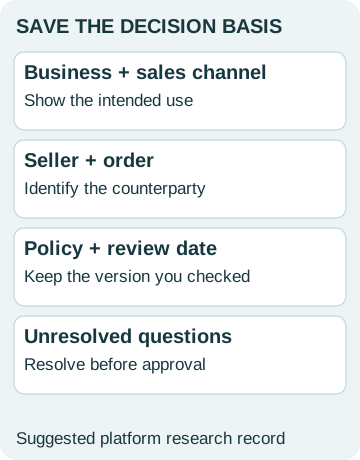
Use one record for each proposed order, with links to the policies you relied on. This lets another buyer understand why a platform qualified and what still needs checking.
| Record field | What to save |
|---|---|
| Business and channel | Legal business identity, storefront and intended resale channel |
| Seller and product | Seller’s legal name, product page and specification version |
| Eligibility | Account requirements and any outstanding verification request |
| Costs and payment | Checkout total, fee categories, payment route and selected terms |
| Returns and disputes | Relevant policy, exclusions, deadline and evidence requirements |
| Review date | Date checked and the document or screenshot used |
Continue with supplier verification resources for business verification, or compare wholesale quotations once candidate orders share the same specification and delivery scope. This guide does not replace either task.
Takeaway: Save the basis for the decision, including what remains unknown.
Frequently asked questions
Can I buy wholesale without an LLC?
An LLC is a business form, not a universal marketplace admission rule. Check what the actual platform accepts as evidence of your business and whether the supplier needs resale documentation. The resale-certificate guide separates that document from choosing an entity type.
How do I buy wholesale directly from a manufacturer?
A listing does not establish that its seller owns a factory. Identify the contracting company and verify its role before treating the transaction as factory-direct. The supplier-finding guide covers building and checking a candidate list; platform participation alone does not answer the question.
Can I buy on Faire for personal use?
Faire’s getting-started guide excludes personal-use purchases. Buying for your business’s own use is a different category and remains subject to approval. Do not describe personal shopping as business purchasing to get an account accepted.
Does paying with PayPal automatically preserve Alibaba.com protection?
No. The Alibaba.com overview specifically describes PayPal payment completed through its platform for a Trade Assurance order. A separate payment sent after moving the conversation elsewhere is not that stated route. Any separate PayPal claim follows PayPal’s own terms; this guide does not determine its eligibility.
Why can my first Faire order be put on hold?
Faire says its account verification starts after a first order, and an order can be held while it requests business documentation. Check the request in your account and provide the required information. A hold by itself is not evidence that the seller has no stock.
Can I use Faire before my online store has launched?
Its business eligibility guide says an unlaunched online shop’s order can be cancelled, but Faire can consider detailed development screenshots for account approval. Ask which evidence its team needs for your situation. Do not treat a draft website as automatic eligibility.
Related reading: wholesale minimum orders explains quantity commitments; domestic versus overseas suppliers covers the operating differences that a website alone cannot remove.
Sources
- How to get started on Faire — Faire Accessed October 7, 2026.
- What types of businesses can buy on Faire? — Faire Accessed October 7, 2026.
- How Faire works — Faire Accessed October 7, 2026.
- Returns, refunds and cancellations policy — Faire Wholesale, Inc. Accessed October 7, 2026.
- How do I submit a return? — Faire Accessed October 7, 2026.
- Trade Assurance buyer overview — Alibaba.com Accessed October 7, 2026.
- Terms of Use — Alibaba.com Accessed October 7, 2026.