
Key takeaways
- An approved wholesale account lets you place orders; it does not confirm stock, delivery dates or permission to resell licensed characters.
- Count only a dated, SKU-level confirmation for your quantity as stock. For a costume still to be made, get a written production commitment for your quantity with dates instead. A catalog page or price list is a reason to ask.
- Keep the seller's dispatch date, the carrier's transit estimate and your own required receipt date in three separate fields.
- Children's costumes need a Children's Product Certificate even when an exemption applies; adult apparel relying on a fabric testing exemption needs no GCC under CPSC policy.
- A certificate only counts if its product description matches the SKU you are buying.
A costume order that lands after the selling window, or lands with paperwork that does not match the cartons, turns seasonal budget into wasted stock you cannot sell in time or should not sell at all. Release a wholesale Halloween costume order one SKU at a time, and only when each SKU has a dated stock allocation (or, for a costume still to be made, a written production commitment for your quantity), a written dispatch date that leaves room before your own receipt deadline, and the certificate or written exemption that fits its age group and product type.
This guide is for U.S. store and online buyers who have found Halloween costume wholesale distributors in the USA or overseas and now have to decide whether to commit. It gives you a release record to fill in for each SKU and explains which Consumer Product Safety Commission (CPSC) documents apply to which kind of costume. National Wholesalers is an independent publication. We do not sell costumes, rank suppliers or check any seller’s stock. The rest of the supplier research guides cover the checks that come before this one.
| Input or item | Where it comes from | Why it matters |
|---|---|---|
| SKU identity | The seller’s quotation or line sheet: style number, size, colour | Every later check is tied to one SKU, not to the catalog |
| Age group and product type | The manufacturer’s product description and size range | Decides whether a CPC, a GCC or a documented exemption applies |
| Seller and certifying firm | The invoicing entity, and the manufacturer or importer named on the certificate | Certification sits with the domestic manufacturer or importer, which may not be your seller |
| Stock status | A dated confirmation for your SKU and quantity | Separates stock allocated to you from a list or a production plan |
| Dispatch commitment | The seller, in writing | A promise about when goods leave, not when they arrive |
| Required receipt date | You | Set by your selling date and the time your team needs to receive and shelve |
| Certificate or exemption | The CPC, the GCC, or the written basis for an exemption | Has to describe this SKU; a generic factory document does not |
| Licensing permission | The seller, for licensed-character SKUs | Specific to the order and your sales channel |
Identify the exact SKU and the business selling it
Pin down what you are buying and from whom before you look at dates or paperwork. For each SKU, write the style number, size range, colour and the age group the seller lists. Then name three parties: the business that invoices you, the business that ships, and the manufacturer or importer that would certify the costume. They can be one company or three.
The roles matter because the certificate duty sits with a particular party. CPSC’s Flammable Fabrics Act guidance places certification on manufacturers and importers of products subject to its rules. A distributor that buys from a U.S. importer should be able to pass on that importer’s certificate. If you bring the goods into the United States yourself, ask who the importer is for the shipment, because that could be your business. The guide to manufacturers, distributors and wholesalers shows how to tell these roles apart from the documents.
Getting access is a separate step. A manufacturer may sell wholesale only through business accounts. Rubies, for example, says on its wholesale buying page that wholesale accounts need a business and tax ID and that approved accounts order through the NuOrder platform. The checklist of what suppliers review before opening an account covers what to prepare. The tax paperwork you supply for an account, such as a resale certificate, concerns sales tax and is separate from product safety certification.
Licensed characters add one more field. If a SKU uses a film, TV or game character, ask whether the seller can sell it to you for the channel you plan to use, such as your store, your own website or a marketplace, and write the answer on the record. The difference between authorized distribution and open-market wholesale explains why the route to branded goods matters.
Common mistake: Treating account approval as an answer about stock or licensing. An approved account lets you place orders. It does not show that a SKU is available in your quantity, or that you may resell a licensed character through your channel.
Takeaway: Write the SKU, its listed age group and the three parties (invoicing seller, shipper, certifying manufacturer or importer) on the record before asking about anything else.
Separate stock you can have from stock on a list
Count a SKU as available only when the seller confirms in writing, with a date, that the quantity you ordered is allocated to you. A catalog page, line sheet or price list shows what a seller offers. It does not reserve units for your order.
At least one costume wholesaler in current search results describes ready-stock orders and production orders separately, and the two carry different risks for a seasonal buyer. Sort each SKU into one of three states:
| Stock state | What the seller can show | What to record |
|---|---|---|
| Allocated to your order | Written confirmation naming your SKU, quantity and date | The confirmation date, who sent it and when the hold expires |
| Listed but not allocated | A catalog page, price list or stock list | Mark it unconfirmed; ask for allocation and its expiry |
| Still to be produced | A written production commitment for your SKU and quantity | The quantity, the date production finishes and the dispatch date that follows, all as the seller’s written commitments |
A stock list can be right when it is sent and wrong by the time you pay. The guide to price lists and stock lists explains how to ask for a dated stock position and how long it holds. Put the allocation question into the same request as price and quantity; the request template for SKU-level quotations has room for it. If a case pack or line minimum pushes a SKU above what you can sell in one season, settle that first with the wholesale MOQ guide, because the minimum decides how many units you take on.
Treat a production SKU as two decisions. You can place the order, or pay a deposit, on the written production commitment. Releasing the goods to ship, or paying the balance, waits until the seller confirms the finished quantity and you have either the certificate for that production run or, where no certificate is required, the documented exemption basis for that SKU. Until then, keep both on the record as open items. They hold the shipment and the balance, not the order already placed, because a commitment is a plan and the run can still finish short or late.
Takeaway: Record each SKU as allocated, listed or still to be produced, with the date and the person who confirmed it. Release a listed SKU only after the seller allocates it. Order a to-be-produced SKU on a written commitment for your quantity, finish date and dispatch date, and release its shipment only once the finished quantity and its certificate or documented exemption are confirmed.
Record dispatch and receipt dates separately
A seasonal order runs on three dates from three sources: the dispatch date the seller commits to, the transit time the carrier estimates, and the date you need the goods received. Keep them in separate fields. A dispatch date tells you when the goods should leave the seller, and on its own says nothing about when they reach your dock.
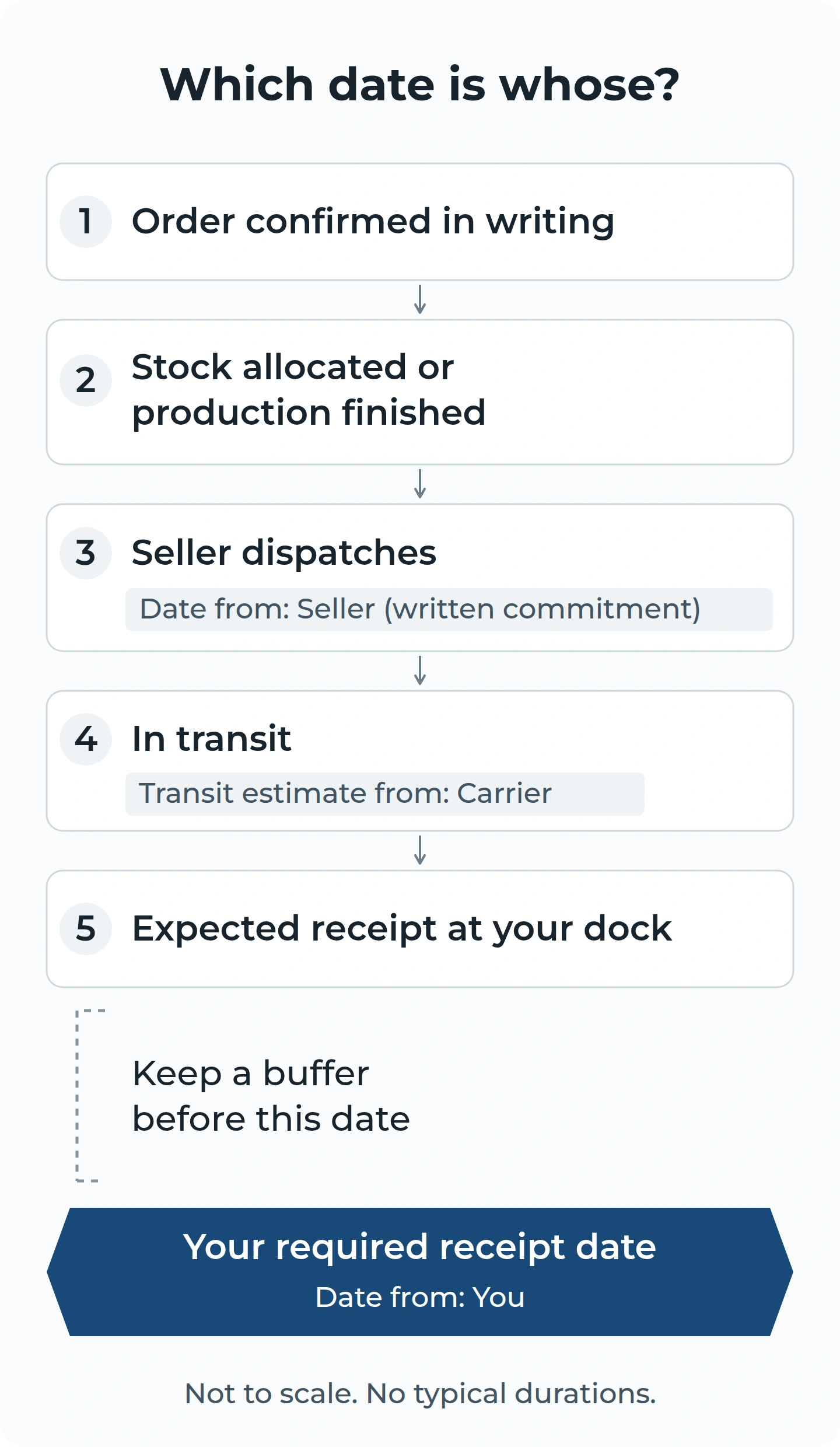
Set your required receipt date first. Work back from when the costumes must be on the floor or listed online, and allow for the time your team needs to check, tag and shelve them. Then ask the seller for a written dispatch date per SKU, or per shipment if several SKUs travel together. If the seller also commits to a delivery date, record it separately with what it depends on, such as the carrier, a delivery appointment or payment clearing.
| Date | Who supplies it | What to record |
|---|---|---|
| Required receipt date | You | The date and the reason behind it, such as a launch date or receiving capacity |
| Dispatch date | The seller, in writing | The date, the SKUs it covers, who confirmed it and what it depends on |
| Delivery commitment, if any | The seller, in writing | The date and its conditions |
| Transit estimate | The carrier, or the seller’s freight quote | The estimated transit time and service level |
| Receiving constraints | Your receiving location | Appointment rules, opening hours and equipment such as a liftgate |
Overseas orders add more steps between dispatch and receipt: international transport, customs clearance and an importer for the shipment. The domestic versus overseas supplier guide outlines them. For a domestic pallet delivery, the guide to delivery appointments and dock checks covers what to arrange and inspect.
If expected receipt leaves no gap before your required date, the order is late on paper already. Ask whether the seller can dispatch earlier or split the shipment so the SKUs you need first leave first, or cut the order to the SKUs that can arrive in time.
Common mistake: Reading the seller’s ship date as the day the costumes arrive. Add the carrier’s transit estimate and your own receiving time before comparing it with your deadline.
Takeaway: Put the three dates in three fields, name the source of each, and hold any SKU whose expected receipt leaves no buffer before your required date.
Match the product paperwork to the SKU
The certificate a costume needs depends on who it is made for and what kind of product it is. A costume designed or intended primarily for children 12 or younger that is subject to CPSC children’s product rules needs a Children’s Product Certificate (CPC). A general-use product subject to a CPSC rule needs a General Certificate of Conformity (GCC), unless a specific rule or CPSC policy says otherwise. Either way, the certificate has to describe the SKU you are buying.
| Situation | What CPSC guidance says | What to keep on the record |
|---|---|---|
| Children’s costume (designed or intended primarily for children 12 or younger) | The domestic manufacturer or importer issues a CPC based on tests by a CPSC-accepted third-party laboratory. Where an exemption makes testing to a particular rule unnecessary, the CPC still cites every applicable rule and lists the exemption claimed instead of a laboratory, only for what was not tested; the other applicable rules still need results from an accepted laboratory (CPC guidance). | The CPC or access to it, the certifying firm, the date and place of manufacture, and for each rule either the laboratory or the exemption claimed |
| Adult costume (general wearing apparel) | Clothing textiles are covered by the flammability standard at 16 CFR part 1610. General-use products subject to a CPSC rule are certified on a GCC (GCC guidance). | The GCC or access to it, or the exemption basis in the next row |
| Adult costume made only of fabrics exempt from flammability testing | Certain fabrics are exempt from testing under 16 CFR 1610.1(d). CPSC states that no GCC is required for adult wearing apparel exempt from testing under that section (FFA guidance). | The seller’s written statement of the exemption claimed and the fabric it relies on |
| Children’s sleepwear | Separate standards apply: 16 CFR part 1615 for sizes 0 to 6X and part 1616 for sizes 7 to 14. Qualifying infant and tight-fitting garments are excepted from those tests but stay subject to part 1610 or 1611, as applicable. | If a children’s item is listed as pajamas or sleepwear, which standard its CPC cites |
| Garments using vinyl plastic film | A separate standard, 16 CFR part 1611, covers nonrigid, unsupported vinyl plastic film used in wearing apparel. | Whether the certificate cites part 1611 |
| Hats, gloves and footwear sold on their own | Excluded from part 1610 only on stated conditions: hats that do not cover the neck, face or shoulders; gloves 14 inches long or shorter that are not attached to a garment; footwear without hosiery that is not attached to a garment (clothing FAQs). | The condition that applies, not just the item name. Other rules, such as the children’s product requirements, can still apply. |
The exemption rows need care. CPSC describes the fabric exemptions as “testing exemptions and not exceptions from the overall flammability requirement” (clothing FAQs). The adult-apparel GCC policy does not carry over to children’s costumes either: a CPC for children’s apparel must still cite 16 CFR part 1610, with the exemption noted on the certificate. A seller saying a fabric is polyester has made a claim to check against the certificate or the written exemption basis. It does not show that the SKU qualifies.
Children’s costumes carry requirements beyond flammability. CPSC’s clothing guidance lists limits on lead in paint and surface coatings and on total lead in accessible components such as buttons, zippers and snaps, along with third-party testing and permanent tracking labels that identify the manufacturer, the date and place of manufacture and the batch. Ask whether the certificate covers the costume as sold, including attached pieces and any accessories packed with it.
Then check the match. CPSC requires a CPC or GCC to describe the product “in enough detail to match the certificate to each product it covers and no others,” and to name the certifying domestic manufacturer or importer and the date and place of manufacture. A certificate can list more than one product. CPSC’s GCC FAQ allows one GCC to cover several shipments, batches or lots only on stated conditions: each shipment is materially unchanged from the one before, the certificate describes the date range covered by batch or lot information or actual dates, and the firm has exercised due care to ensure each additional batch or lot still complies with all applicable rules. A date range on the certificate is needed but does not establish coverage by itself. So read what it actually identifies: the products and the manufacture dates or batches. Pause the SKU when that description cannot be matched to your SKU, or when the dates or batches stop short of the units you are buying. A family name or last season’s date is a reason to ask for that detail, not a verdict either way. Where a GCC applies, CPSC says it must be furnished to distributors and retailers, and that reasonable physical or electronic access to the certificate satisfies that (GCC FAQ). Ask for access to the certificate itself, not a summary of it.
If the answers stay vague or the paperwork names a different product, pause that SKU. The supplier red flags guide covers how to handle a material claim the seller cannot back up.
Common mistake: Asking for the same certificate for every costume. Demanding a GCC for adult costumes covered by the fabric exemption wastes a round of emails, while accepting the adult rule for a children’s costume leaves out the CPC that children’s products need.
Takeaway: For each SKU, record the age group, the product type, the certificate or exemption that applies and the certifying firm, and confirm that the certificate’s product description matches the SKU.
Fill in the seasonal order release record
Keep one record per order with a row set for each SKU, and decide release SKU by SKU. Release a SKU when every required field holds an answer with a source and a date. Hold it when any required field is blank or contradicted by another document. The one planned exception is a production SKU, whose finished quantity and run paperwork can stay open at order stage and hold only its shipment and balance. A field that does not apply to a SKU, such as licensing for an unlicensed costume or the certifying firm for adult apparel that needs no GCC, gets “N/A” with the reason and its source. N/A is an answer you can check; a blank is missing evidence.
| Field | What to enter | Where the answer comes from |
|---|---|---|
| SKU, style, size, colour | Exactly as on the quotation | Seller quotation or line sheet |
| Quantity and case pack | Units ordered, units per case | Seller quotation |
| Age group and product type | For example children’s apparel, adult apparel, sleepwear or accessory | Manufacturer description, then the certificate |
| Invoicing seller | Legal name on the quotation or invoice | Quotation, invoice |
| Shipper and ship-from location | Who dispatches and from where | Seller, in writing |
| Certifying manufacturer or importer | Name and address on the CPC or GCC; if no certificate is required, “N/A” with the reason | The certificate, or the exemption basis below |
| Stock status | Allocated, listed or to be produced, with date and sender; for production, quantity and finish date | Seller, in writing |
| Dispatch commitment | Date and what it depends on | Seller, in writing |
| Delivery commitment | Date and conditions, or “none given” | Seller, in writing |
| Transit estimate | Time and service level | Carrier or freight quote |
| Required receipt date | Date and reason | You |
| Receiving constraints | Appointment, hours, equipment | Your receiving location |
| Certificate or exemption | CPC, GCC, or the written exemption basis and citation, with who confirmed it and the source | Certifying firm, via the seller |
| Licensing permission | Licensed-character SKUs only: channels allowed | Seller, in writing |
| Missing items | Each blank field, who was asked and when | Your notes |
| Decision | Release, hold or drop, with decision owner and date | You |
| Decision | When it fits | Next step |
|---|---|---|
| Release | Every required field has a dated source or a reasoned N/A, stock is allocated, expected receipt leaves a buffer, and the certificate or exemption matches the SKU | Confirm the order or payment step under the agreed terms |
| Order now, hold shipment | The SKU is still to be produced, the written commitment covers your quantity with finish and dispatch dates that leave a buffer, and the other fields are filled; the finished quantity and the certificate for the run, or the documented exemption basis for the SKU, are still to come | Place the order or deposit under the agreed terms; list the open items and release shipment or the balance only when they arrive and match |
| Hold | A required field is blank, the certificate names another product, or the dates leave no buffer | Send the seller the blank fields and set the date by which you will decide |
| Drop the SKU | The seller cannot allocate in time, cannot provide the certificate or exemption basis, or cannot confirm licensing for your channel | Remove it from the order or source it elsewhere |
If releasing the order means paying a deposit or accepting payment terms, check which event starts the payment clock in the wholesale payment terms guide. If two sellers offer the same costumes, fill in the record for both and compare them field by field alongside price with the quote comparison guide. For clothing sellers beyond costumes, the apparel wholesalers guide covers the main sourcing channels.
Save the completed record with the order documents. Send the blank fields to the seller that issued the quotation, ask for the answers in writing, and update the record as they arrive. National Wholesalers does not check orders or contact sellers on readers’ behalf; the related guides below go deeper on each field.
Takeaway: Release SKU by SKU from the record, and send the seller the blank fields instead of releasing the whole order on a general promise.
When this does not apply
This page lists the evidence to collect before releasing an order. It does not decide whether any costume complies with CPSC rules, and the CPSC pages cited here are business guidance, not a ruling on your product. Several situations need more than this record:
- Halloween goods that are not apparel, such as decorations, props, toys or cosmetics, can fall under other rules that this page does not cover.
- Apparel may also be subject to Federal Trade Commission requirements and, for imported goods, U.S. Customs and Border Protection requirements, as CPSC’s clothing guidance notes. Duties, customs entry and labelling are outside this page.
- State requirements are not covered.
- Licensing permission is a matter between the seller and the licensor. This record captures what the seller tells you; it cannot confirm the licence itself.
- Seller identity and payment safety come before any of this. Use the guide to verifying a wholesale supplier before money moves.
- For a specific product classification or exemption question, read the cited rule or ask a qualified compliance professional.
Takeaway: Use the record to decide what to ask and when to hold, and rely on the cited rules and qualified advice for whether a particular costume complies.
Related buyer guides
- Supplier research: the full set of supplier checks this guide belongs to.
- How to verify a wholesale supplier: confirm who the seller is and how to pay safely.
- Price list vs stock list: ask for a dated stock position you can rely on.
- Quotation request template: put SKU, allocation and dispatch questions in one request.
- Receiving a wholesale delivery: plan the delivery appointment and dock checks.
- Apparel wholesalers: find general clothing channels before narrowing to costumes.
Frequently asked questions
Where can I find a supplier of Halloween costumes?
Start with costume manufacturers that publish a wholesale route and the distributors they supply, then check each candidate before you order. Rubies, for example, publishes its wholesale account process on its website. Confirm the seller's identity, its route to the goods and its stock for your SKUs before relying on a listing. This site does not recommend specific suppliers.
Where can I buy Halloween costumes in bulk?
Through a wholesale account with a manufacturer or distributor that sells to businesses; Rubies, for example, asks for a business and tax ID. Buying in bulk does not remove the per-SKU checks: a dated stock confirmation or, for a costume still to be made, a written production commitment for your quantity; a written dispatch date that fits your receipt deadline; and the certificate or documented exemption that matches the SKU's age group and product type. A production order can be placed on the commitment, with shipment held until the finished quantity and that paperwork are confirmed.
Do wholesale distributors sell to the public?
It depends on the seller's own policy. Rubies, for example, says it does not sell directly to consumers, points shoppers to retailers and requires a business and tax ID for a wholesale account. Check the published terms of each seller rather than assuming one rule covers every distributor.
Sources
- Flammable Fabrics Act (FFA) business guidance — U.S. Consumer Product Safety Commission Accessed October 11, 2026.
- Clothing and general wearing apparel FAQs — U.S. Consumer Product Safety Commission Accessed October 11, 2026.
- Children's Product Certificate — U.S. Consumer Product Safety Commission Accessed October 11, 2026.
- General Certificate of Conformity — U.S. Consumer Product Safety Commission Accessed October 11, 2026.
- General Certificate of Conformity (GCC) FAQ — U.S. Consumer Product Safety Commission Accessed October 11, 2026.
- Where to Buy Wholesale — Rubies II LLC Accessed October 11, 2026.