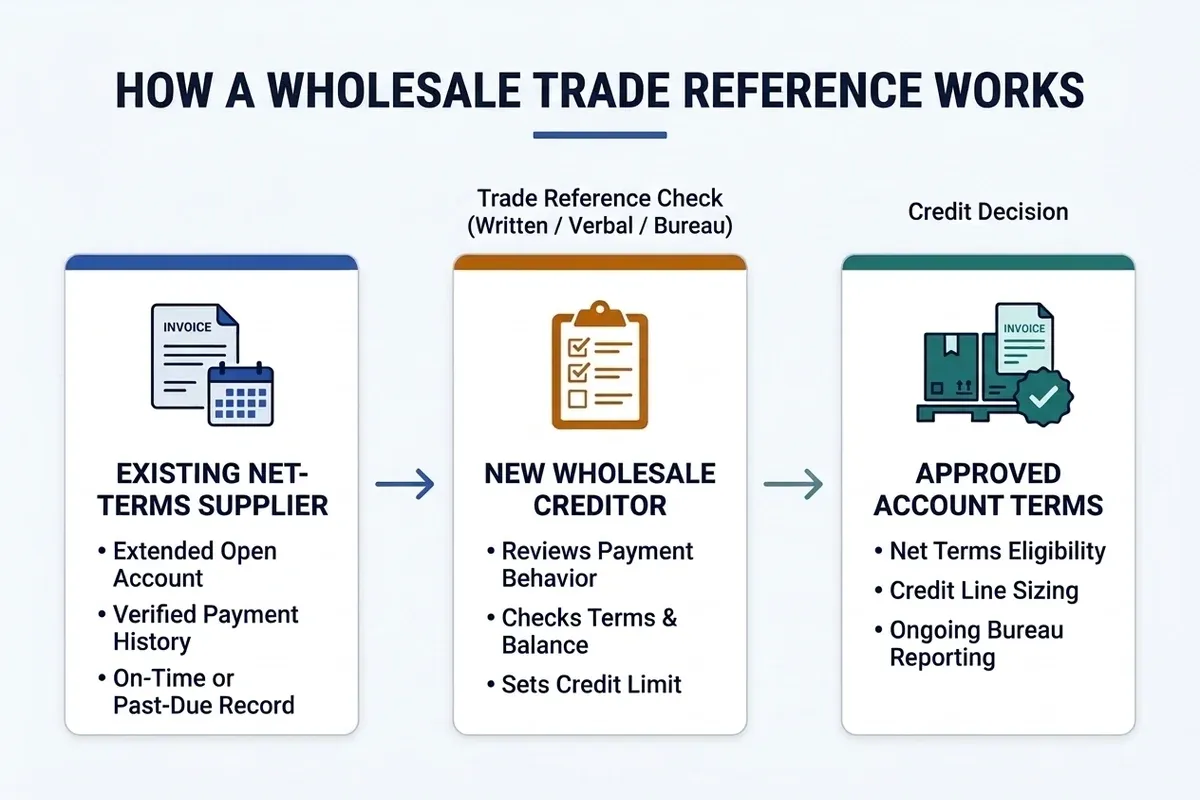
A trade reference is a payment-history report from an existing commercial supplier showing how reliably a business pays invoices bought on deferred credit terms. Only independent vendors that extended open-account credit—such as net 10 through net 120—can verify commercial repayment behavior on a wholesale credit application; prepaid sellers or personal contacts cannot substitute.
For the full account onboarding sequence before requesting net terms, start at the wholesale buying hub. Review onboarding paperwork in wholesale account requirements, check invoice due dates in wholesale payment terms, and see how approved credit lines support recurring releases in our blanket purchase order guide.
What Is a Trade Reference on a Wholesale Credit Application?
On a wholesale credit application, a trade reference is a commercial payment-history record provided by a supplier with whom your business already buys on deferred payment terms. According to Florida SBDC at FIU (GrowBiz), creditors verify that history verbally, via a written trade reference letter, or through commercial credit bureaus including Dun & Bradstreet, Experian, and Equifax.
Understanding why distributors ask for vendor contacts starts with the distinction between trade credit and the reference itself. Trade credit is the loan extended by one business to another when goods or services are bought on account without immediate payment, and it represents the largest use of capital for a majority of B2B sellers in the United States. The trade reference is the resulting record of how the customer managed that credit relationship.
Because companies are more likely to extend open-account terms to buyers they trust, credit managers screen applications in two ways. They either pull commercial credit reports—which any business can check without obtaining permission from the customer first—or contact listed suppliers directly when a buyer’s business credit scores are thin or not yet established. Manual written or verbal verification takes more time than an automated bureau pull, which is why strong bureau-reported trade references speed up credit underwriting.
| Verification channel | How the creditor receives payment history | Primary underwriting strength | Practical limitation for wholesale buyers |
|---|---|---|---|
| Commercial credit bureau report | Automated payment feed from reporting vendors to Dun & Bradstreet, Experian, Equifax, or the Small Business Financial Exchange | Fast underwriting without calling suppliers; any business can check commercial files without prior permission | Only reflects vendors that actively report customer payment experiences |
| Written trade reference letter or form | Completed credit inquiry form or reference letter signed by the party verifying payment records | Captures granular account history, credit limits, and reasons for any past-due balances when bureau files are thin | Slower review cycle while awaiting vendor response and manual verification |
| Verbal trade reference check | Direct phone verification between a new creditor and an existing supplier’s accounts receivable team | Confirms current account standing quickly for smaller or non-reporting local vendors | More time-consuming than bureau checks and dependent on staff availability |
Who Should You Put as a Trade Reference—and Who Does Not Count?
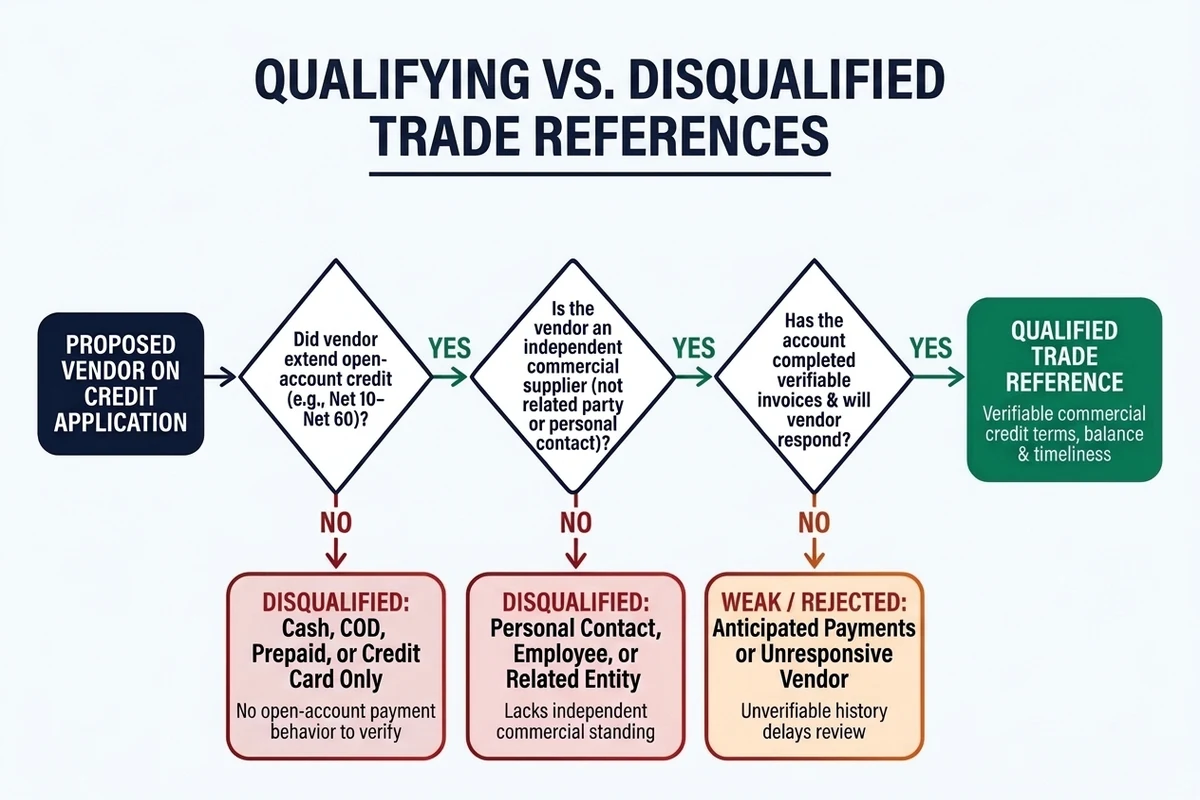
List only independent commercial suppliers that have extended deferred payment terms—such as net 30, where payment is due 30 days after the invoice date, or terms ranging from net 10 to net 120 or longer—and can verify your completed payment history. Prepaid vendors, cash-only sellers, and parties closely associated with your business do not demonstrate open-account credit reliability.
Why Prepaid Sellers and Related Parties Fail Credit Screening
A trade reference exists specifically to show how a buyer handles unpaid balances between invoice issue and due date. When a buyer pays upfront by cash or card, the supplier never bears deferred-payment exposure, so the relationship produces no accounts receivable track record to evaluate.
Underwriting standards also enforce strict independence between the buyer and the party providing or recording the reference. On the Export-Import Bank of the United States (EXIM) Trade Reference Form EIB 99-14, the form must be completed, signed, and dated by the person obtaining the information, and it explicitly prohibits completion by any individual closely associated with the buyer, including shareholders, employees, or related companies.
Selecting Strong Existing Suppliers Before Applying
Established businesses should start with current suppliers and vendors to confirm which accounts already carry credit terms and monitor business credit reports to see which vendors report payment history automatically. Prioritize suppliers that know your payment record well, hold active open-account terms, and are willing to respond to credit inquiries.
When your own business extends trade credit to downstream buyers without full upfront payment, you step into the same verification role for your customers. Accommodating legitimate reference requests helps reliable customers secure terms while helping other businesses avoid unnecessary credit risk, and informing customers that you report payment experiences to Dun & Bradstreet, Equifax, Experian, or the Small Business Financial Exchange creates a direct incentive for on-time payment.
| Candidate reference type | Counts as a valid trade reference? | Underwriting reason | Recommended buyer action |
|---|---|---|---|
| Independent supplier with net 10 to net 120 terms and completed invoices | Yes | Proves commercial repayment speed, credit limit usage, and accounts receivable discipline | Confirm current billing contact details before listing on the credit application |
| Supplier reporting payment history to Dun & Bradstreet, Experian, or Equifax | Yes | Feeds commercial tradelines directly into business credit files and scores | Monitor bureau reports to verify active reporting and accurate payment status |
| Prepaid, cash-on-delivery, or upfront-only vendor | No | No deferred payment credit was extended, so no invoice repayment behavior exists to measure | Ask whether the supplier offers net terms after completing an initial purchase cycle |
| Buyer shareholders, employees, or related companies | No | Fails commercial independence rules such as EXIM Form EIB 99-14 restrictions | Exclude related parties completely and list only arm’s-length commercial creditors |
Is a Trade Reference the Same as a Credit Reference or Bank Reference?
A trade reference is a specific type of credit reference, not an identical synonym for a bank reference or a personal credit report. Credit reference is the broad umbrella covering any organization, individual, or report documenting a past credit track record, whereas a trade reference comes specifically from a commercial supplier and a bank reference comes from a depository bank.
The information each document proves is fundamentally different. Bank letters of credit reference report basic account standing—how long an applicant has held an account, the type of account, and whether overdrafts or late payments were noted. By contrast, supplier trade references document commercial credit limits, payment terms, open balances, and how promptly trade invoices are settled, giving creditors direct insight into whether a buyer pays on time or risks default.
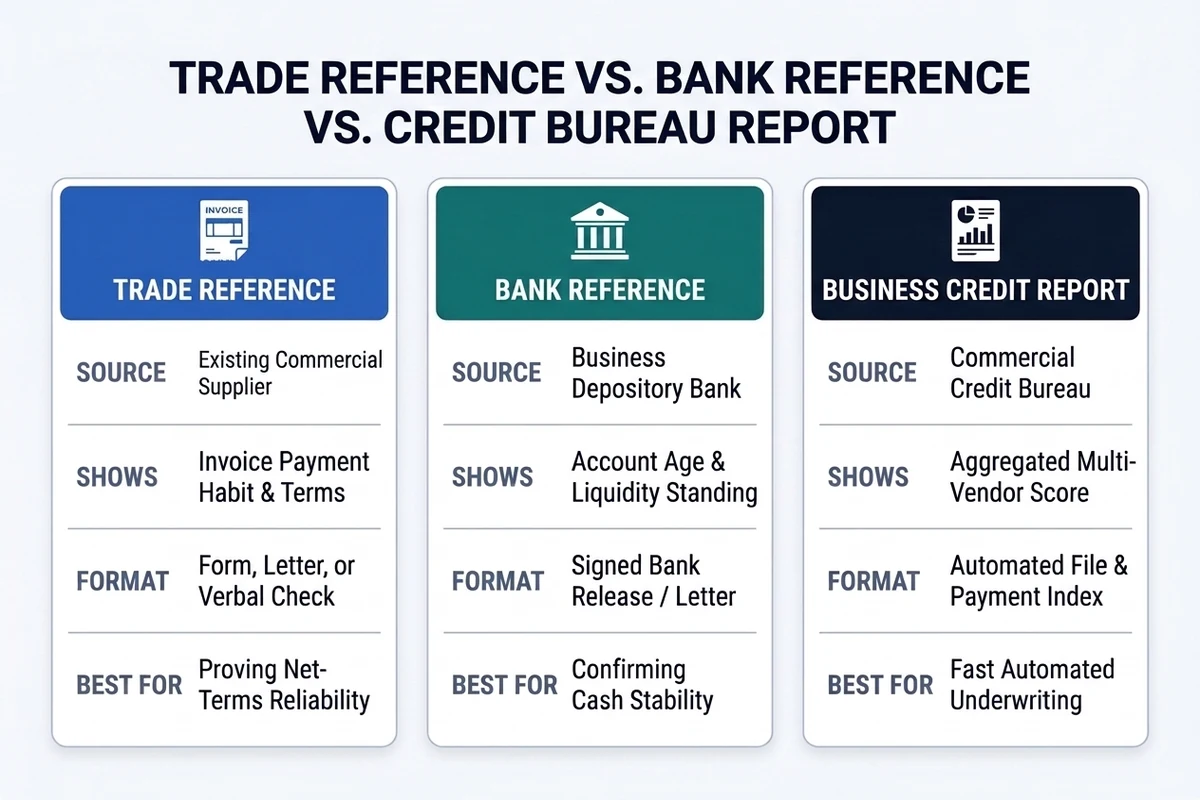
Commercial credit bureaus bridge individual supplier relationships into standardized scores. Credit rating agencies provide credit references for companies while credit bureaus provide them for individuals. For example, Dun & Bradstreet’s Paydex score is heavily weighted toward trade credit experiences, which lenders consider alongside time in business, revenues, and personal credit scores when evaluating financing requests.
Buyers should also match reference preparation to the type of financing sought. Trade references are unlikely to be checked when applying for business credit cards—which usually evaluate the business owner’s personal credit scores—and banks do not commonly request trade references when extending credit, though preparing supplier references in advance remains prudent whenever applying for wholesale accounts or commercial financing.
| Comparison criterion | Trade reference | Bank reference | Commercial credit bureau report |
|---|---|---|---|
| Issuing source (verifier) | Existing independent commercial supplier or vendor | Applicant’s depository bank | Commercial credit reporting agency (Dun & Bradstreet, Experian, Equifax) |
| Core financial signal (data scope) | Credit limit, net terms, open balance, past-due amounts, and invoice payment speed | Length of banking relationship, account type, and any overdrafts or late payments | Aggregated commercial tradelines and payment-weighted scores such as Paydex |
| Typical delivery format (channel) | Verbal verification, written trade reference letter, or standardized form | Written bank letter of credit reference | Automated business credit report pulled without customer permission |
| Primary underwriting role (decision use) | Verifies B2B invoice reliability for wholesale net-terms applications | Confirms baseline depository standing and account longevity | Enables rapid screening across multiple suppliers and commercial lenders |
How Do New Businesses Get a Trade Reference With No Credit History?
New businesses build their first trade references by registering a business credit profile and opening starter net-terms accounts with vendors willing to work with companies less than two years old. Because some suppliers require a certain number of initial purchases before approving credit, building those accounts early prevents delays on larger orders.
Step-by-Step Path to Your First Verifiable Trade References
Guidance from the U.S. Small Business Administration (SBA) emphasizes that poor credit history is one of the main reasons small business loan applications are declined and can affect insurance rates as well as attractiveness to potential partners, suppliers, and vendors. While existing businesses rely on established financial history, loan eligibility for a new business typically depends on the owner’s personal credit score. Establishing business credit early helps companies secure better financing terms, negotiate supply agreements, and protect against business identity theft.
- Register a unique nine-digit DUNS number: SBA identifies registering for a Dun & Bradstreet (DUNS) number—a unique nine-digit identifier assigned to each physical business location—as one of the first steps in building commercial credit.
- Start with existing suppliers or starter net-terms vendors: Ask current vendors whether they extend credit, or look for companies offering vendor terms to businesses under two years old that do not yet have a business credit file.
- Complete initial purchase requirements and pay on time: Expect some suppliers to require a certain number of completed purchases before unlocking deferred credit, and pay every net-terms invoice promptly to build positive payment history.
- Monitor commercial credit reports for active reporting: SBA advises checking company credit reports from Experian, Equifax, Dun & Bradstreet, or smaller credit reporting services to confirm which suppliers report payment history and keep records accurate.
Tradeoffs, Personal Credit Checks, and Consignment Alternatives
Buyers do not need stellar personal credit to begin building trade credit. Some trade-credit suppliers do not check the business owner’s personal credit reports at all, while others run a soft check strictly to rule out very low personal credit scores. Even so, new accounts come with structural tradeoffs that buyers should plan around before committing cash flow, and in categories where open-account terms are not yet available, suppliers sometimes offer consignment as an alternative in which the supplier retains ownership of the goods until the buyer sells them.
| Factor | Trade credit advantage for new buyers | Trade credit limitation to plan around |
|---|---|---|
| Access threshold (approval ease) | Often easier to obtain than small business loans, with some vendors skipping personal credit pulls or using soft checks | Some suppliers require a certain number of initial purchases before granting net terms |
| Working capital (cash flow) | Improves cash flow by allowing supplies to be purchased without immediate upfront payment | Lower credit limits initially until timely repayment history accumulates |
| Supplier flexibility (purchasing scope) | Strengthens future negotiations on wholesale supply agreements and longer net terms | Early vendor credit options may offer limited purchasing selection |
| Credit-building impact (bureau visibility) | On-time payments to reporting vendors help build commercial credit scores | Accounts with non-reporting vendors may not help build a business credit file automatically |
What Does a Trade Reference Example or Form Include?
A complete trade reference letter or form documents core commercial metrics: customer identity, credit terms, account opening date or years of trade experience, credit limit, open accounts receivable balance, past-due balance, highest previous balance, Days Beyond Terms (DBT) or slow-pay brackets, late payments, and credit transactions. Federal forms add collateral disclosure and verifier sign-off.
Standard Commercial Fields and EXIM Form EIB 99-14 Benchmarks
Combining the commercial trade reference checklist from Florida SBDC at FIU with the federal template published on EXIM Bank Form EIB 99-14 (OMB 3048-0042, Rev. 12/2024, expiring 8/31/2028) shows exactly what wholesale credit underwriters inspect during manual verification. Under EXIM’s Paperwork Reduction Act estimate, completing the standardized form takes about 15 minutes once account records are on hand.
| Trade reference data field | Standard commercial checklist (GrowBiz / FIU) | Standardized form benchmark (EXIM Form EIB 99-14) | What the credit manager evaluates |
|---|---|---|---|
| Party identification (identity block) | Customer identifying information such as business name and address | Buyer name and address plus reference company, individual name, title, phone, fax, and email | Confirms legal entity match and verifies an authentic, independent supplier contact |
| Relationship tenure (time unit) | Date account opened | Years of trade experience and date of last sale (MM/DD/YYYY) | Measures relationship maturity and whether the account is currently active |
| Commercial terms and volume (days and currency) | Credit terms (such as net 10 or net 30) and number of credit transactions | Payment terms, credit limit, and estimated current annual sales (specifying currency) | Evaluates order cadence and whether prior credit exposure matches the new credit request |
| Balance exposure (currency) | Open AR (accounts receivable) balance, past-due balance, and highest previous balance | Current outstanding balance, past-due balance, and highest amount owed at one time and paid in the past 12 months | Tests whether the buyer has successfully repaid peak balances without carrying delinquency |
| Payment timeliness (days beyond terms) | Current and previous DBT (days beyond terms) and number of late payments | Number of days past due plus five brackets: Prompt, 1-30 days slow, 31-60 days slow, 61-90 days slow, and 91+ days slow, with reasons for past dues | Quantifies exact payment discipline and isolates disputed invoices from chronic slow pay |
| Security and sign-off (attestation) | Not listed separately on basic commercial summaries | Disclosure of standby letter of credit, guarantees, or collateral (or statement that none exists) plus verifier name, title, contact details, signature, and date | Separates unsecured open-account credit from secured shipments and prevents self-authored references |
Confidentiality and Verification Governance
Because trade references expose live receivables and sales volume, formal credit forms address confidentiality directly. On EXIM Form EIB 99-14, EXIM and its officers and employees are subject to the Trade Secrets Act (18 U.S.C. 1905) and 12 CFR 404.7, which require protecting confidential commercial information and prohibit disclosing confidential submissions without the submitter’s consent except as required by law. In private wholesale applications, keeping supplier contact details accurate and alerting your accounts receivable contacts ahead of time helps ensure verification forms are returned accurately and without delay.
Before submitting your next wholesale credit packet, review wholesale account requirements to verify tax and entity documents alongside your vendor list, and confirm how net-term clocks and discounts operate in wholesale payment terms.
Frequently Asked Questions
What is a trade reference on a credit application?
A trade reference on a credit application is a supplier or vendor that has extended trade credit to your business and can verify your payment history. Creditors check trade references verbally, via a written trade reference letter or form, or through commercial credit bureau reports from Dun & Bradstreet, Experian, or Equifax to decide whether to approve net terms.
Who should I put as a trade reference?
List independent commercial suppliers that have extended open-account credit terms—such as net 10, net 30, or longer—where you have completed invoices and a clean repayment record. Leave off cash-only or prepaid sellers that never extended credit, as well as related companies, shareholders, or employees of your business.
Is a trade reference the same as a credit reference?
No, although a trade reference is one type of credit reference. Credit reference is the broader term covering supplier trade references, bank letters of credit reference (which confirm account age, account type, and any overdrafts or late payments), and credit reports maintained by credit rating agencies or credit bureaus.
How do new businesses get a trade reference?
New businesses can register for a unique nine-digit DUNS number, open starter net-terms accounts with suppliers willing to work with companies less than two years old, and complete any required initial purchase history while paying invoices on time. Monitoring reports from Dun & Bradstreet, Experian, and Equifax confirms which vendors report payment history.
Do I need good personal credit to get trade references?
Not necessarily. Some suppliers that extend trade credit do not check the business owner’s personal credit reports at all, while others run a soft check only to rule out very low personal credit scores. However, business credit cards are usually evaluated on personal credit scores, and new-business loan eligibility is typically based on the owner’s personal credit score.
Sources
- Florida SBDC at FIU (GrowBiz): What is a Trade Reference and when do you need one?
- Export-Import Bank of the United States (EXIM): Trade Reference Form EIB 99-14 (OMB 3048-0042, Rev. 12/2024)
- U.S. Small Business Administration (SBA): Plan Your Business — Establish Business Credit
- Reference Overviews: Wikipedia: Trade credit and Wikipedia: Credit reference