Key takeaways
- FSVP responsibility follows the U.S. owner or consignee at CBP entry submission (21 CFR § 1.500), not the CBP Importer of Record (19 CFR § 142.3); DDP or landed POs do not shift FSVP away from the U.S. buyer.
- An FSVP file is both food-specific and foreign-supplier-specific (21 CFR § 1.502(a)), and the foreign supplier is the actual manufacturing plant or farm—not an overseas trading company or export broker.
- When a foreign supplier controls a SAHCODHA hazard (21 CFR § 1.506(d)(2)), the default requirement is an initial onsite audit before first import and an annual onsite audit thereafter by a Qualified Auditor (§ 1.503(b)).
- Modified FSVP tracks cover dietary supplements (§ 1.511), very small importers below the $1,372,952 human food or $3,432,379 animal food 2023–2025 average (§ 1.512), downstream controls (§ 1.507), and recognized countries (§ 1.513).
- Since July 24, 2022, CBP ACE rejects any FSV entry line filed with 'UNK' or lacking a 9-digit DUNS number (21 CFR § 1.509); FDA Form 482d demands require 24-hour offsite or 72-hour FURLS electronic submission (§ 1.510).
Under the FSMA Foreign Supplier Verification Program (FSVP) regulation (21 CFR Part 1, Subpart L, §§ 1.500–1.514), the United States owner or consignee of imported human or animal food at the time of customs entry must verify and document that each foreign supplier produces food meeting federal public health protection, adulteration, and allergen-labeling standards. Compliance operates across two distinct enforcement stages: at the customs declaration stage (21 CFR § 1.509), transmitting an entry line in CBP ACE without Entity Role Code FSV and a valid 9-digit DUNS number triggers an automated EDI entry transmission rejection; at the post-entry FDA inspection stage (21 CFR §§ 1.510, 1.514), failing to establish or produce required Qualified Individual verification records upon a Form FDA 482d inspection can result in Form FDA 483a observations, an FDA Warning Letter, and—where significant noncompliance remains unresolved—listing on FDA Import Alert 99-41 (Detention Without Physical Examination) and refusal of admission under FD&C Act § 801(a)(3).
Enacted under Section 805 of the Federal Food, Drug, and Cosmetic Act (21 U.S.C. § 384a; Final Rule 80 FR 74225), FSVP shifts food-safety verification upstream into commercial distribution and logistics workflows before cargo ever reaches a U.S. receiving dock. Every covered food line requires a completed, food-and-supplier-specific verification file prior to entry submission.
| FSVP Compliance Dimension | Controlling CFR Citation | Operational Standard for U.S. Wholesale Importers | Consequence of Noncompliance |
|---|---|---|---|
| Statutory Scope & Public Health Standard | 21 CFR § 1.502(a)21 U.S.C. § 384a |
Separate FSVP per food and per foreign manufacturer/farm; verify equivalence to FD&C Act § 418 (Part 117/507) or § 419 (Part 112), non-adulteration (§ 402), and human food allergen labeling (§ 403(w)). |
Prohibited act under FD&C Act § 301(zz) (21 CFR § 1.514(b)); FDA Form 483a and Warning Letter. |
| FSVP Importer Identity | 21 CFR § 1.500 |
The U.S. owner or consignee who owns, purchased, or agreed in writing to buy the food at CBP entry submission—or a signed U.S. agent if no U.S. owner exists. | Misidentifying the DDP seller or customs broker triggers Form 482d citation against the true U.S. buyer. |
Qualified Individual (QI) & Qualified Auditor (QA) |
21 CFR § 1.503(a)–(b)21 CFR § 1.506(e) |
All FSVP tasks must be executed by a trained QI fluent in the record language; onsite audits require a Qualified Auditor. Foreign suppliers cannot self-verify (except lot testing). | Form FDA 483a citations for unqualified or conflicted verification records during FDA audit. |
| SAHCODHA Hazard Verification | 21 CFR § 1.506(d)(2) |
Hazards controlled by the foreign supplier that carry a reasonable probability of serious adverse health consequences or death require an onsite audit before initial import and annually thereafter. | Unresolved audit deficiencies can lead to Warning Letter and FDA Import Alert 99-41 (DWPE). |
Very Small Importer (VSI) Thresholds |
21 CFR § 1.50021 CFR § 1.512 |
<$1,000,000 human food baseline ($1,372,952 2023–2025 inflation average) or <$2,500,000 animal food baseline ($3,432,379 2023–2025 average); document eligibility annually by Dec. 31. |
Loss of modified written-assurance status; enforcement of standard §§ 1.504–1.506 verification rules. |
| CBP ACE Entry Filing | 21 CFR § 1.509(a) |
Transmit Entity Role Code FSV in PG19, 9-digit D&B DUNS number, legal name, and PG20 email—or PG23 exemption code FSX / RNE. ("UNK" disabled since July 24, 2022). |
Automated CBP ACE electronic entry line transmission rejection. |
| Record Production & Retention | 21 CFR § 1.510(a)–(c)21 CFR § 1.514(a) |
Sign and date all records; retain ≥2 years (≥3 years for VSI eligibility). Produce onsite promptly, within a 24-hour window for offsite files, or within 72 hours via FDA’s FURLS portal. |
Uncorrected noncompliance subjects future shipments to DWPE under Import Alert 99-41 and refusal under FD&C Act § 801(a)(3). |
Who Is the FSVP Importer (21 CFR § 1.500) vs. CBP Importer of Record (19 CFR § 142.3)
Under 21 CFR § 1.500, the FSVP importer is the U.S. owner or consignee of an article of food offered for import into the United States at the time of U.S. entry. The regulation defines U.S. owner or consignee as the person in the United States who, at the time electronic entry is submitted to U.S. Customs and Border Protection (CBP), either owns the food, has purchased the food, or has agreed in writing to purchase the food. If no U.S. owner or consignee exists at the time of entry, the FSVP importer is the U.S. agent or representative of the foreign owner or consignee, confirmed in a signed statement of consent to serve as the importer under Subpart L.
In FDA’s January 2023 FSVP Final Guidance (Questions A.4 through A.18), FDA explicitly separates the FSVP importer (21 CFR § 1.500) from the customs Importer of Record (IOR) under 19 CFR § 101.1 and 19 CFR § 142.3. When evaluating food distributors USA buyers use for wholesale replenishment, commercial teams frequently confuse customs brokerage responsibility with FSVP liability:
- Why DDP (“Landed”) Purchase Orders Do Not Shift FSVP Liability (Guidance Questions A.7 & A.12): Under
19 CFR § 142.3(a)–(b), customs entry release is filed onCBP Form 3461orCBP Form 7501by the owner, purchaser, or licensed customs broker—including a foreign shipper acting as a non-resident Importer of Record under Delivered Duty Paid (DDP) Incoterms. However, if a U.S. wholesale food distributor issued a purchase order accepted in writing by the foreign seller before the CBP entry was submitted, the U.S. distributor has “agreed in writing to purchase the food” at the time of entry. The U.S. wholesale distributor is therefore the statutory FSVP importer, even though the foreign seller acts as CBP Importer of Record and pays customs duties. - Conditional Purchase Orders (Guidance Questions A.4 & A.11): Writing into a wholesale purchase order that title passes only upon warehouse delivery, deferred invoice payment, or satisfactory post-entry microbiological lab testing does not alter FSVP status. Because a binding written agreement to purchase exists when the entry is transmitted to CBP, the U.S. wholesale buyer remains the FSVP importer.
- When U.S. Buyers of Domestic Distributor Stock Are Outside FSVP (Guidance Questions A.9 & A.10): When restaurants, grocery chains, or regional wholesalers source from food distributors in the USA by purchasing goods out of the distributor’s already-imported domestic warehouse inventory—or by placing a domestic purchase order that does not specify a foreign manufacturer—the upstream U.S. distributor that imported the stock is the FSVP importer. The downstream domestic customer has no FSVP filing or recordkeeping duty.
- Identifying the True “Foreign Supplier” (
21 CFR § 1.500): Under§ 1.500, theforeign supplieris the establishment that manufactures or processes the food, raises the animal, or grows the food exported to the United States without further manufacturing or processing by another establishment (except de minimis activities such as applying labels). If a U.S. wholesaler buys through an overseas export trading house, consolidator, or foreign broker, the trading company is not the foreign supplier; the importer’s FSVP must evaluate and verify the actual manufacturing plant or farm.
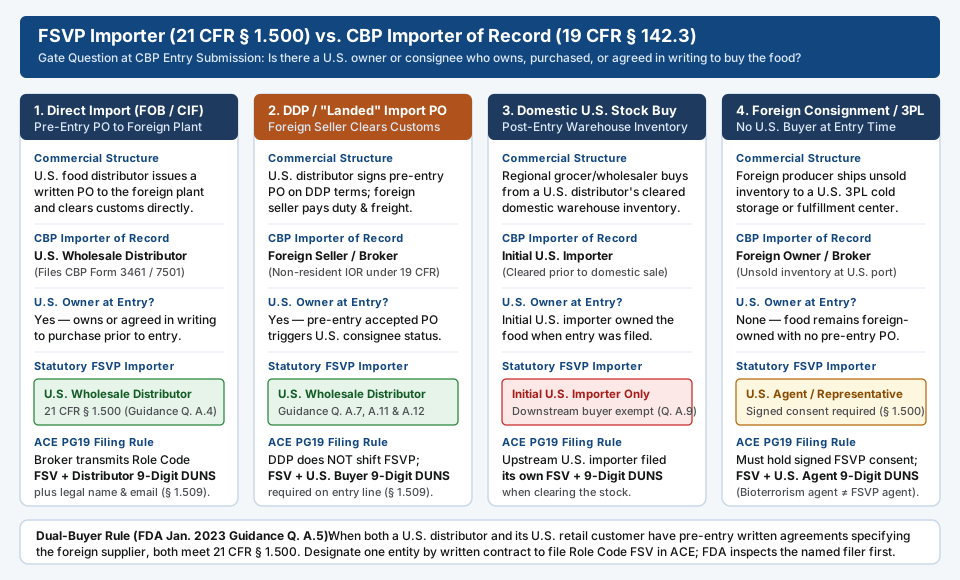
Six Commercial Wholesale Scenarios: CBP Importer of Record vs. FSVP Importer
| Wholesale Sourcing Structure | CBP Importer of Record (19 CFR § 142.3) |
Statutory FSVP Importer (21 CFR § 1.500) |
Controlling FDA Rule & ACE Filing Requirement |
|---|---|---|---|
| 1. Direct FOB / CIF / EXW Import: U.S. food distributor issues a PO to an overseas processor and clears the container through its U.S. customs broker. | U.S. Food Distributor | U.S. Food Distributor | Under 21 CFR § 1.500 & Guidance Q. A.4/A.7, the distributor owns or agreed in writing to buy the food before CBP entry. File FSV + distributor’s 9-digit DUNS. |
| 2. DDP / “Landed” Import Against Pre-Entry PO: Foreign supplier acts as non-resident IOR, pays duty/freight, and delivers to the U.S. distributor’s dock. | Foreign Supplier or Customs Broker | U.S. Food Distributor | Under Guidance Q. A.7 & A.12, pre-entry written PO acceptance makes the U.S. buyer the U.S. owner or consignee. File FSV + U.S. distributor’s 9-digit DUNS. |
| 3. Conditional PO (Pending Post-Entry Lab Test or Dock Acceptance): U.S. buyer’s PO states ownership is contingent on passing U.S. arrival testing. | Either Party | U.S. Food Distributor | Under Guidance Q. A.4 & A.11, a written purchase agreement exists at entry submission regardless of deferred payment or post-entry inspection contingencies. |
| 4. Buying Cleared Stock from a Domestic U.S. Food Distributor: Retailer or regional wholesaler orders from a U.S. distributor’s domestic warehouse or without naming a foreign plant. | Upstream U.S. Importer | Upstream U.S. Importer (Not Downstream Buyer) | Under Guidance Q. A.9 & A.10, purchasing after CBP entry—or ordering without specifying a foreign supplier—places zero FSVP obligation on the downstream U.S. buyer. |
| 5. Pre-Sold Back-to-Back Import (Dual Pre-Entry Contracts): U.S. distributor imports from Foreign Plant X to fulfill a pre-entry written contract with a U.S. grocery chain specifying Plant X. | U.S. Food Distributor | Both Meet § 1.500 (Designate One in ACE via Contract) |
Under Guidance Q. A.5, both entities are U.S. owners or consignees. Because ACE accepts only one FSV entity per entry line, designate one by contract; FDA inspects the named ACE filer first. |
| 6. Foreign-Owned Consignment / 3PL / E-Commerce Fulfillment: Foreign manufacturer ships unsold stock to a U.S. cold-storage 3PL with no U.S. buyer at entry. | Foreign Owner or Customs Broker | Designated U.S. Agent for FSVP (Signed Consent) | Under 21 CFR § 1.500, § 1.509(b), & Guidance Q. A.13–A.18, the foreign owner must appoint a U.S. agent via a signed statement of consent. (A Bioterrorism Act § 1.227 registration agent is not automatically the FSVP agent.) |
When comparing cross-border factory sourcing against buying cleared domestic inventory in our domestic vs. overseas wholesale suppliers comparison, procurement teams should incorporate FSVP administrative overhead directly into the sourcing decision.
Key Takeaway: Always audit the date of your written purchase order against the CBP entry submission timestamp (
19 CFR § 141.68vs.21 CFR § 1.500). If your company agreed in writing to buy a specific overseas lot before customs entry was transmitted, your company is the FSVP importer—even on a DDP invoice.
Qualified Individual (QI) vs. Qualified Auditor (21 CFR § 1.503 & § 1.506(e))
Under 21 CFR § 1.503(a), an importer must ensure that a Qualified Individual (QI) develops the FSVP and performs every required activity—from writing or reviewing the hazard analysis (§ 1.504) and evaluating foreign supplier compliance history (§ 1.505) to reviewing laboratory certificates of analysis (COAs) and signing off on corrective actions (§§ 1.506, 1.508).
Whenever an onsite audit is required or selected to verify hazard control (21 CFR § 1.506(e)(1)(i) for standard FSVP or § 1.511(c)(5)(i)(A) for dietary supplements), 21 CFR § 1.503(b) mandates a higher credential tier: the audit must be conducted by a Qualified Auditor (QA).
| Statutory Role & Citation | Mandatory Qualification Criteria | Permissible Personnel & Statutory Restrictions |
|---|---|---|
Qualified Individual (QI)21 CFR § 1.50021 CFR § 1.503(a) |
1. Must possess the education, training, or experience (or a combination thereof) necessary to perform each assigned FSVP activity. 2. Must be able to read and understand the language of any records reviewed in performing that activity. |
• May be an in-house employee (e.g., QA director trained under the FSPCA FSVP curriculum) or an external third-party consultant. • Foreign Supplier Self-Verification Bar ( § 1.506(e)(2)(ii)): Neither the foreign supplier nor its employees may perform supplier verification activities, except for sampling and testing of food.• Conflict-of-Interest Bar ( § 1.506(e)(4)): No financial conflicts of interest may influence verification results, and compensation cannot be tied to the outcome. |
Qualified Auditor (QA)21 CFR § 1.50021 CFR § 1.503(b)21 CFR § 1.506(e)(1)(i)(A) |
1. Must satisfy all requirements of a Qualified Individual. 2. Must possess technical expertise obtained through education, training, or experience (or a combination thereof) necessary to perform the food safety auditing function. |
• Required for all onsite audits under § 1.506(e)(1)(i) and § 1.511(c)(5)(i)(A).• Qualifying examples under § 1.500: (1) A domestic or foreign government food safety employee; (2) An audit agent of a certification body accredited under 21 CFR Part 1, Subpart M; or (3) An experienced private third-party food safety auditor.• Under § 1.506(e)(1)(i)(C), an audit conducted solely for FSVP by a Subpart M audit agent is not subject to Subpart M regulatory audit upload rules. |
While 21 CFR § 1.504(d) and § 1.505(d) allow an importer to rely on a hazard analysis conducted by another entity (including the foreign supplier’s QI) or a supplier evaluation performed by a non-supplier third party, the importer’s own Qualified Individual must review, assess, and document that review in a signed and dated record (21 CFR § 1.510(a)(2)). Commercial identity checks covered in how to verify a wholesale supplier before you pay establish corporate existence and bank-account legitimacy, whereas 21 CFR §§ 1.503–1.506 require technical food-safety verification by a credentialed QI.
Key Takeaway: A bare GFSI certificate (such as a 1-page BRCGS, SQF, or FSSC 22000 summary) does not satisfy
21 CFR § 1.506(e)(1)(i)(D). Your Qualified Individual must obtain and review the complete onsite audit report—including audit procedures, dates, conclusions, corrective actions for significant deficiencies, Qualified Auditor credentials, and the applicable FDA FSMA regulatory addendum (Part 117,Part 112,Part 111, orPart 507).
Standard FSVP Workflow (21 CFR §§ 1.504–1.508) vs. Modified Compliance Tracks
Under 21 CFR § 1.502(a), an importer must establish and follow an FSVP for each food brought into the United States and for each foreign supplier of that food. Importing canned crushed tomatoes from three Italian canneries requires three distinct FSVP files; importing four product categories (crushed tomatoes, roasted bell peppers, capers, and extra-virgin olive oil) from one foreign processor requires four distinct FSVP files.
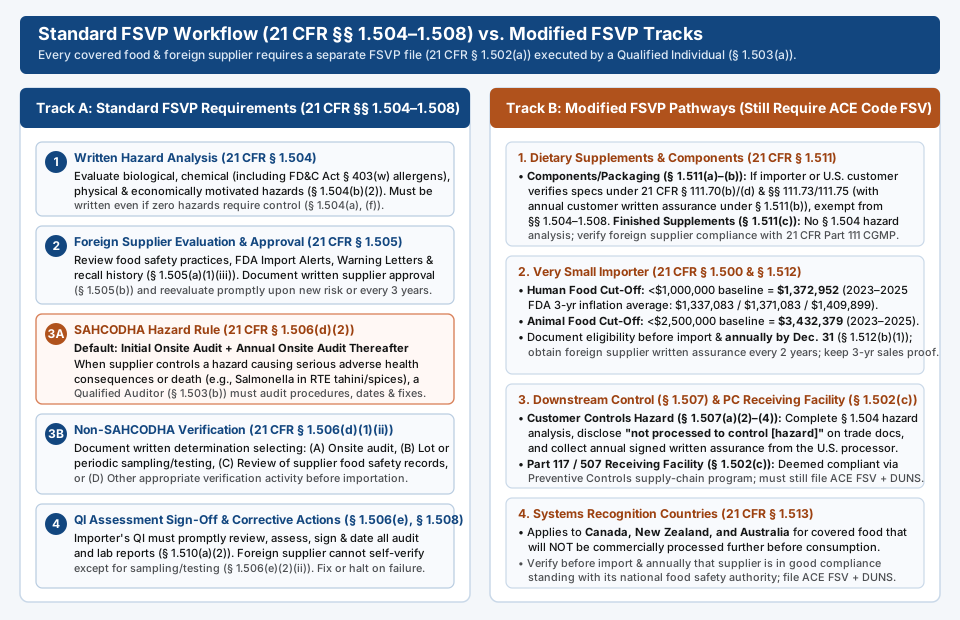
Unless a product qualifies for a statutory exemption (§ 1.501) or a modified compliance track (§§ 1.502(b)–(c), 1.507, 1.511, 1.512, 1.513), the importer’s Qualified Individual must complete the six-step Standard FSVP Workflow prior to importing the first shipment:
- Written Hazard Analysis (
21 CFR § 1.504):- Identify known or reasonably foreseeable biological hazards (parasites, environmental pathogens such as Salmonella spp. and Listeria monocytogenes, and other bacteria/viruses), chemical hazards (radiological contaminants, pesticide and drug residues, natural toxins such as aflatoxin/mycotoxins, decomposition/histamine, unapproved food or color additives, major food allergens under
FD&C Act § 201(qq)/§ 403(w), and nutrient deficiencies or toxicities in animal food), and physical hazards (stones, glass, or metal fragments) (§ 1.504(b)(1)). - Evaluate hazards occurring naturally, unintentionally introduced, or intentionally introduced for purposes of economic gain (economically motivated adulteration, such as lead chromate in spices or melamine in protein meals) (
§ 1.504(b)(2)). - Assess probability and severity across the 10 factors in
§ 1.504(c)(3)(i)–(x). Under§ 1.504(a)and(f), the hazard analysis must be written even if the QI determines that zero hazards require a control. - For raw agricultural commodities (
RACs) that are “covered produce” under21 CFR § 112.3, biological hazards are deemed by statute to require a control under21 CFR Part 112, so the importer’s written hazard analysis under§ 1.504(e)addresses only non-biological (chemical and physical) hazards.
- Identify known or reasonably foreseeable biological hazards (parasites, environmental pathogens such as Salmonella spp. and Listeria monocytogenes, and other bacteria/viruses), chemical hazards (radiological contaminants, pesticide and drug residues, natural toxins such as aflatoxin/mycotoxins, decomposition/histamine, unapproved food or color additives, major food allergens under
- Foreign Supplier Evaluation and Approval (
21 CFR § 1.505):- Evaluate the hazard analysis, identify which entity controls each hazard (
§ 1.505(a)(1)(ii)), and examine the foreign supplier’s food safety practices, testing/audit history, storage/transportation controls, and FDA compliance history (§ 1.505(a)(1)(iii)(B)—checking FDA Import Alerts, Warning Letters, and recalls). - Document written supplier approval (
§ 1.505(b)) and establish written procedures (§ 1.506(a)) ensuring imports originate exclusively from approved foreign suppliers. - Mandatory 3-Year Reevaluation (
§ 1.505(c)): Reevaluate supplier performance promptly upon learning of any new compliance risk (such as an Import Alert listing or failed lot test) and at least every 3 years (§ 1.505(c)(2)).
- Evaluate the hazard analysis, identify which entity controls each hazard (
- Written Verification Determination (
21 CFR § 1.506(b) & (d)):- Establish written procedures and document which verification activities (
§ 1.506(d)(1)(ii)(A)–(D)—onsite audits, sampling and testing, review of supplier food safety records, or other appropriate activities) and frequencies will be executed before importing and periodically thereafter.
- Establish written procedures and document which verification activities (
- Execution of Verification Activities & SAHCODHA Default Rule (
21 CFR § 1.506(d)(2) & (e)):- When the foreign supplier controls a SAHCODHA hazard—a hazard for which exposure presents a reasonable probability of serious adverse health consequences or death to humans or animals—
21 CFR § 1.506(d)(2)requires the importer to conduct or obtain documentation of an onsite audit before initially importing the food and at least annually thereafter, unless the QI documents an adequate written determination justifying why alternative verification activities or a lower audit frequency provide equivalent assurance. - Under
§ 1.506(e)(1)(i)(E), written results of an official inspection conducted within 1 year of when the onsite audit was due can substitute for an onsite audit if performed by FDA, USDA, another U.S. federal/state/local/tribal agency, or the food safety authority of an officially recognized Systems Recognition country (§ 1.513: Canada, New Zealand, Australia).
- When the foreign supplier controls a SAHCODHA hazard—a hazard for which exposure presents a reasonable probability of serious adverse health consequences or death to humans or animals—
- Prompt QI Review and Assessment (
21 CFR § 1.506(e)(3)):- Collecting an audit report or lab COA on file without review violates FSVP. The importer’s QI must promptly review and assess the results of every verification activity and sign and date the assessment record (
§ 1.510(a)(2)).
- Collecting an audit report or lab COA on file without review violates FSVP. The importer’s QI must promptly review and assess the results of every verification activity and sign and date the assessment record (
- Corrective Actions (
21 CFR § 1.508):- When an audit finding, positive pathogen test, customer complaint, or FDA enforcement action indicates a foreign supplier’s processes fail to control hazards, the importer must promptly investigate, document corrective actions taken by the supplier, or halt imports from that supplier.
Key Takeaway: Budget annual third-party Qualified Auditor fees, lot-level microbiological laboratory testing, and QI review hours into your per-unit import math using our landed cost calculation worksheet before committing to an overseas purchase order.
Four Worked Foreign Supplier Verification Program Examples
Buyers searching for a foreign supplier verification program example need to match their exact product risk and business structure to the governing subpart of 21 CFR Part 1, Subpart L. The four regulatory compliance examples below illustrate how FSVP obligations change across SAHCODHA foods, non-SAHCODHA commodities, dietary supplements, and very small importers.
Example 1: Standard FSVP with a SAHCODHA Hazard (21 CFR § 1.506(d)(2)) — Imported Ready-to-Eat (RTE) Sesame Tahini or Ground Black Pepper
- Commercial Scenario: A U.S. foodservice and grocery wholesaler imports 20-metric-ton containers of ready-to-eat (
RTE) sesame tahini and steam-treated ground black pepper directly from a manufacturing facility in Turkey. - Step 1 — Written Hazard Analysis (
§ 1.504): The wholesaler’s Qualified Individual identifies Salmonella spp. (biological environmental and post-lethality pathogen in low-moisture RTE foods consumed without a further consumer cooking step), undeclared peanut/tree-nut cross-contact (FD&C Act § 403(w)major food allergen chemical hazard), and mycotoxins/pesticide residues (chemical hazards) as hazards requiring a control. Because Salmonella exposure in an RTE food causes severe illness or death, it is classified as a SAHCODHA hazard controlled at the foreign plant’s thermal roasting/steam-sterilization step and post-process sanitation zone. - Step 2 — Supplier Evaluation (
§ 1.505): The QI checks FDA Import Alert 99-19 (Detention Without Physical Examination of Food Products Due to the Presence of Salmonella), Warning Letters, and recall logs, reviews the foreign processor’s21 CFR Part 117Food Safety Plan and roasting validation data, and signs the written supplier approval (§ 1.505(b)). - Step 3 — Annual Onsite Audit + Lot Testing (
§ 1.506(d)(2)&(e)(1)(i)–(ii)): Under the default SAHCODHA rule in21 CFR § 1.506(d)(2), the wholesaler obtains a complete onsite audit report performed by a Qualified Auditor before the initial shipment and at least annually thereafter (verifying compliance with21 CFR Part 117Preventive Controls), paired with lot-by-lot microbiological COA testing (§ 1.506(e)(1)(ii)). - Step 4 — Mandatory Record Retention (
§ 1.506(e)(1)(i)(D)&(e)(3)): The file retains the full audit report (procedures, dates, conclusions, corrective actions, and Qualified Auditor credentials), each lot’s lab report (lot number, sample count, analytical method, lab ID, test dates/results), and the QI’s signed and dated review assessment (§ 1.510(a)(2)). At customs entry, the broker files Entity Role CodeFSV+ the wholesaler’s 9-digit DUNS number (§ 1.509(a)).
Example 2: Standard FSVP with Non-SAHCODHA Hazards (21 CFR § 1.506(d)(1)(ii)(B)–(C)) — Milled Specialty Flour or Acid-Preserved Shelf-Stable Condiments
- Commercial Scenario: A U.S. wholesale distributor imports shelf-stable wine vinegar and milled durum semolina (intended for commercial pasta extrusion and boiling) from an Italian mill.
- Step 1 — Written Hazard Analysis (
§ 1.504): The QI identifies mycotoxins (deoxynivalenol / DON in wheat) and pesticide residues as chemical hazards requiring control at the foreign mill, alongside metal fragments controlled by rare-earth magnets and metal detection. - Step 2 — Written Verification Determination (
§ 1.506(d)(1)): Because the identified hazards under the specific product and intended-use profile do not trigger the default annual onsite audit mandate of§ 1.506(d)(2)—or the QI documents a written justification based on the§ 1.505evaluation—the QI writes a formal verification determination under21 CFR § 1.506(d)(1)(ii)(B)and(C)selecting:- Lot-by-lot Certificate of Analysis (
COA) review and periodic independent laboratory testing (§ 1.506(e)(1)(ii)) for DON mycotoxin and pesticide residue limits; and - Semi-annual review of the foreign supplier’s metal-detector calibration and sanitation monitoring records (
§ 1.506(e)(1)(iii)).
- Lot-by-lot Certificate of Analysis (
- Step 3 — QI Assessment Sign-Off (
§ 1.506(e)(3)): Every lot COA and production record batch is reviewed, assessed, signed, and dated by the importer’s QI before release into wholesale inventory, with supplier reevaluation completed at least every 3 years (§ 1.505(c)(2)).
Example 3: Dietary Supplements & Dietary Supplement Components (21 CFR § 1.511 & 21 CFR Part 111)
Dietary supplements (FD&C Act § 201(ff)) operate under a dedicated modified FSVP track in 21 CFR § 1.511 aligned with Dietary Supplement Current Good Manufacturing Practice (21 CFR Part 111):
- Pathway 3A — Imported Bulk Botanical Extracts, Amino Acids, or Empty Capsules (
21 CFR § 1.511(a)–(b)):- Importer Is the U.S. Part 111 Manufacturer (
§ 1.511(a)): If the U.S. importer is a dietary supplement manufacturer/packager required to establish component or packaging specifications under21 CFR § 111.70(b)or(d)and verifies those specifications are met under§§ 111.73and111.75(including 100% identity testing of dietary ingredients), the importer is exempt from§§ 1.502,1.504–1.508, and1.510and must only use a Qualified Individual (§ 1.503) and transmit Role CodeFSV+ 9-digit DUNS at CBP entry (§ 1.509). - Importer Is a Wholesale Ingredient Distributor (
§ 1.511(b)): If a U.S. wholesale ingredient distributor imports bulk dietary ingredients and sells them to a U.S. contract manufacturer subject to21 CFR § 111.70(b)/(d), the distributor is exempt from§ 1.502and§§ 1.504–1.508provided it annually obtains written assurance from its U.S. customer confirming the customer is in compliance with21 CFR §§ 111.73and111.75, uses a QI (§ 1.503), filesFSV+ DUNS at entry (§ 1.509), and retains those customer assurances under§ 1.510.
- Importer Is the U.S. Part 111 Manufacturer (
- Pathway 3B — Imported Finished, Retail-Labeled Dietary Supplements (
21 CFR § 1.511(c)):- When a U.S. wholesaler imports finished packaged softgels, tablets, or gummies that undergo no further Part 111 manufacturing or packaging in the United States,
21 CFR § 1.511(c)governs. - No
§ 1.504hazard analysis is required (§ 1.511(c)(1)). Instead, the wholesaler’s QI evaluates and approves the foreign supplier (§ 1.511(c)(2)–(3)) and conducts verification activities (§ 1.511(c)(5)—such as an onsite21 CFR Part 111CGMP audit by a Qualified Auditor, finished-product testing, or batch production record review) to verify the foreign facility manufactures the supplement in compliance with21 CFR Part 111. For broader document verification on wellness lines, see our guide on checking health and beauty wholesale documents.
- When a U.S. wholesaler imports finished packaged softgels, tablets, or gummies that undergo no further Part 111 manufacturing or packaging in the United States,
Example 4: Very Small Importer (21 CFR § 1.512) & Downstream Processor Hazard Control (21 CFR § 1.507)
- Pathway 4A — Very Small Importer (
21 CFR § 1.500&§ 1.512):- Statutory & Inflation-Adjusted Eligibility Cut-Offs: Under
21 CFR § 1.500and FDA’s FSMA Inflation Adjusted Cut Offs (2023–2025), an importer (including all subsidiaries and affiliates) qualifies as a Very Small Importer (VSI) when its 3-year rolling average of total food sales combined with the U.S. market value of food imported, manufactured, processed, packed, or held without sale is below:- Human Food VSI: Statutory baseline
<$1,000,000(2011 dollars) =<$1,372,952per year for the 2023–2025 3-year average ($1,337,083in 2023;$1,371,083in 2024;$1,409,899in 2025). - Animal Food / Pet Food VSI: Statutory baseline
<$2,500,000(2011 dollars) =<$3,432,379per year for the 2023–2025 3-year average ($3,344,684in 2023;$3,427,706in 2024;$3,524,748in 2025).
- Human Food VSI: Statutory baseline
- Worked Eligibility Calculation: Suppose a specialty European cheese wholesaler (with no corporate affiliates) recorded total human food sales plus unsold imported inventory value of
$1,190,000in Year 1,$1,285,000in Year 2, and$1,340,000in Year 3:- Formula:
3-Year Average Human Food Value = (Year 1 + Year 2 + Year 3) / 3 - Worked Calculation:
($1,190,000 + $1,285,000 + $1,340,000) / 3 = $3,815,000 / 3 = $1,271,667Because$1,271,667 < $1,372,952, the wholesaler qualifies as a Very Small Importer under21 CFR § 1.512for the following calendar year.
- Formula:
- Modified VSI Obligations (
21 CFR § 1.512(b)): Exempt from§§ 1.504–1.506(no hazard analysis or onsite audit required). Instead, the VSI must:- Document VSI eligibility before initially importing under
§ 1.512and annually thereafter by December 31 of each calendar year (§ 1.512(b)(1)(i)(A)), retaining financial eligibility proof for at least 3 years (§ 1.512(b)(5)(iii)(C)); - Obtain written assurance from each foreign supplier before importing and at least every 2 years thereafter (
§ 1.512(b)(3)(i)) confirming the supplier produces food with processes providing the same level of public health protection asFD&C Act § 418/§ 419and that the food is not adulterated (§ 402) or allergen-misbranded (§ 403(w)); and - File Entity Role Code
FSV+ 9-digit DUNS at CBP entry (§ 1.509).
- Document VSI eligibility before initially importing under
- (Note: Under
21 CFR § 1.512(a)(2)and(c), an importer of any revenue size importing food from certain small foreign suppliers—specifically a qualified facility under21 CFR § 117.3/§ 507.3, a non-covered produce farm under21 CFR § 112.4, or a shell egg producer with<3,000laying hens under21 CFR Part 118—can also use biennial written supplier assurances, provided the importer evaluates the supplier’s FDA compliance history every 3 years under§ 1.512(c)(1)and obtains annual size-eligibility assurance by December 31).
- Statutory & Inflation-Adjusted Eligibility Cut-Offs: Under
- Pathway 4B — Hazard Controlled After Importation by a U.S. Customer (
21 CFR § 1.507) or Receiving Facility (21 CFR § 1.502(c)):- When a U.S. wholesaler imports raw agricultural commodities that cannot be consumed without application of a control (such as green coffee beans or raw cocoa beans under
§ 1.507(a)(1)), the QI documents the§ 1.504hazard analysis and a written determination that the food cannot be consumed without that control; no§ 1.505evaluation or§ 1.506verification is required. - When a U.S. ingredient wholesaler imports bulk raw tree nuts or unpasteurized ingredients sold to a U.S. food processor that applies a validated lethality step (
§ 1.507(a)(2)–(4)), the wholesaler completes the§ 1.504hazard analysis, states on commercial documents accompanying the shipment that the food is"not processed to control [identified hazard]", and annually obtains signed written assurance (§ 1.507(b)) from the U.S. processor. - If the U.S. importer is itself a Receiving Facility under
21 CFR Part 117(human food) orPart 507(animal food) implementing preventive controls or a Subpart G / Subpart E supply-chain program,21 CFR § 1.502(c)deems the facility in compliance with FSVP—except it must still file Entity Role CodeFSVand its 9-digit DUNS number at CBP entry under§ 1.509.
- When a U.S. wholesaler imports raw agricultural commodities that cannot be consumed without application of a control (such as green coffee beans or raw cocoa beans under
Key Takeaway: Very Small Importer status (
21 CFR § 1.512) is never automatic: you must re-calculate your 3-year rolling human or animal food value against FDA’s current inflation table and sign the eligibility record by December 31 each year, while retaining the underlying financial documentation for at least 3 years.
Statutory Exemptions, Partial Exemptions, and ACE FSX / RNE Codes (21 CFR § 1.501, § 1.502(b), § 1.513)
Before instructing a customs broker on an entry line, U.S. wholesale buyers must distinguish between complete statutory exemptions under 21 CFR § 1.501 (which transmit Affirmation of Compliance code FSX or RNE in ACE PG23), partial exemptions for Low-Acid Canned Foods (§ 1.502(b)), and modified verification for Systems Recognition Arrangement countries (§ 1.513):
| Food / Import Category | Controlling Citation | Statutory Exemption or Modification Conditions | CBP ACE Code (PG19 / PG23) |
|---|---|---|---|
| Seafood HACCP (Fish & Fishery Products) | 21 CFR § 1.501(b)(1)–(2) |
Exempt from FSVP if imported from a foreign supplier required to comply with, and in compliance with, 21 CFR Part 123 (importer must verify compliance under 21 CFR § 123.12). Also covers raw materials imported for a U.S. Part 123 processor. |
FSX (PG23 Affirmation of Compliance) |
| Juice HACCP (Juice & Juice Ingredients) | 21 CFR § 1.501(b)(1)–(2) |
Exempt from FSVP if imported from a foreign supplier in compliance with 21 CFR Part 120 (importer must comply with 21 CFR § 120.14), or raw materials imported by a U.S. Part 120 juice processor. (Whole fresh fruit imported for wholesale produce sale is NOT exempt). |
FSX (PG23 Affirmation of Compliance) |
| USDA-Regulated Meat, Poultry & Egg Products | 21 CFR § 1.501(h)(1)–(3) |
Inapplicable at importation to meat products under the Federal Meat Inspection Act (21 U.S.C. 601), poultry under the Poultry Products Inspection Act (21 U.S.C. 451), and liquid/frozen/dried egg products under the Egg Products Inspection Act (21 U.S.C. 1031). (FDA-regulated shell eggs and game meats ARE subject to FSVP). |
USDA FSIS Entry (Outside FDA FSVP) |
Alcoholic Beverages & Co-Located Prepackaged Food (≤5% Sales) |
21 CFR § 1.501(e)(1)–(3) |
Exempt when imported from a foreign facility registered under FD&C Act § 415 that would require a TTB permit (27 U.S.C. 201 / 26 U.S.C. 5001). Also exempts prepackaged non-alcoholic food from that same facility if packaged to prevent direct human contact and constituting ≤5% of overall facility sales. |
FSX (PG23 Affirmation of Compliance) |
| Food for Research or Evaluation Use | 21 CFR § 1.501(c)(1)–(4) |
Exempt only if: (1) not intended for retail sale and not sold or distributed to the public; (2) labeled "Food for research or evaluation use"; (3) imported in small quantities consistent with research/analysis/QA with unused portions properly disposed of; and (4) accompanied by an electronic declaration at CBP entry. |
RNE (PG23 Affirmation of Compliance) |
| Personal Consumption, Transshipped, Import-for-Export & Returned U.S. Food | 21 CFR § 1.501(d), (f), (g) |
Exempt when imported for personal consumption (§ 1.501(d)), transshipped or imported for processing and future export without U.S. consumption (§ 1.501(f)), or U.S. food returned without foreign manufacturing/processing (§ 1.501(g)). |
FSX (PG23 Affirmation of Compliance) |
Low-Acid Canned Foods (LACF) vs. Acidified Foods |
21 CFR § 1.502(b)(1)–(2) |
Partial Exemption Only: For thermally processed low-acid foods packaged in hermetically sealed containers (21 CFR Part 113), the importer verifies Part 113 compliance (FCE/SID registration and scheduled process) for microbiological hazards controlled by Part 113, but MUST maintain a standard FSVP (§ 1.502(a)) for all chemical, physical, and allergen hazards not controlled by Part 113. (Acidified foods under 21 CFR Part 114 have NO exemption and require a full FSVP). |
FSV (PG19 Role Code + 9-Digit DUNS) |
Systems Recognition Arrangement Countries (Canada, New Zealand, Australia) |
21 CFR § 1.513(a)–(b) |
Modified FSVP (Not Exempt): For covered food that will not be commercially processed further before consumption imported from a supplier under the regulatory oversight of Canada, New Zealand, or Australia, the importer is exempt from §§ 1.504–1.508 if it documents before import and annually thereafter that the supplier is under that authority’s oversight and in good compliance standing (§ 1.500, § 1.513(b)). |
FSV (PG19 Role Code + 9-Digit DUNS) |
Key Takeaway: Never instruct a customs broker to file
FSXon Low-Acid Canned Foods (21 CFR Part 113), Acidified Foods (21 CFR Part 114), Dietary Supplements (21 CFR § 1.511), or imports from Canada, New Zealand, or Australia (21 CFR § 1.513). All four categories remain subject to21 CFR § 1.509and require Entity Role CodeFSVplus a 9-digit DUNS number in CBP ACE.
CBP ACE PG19 Entry Filing (21 CFR § 1.509) and FDA Form 482d Inspection Timeline (21 CFR § 1.510)
Once the FSVP file is signed by the Qualified Individual, compliance moves to two operational checkpoints: electronic transmission in CBP’s Automated Commercial Environment (ACE) at the time of entry (21 CFR § 1.509) and post-entry record production during an FDA inspection (21 CFR § 1.510). Coordinating customs entry records with physical dock arrival works alongside your warehouse pickup, receiving, and damage claims workflow and broader supplier research verification records.
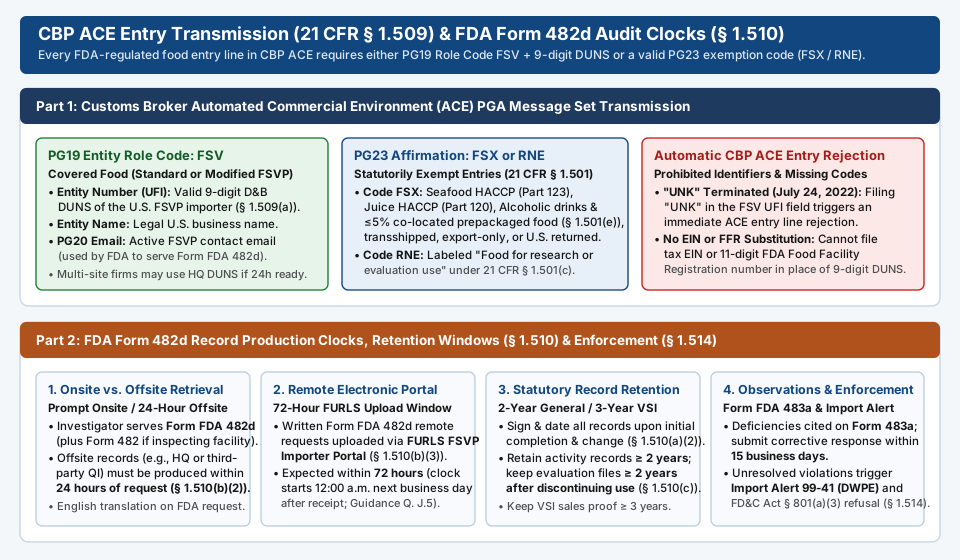
1. Customs Broker ACE PGA Message Set Transmission Table (21 CFR § 1.509)
Under FDA’s April 2022 UFI Final Guidance and FDA’s Section 1.509 UFI Fact Sheet, every FDA-regulated food line submitted in CBP ACE must contain either Entity Role Code FSV or an exemption code (FSX or RNE), or ACE automatically rejects the entry filing:
| ACE PGA Record & Field | Required Transmission Value | Statutory & Technical Filing Rules (21 CFR § 1.509) |
|---|---|---|
PG19 Entity Role Code |
FSV |
Transmitted on all entry lines subject to standard or modified FSVP (§§ 1.502–1.513). |
PG19 Entity Identification Code & Number (UFI) |
9-Digit D&B DUNS Number |
Must be the U.S. FSVP importer’s valid 9-digit numeric Dun & Bradstreet DUNS number. Effective July 24, 2022, FDA terminated the temporary "UNK" policy; transmitting "UNK", a federal tax EIN, or an 11-digit Bioterrorism Act FFR number causes an immediate ACE rejection. |
PG19 Entity Name & Address |
FSVP Importer Legal Name & U.S. Site Address | Because DUNS numbers are site-specific, a multi-warehouse U.S. distributor can transmit the DUNS number of its corporate headquarters (where FSVP records are managed) or the receiving facility, provided offsite records can be produced within a 24-hour window (§ 1.510(b)(2)). |
PG20 Electronic Mail Address |
Active FSVP Contact Email | Mandatory under 21 CFR § 1.509(a). FDA investigators use this exact email address to initiate FSVP audits and serve written Form FDA 482d electronic record demands. |
PG23 Affirmation of Compliance (A of C) |
FSX or RNE |
Transmitted only when the food line is statutorily exempt from FSVP under 21 CFR § 1.501 (FSX for Seafood/Juice HACCP, alcohol, personal, transshipped/export, or U.S. returned; RNE for labeled research/evaluation samples under § 1.501(c)). |
Note on Foreign Suppliers and Prior Notice (FDA UFI Fact Sheet Q9 & Q12): Foreign suppliers are not required to obtain or transmit a DUNS number for FSVP entry purposes—only the U.S. FSVP importer’s DUNS number is filed under FSV. Furthermore, FSVP importer data is transmitted in the customs entry filing (PG19), not in FDA Prior Notice submissions. If a foreign exporter or broker transmits a U.S. wholesaler’s DUNS number without authorization, the U.S. firm can verify filings via FOIA; willful false statements on entry documents violate 18 U.S.C. § 1001 (Guidance Q. A.18).
2. FDA Form 482d / 483a Inspection Deadlines & Record Retention (21 CFR § 1.510 & § 1.514)
Under 21 CFR § 1.510 and FDA’s FSVP Inspection Fact Sheet, importers must maintain FSVP records as original paper records, true copies, or electronic files in strict compliance with five operational rules:
- Mandatory Signature and Date Upon Completion & Modification (
21 CFR § 1.510(a)(2)):- Every FSVP record—including the written hazard analysis (
§ 1.504), supplier evaluation and approval (§ 1.505), verification determination (§ 1.506(d)), QI review and assessment of audit or laboratory results (§ 1.506(e)(3)), and corrective action determinations (§ 1.508)—must be signed and dated by the Qualified Individual upon initial completion and upon any modification. Unsigned worksheets or undated audit reviews are cited on Form FDA 483a.
- Every FSVP record—including the written hazard analysis (
- Onsite Inspection (
Form FDA 482d) & 24-Hour Offsite Production Window (21 CFR § 1.510(b)(1)–(2)):- When an FDA investigator initiates an FSVP inspection, the investigator serves Form FDA 482d (Request for FSVP Records) listing the specific food-and-supplier combinations under review. (If the investigator simultaneously conducts a physical facility inspection under
FD&C Act § 704, FDA issues a separate Form FDA 482, Notice of Inspection). - Records kept at the inspected location (including electronic files accessible from that site) must be made available promptly during normal business hours (
§ 1.510(b)(1)). - Records stored offsite (for example, at a regional corporate office or with an external QI consultant) must be produced onsite inside a 24-hour window following FDA’s official request (
§ 1.510(b)(2)).
- When an FDA investigator initiates an FSVP inspection, the investigator serves Form FDA 482d (Request for FSVP Records) listing the specific food-and-supplier combinations under review. (If the investigator simultaneously conducts a physical facility inspection under
- 72-Hour Remote Electronic Portal Submission (
21 CFR § 1.510(b)(3)& Guidance Question J.5):- When FDA serves a written Form FDA 482d request for a remote records review instead of appearing onsite, the importer must submit the requested records electronically via the FDA FSVP Importer Portal for Records Submission (hosted inside FDA’s Unified Registration and Listing System,
FURLS, ataccess.fda.gov). - Under FDA January 2023 Final Guidance Question J.5, FDA expects electronic portal upload within 72 hours of receipt of the written request. The 72-hour clock starts at 12:00 a.m. on the next business day after courier delivery signature or email read receipt (if no email read receipt is returned, FDA deems the request received 1 business day after email transmission).
- English Translation Rule (
§ 1.510(b)(1)): While a foreign supplier’s underlying records may be maintained in another language if the reviewing QI reads and understands that language (§ 1.503(a)), the importer must provide an English translation within a reasonable time upon FDA request.
- When FDA serves a written Form FDA 482d request for a remote records review instead of appearing onsite, the importer must submit the requested records electronically via the FDA FSVP Importer Portal for Records Submission (hosted inside FDA’s Unified Registration and Listing System,
- 2-Year vs. 3-Year Record Retention Periods (
21 CFR § 1.510(c)&§ 1.512(b)(5)(iii)):- Activity & Transaction Records (
§ 1.510(c)(1)): Retain individual onsite audit reports, laboratory COA test reports, and lot record reviews for at least 2 years after the record was created or obtained. - Process, Procedure & Evaluation Records (
§ 1.510(c)(2)): Retain records that relate to processes or procedures—including the written hazard analysis,§ 1.505supplier evaluation, verification determination, and customer/supplier written assurances—for the entire period they are in use plus at least 2 years after their use is discontinued (e.g., 2 full years after you stop importing from that supplier or replace the evaluation). - Very Small Importer Eligibility Records (
§ 1.512(b)(5)(iii)(C)): Retain annual 3-year revenue and market-value calculation records supporting Very Small Importer eligibility for at least 3 years.
- Activity & Transaction Records (
- Form FDA 483a Observations, Import Alert 99-41, and Refusal of Admission (
21 CFR § 1.514):- If the FDA investigator identifies compliance deficiencies during an inspection, FDA issues Form FDA 483a (FSVP Observations) at the exit conference, giving the importer an opportunity to submit a written response with documented corrective action evidence (typically within 15 business days).
- Where significant FSVP violations remain uncorrected following Form FDA 483a or an FDA Warning Letter, FDA may place the importer/product combination on FDA Import Alert 99-41 (Detention Without Physical Examination of Human and Animal Foods Imported from Foreign Suppliers by Importers Who Are Not in Compliance with the Requirements of the FSVP Regulation), subjecting future shipments to refusal of admission under
FD&C Act § 801(a)(3)(21 CFR § 1.514(a)) and enforcement for a prohibited act underFD&C Act § 301(zz)(21 CFR § 1.514(b)).
Key Takeaway: Monitor the email inbox transmitted in ACE
PG20daily and maintain an activeFURLSaccount ataccess.fda.gov. Because FDA’s 72-hour remote Form 482d clock starts at 12:00 a.m. on the next business day after delivery, an unmonitored compliance inbox or an unsigned hazard analysis can trigger an avoidable Form FDA 483a observation.
Frequently asked questions
If a U.S. food distributor buys on DDP ('landed') terms where the foreign supplier is the CBP Importer of Record, who is the FSVP importer?
The U.S. food distributor is the FSVP importer whenever it has issued a purchase order accepted in writing prior to CBP entry submission. Under 21 CFR § 1.500 and FDA's January 2023 FSVP Final Guidance (Questions A.7 and A.12), FSVP responsibility attaches to the U.S. owner or consignee at the time of entry, regardless of which party serves as the CBP Importer of Record under 19 CFR § 142.3 or pays customs duties.
When are food distributors in the USA exempt from acting as the FSVP importer on imported goods?
Under FDA's January 2023 Final Guidance (Questions A.9 and A.10), a regional wholesaler, grocer, or foodservice distributor that purchases products from an upstream U.S. importer's already-cleared domestic warehouse inventory—or places a domestic order without specifying a foreign supplier before entry—is not the U.S. owner or consignee at the time of entry. In those transactions, the upstream U.S. importer bears full FSVP liability.
Can a U.S. importer use its EIN or FDA Food Facility Registration number instead of a 9-digit DUNS number for FSVP entry?
No. Under 21 CFR § 1.509(a) and FDA's April 2022 Unique Facility Identifier Guidance, the 9-digit Dun & Bradstreet (D&B) DUNS number is the only Unique Facility Identifier recognized as acceptable by FDA for Entity Role Code FSV in CBP ACE. Neither a federal tax EIN nor an 11-digit Bioterrorism Act Food Facility Registration (FFR) number is accepted, and 'UNK' has been permanently rejected by ACE since July 24, 2022.
What is the current revenue threshold to qualify as a Very Small Importer under 21 CFR § 1.512?
Under 21 CFR § 1.500 and § 1.512, the statutory 2011 baseline cut-offs are less than $1,000,000 per year for human food and less than $2,500,000 per year for animal food. Adjusted for inflation across the official FDA 2023–2025 3-year rolling average, the human food threshold is $1,372,952 ($1,337,083 in 2023; $1,371,083 in 2024; $1,409,899 in 2025) and the animal food threshold is $3,432,379 ($3,344,684 in 2023; $3,427,706 in 2024; $3,524,748 in 2025), measured across total food sales plus the U.S. market value of food imported, manufactured, processed, packed, or held without sale.
How quickly must an importer submit FSVP records when FDA issues Form FDA 482d?
Under 21 CFR § 1.510(b)(1)–(3) and FDA's January 2023 Final Guidance (Question J.5), onsite records must be provided promptly upon presentation of Form FDA 482d. Records stored offsite (such as at corporate headquarters) must be produced onsite within a 24-hour window (§ 1.510(b)(2)). When FDA serves a written Form FDA 482d request for remote inspection, the importer must upload the records electronically through the FURLS FSVP Importer Portal within 72 hours of receipt.
Sources
- eCFR Title 21, Part 1, Subpart L — Foreign Supplier Verification Programs for Food Importers (§§ 1.500–1.514) — National Archives and Records Administration (NARA) & U.S. Food and Drug Administration Accessed October 25, 2026.
- FSMA Final Rule on Foreign Supplier Verification Programs (FSVP) for Importers of Food for Humans and Animals — U.S. Food and Drug Administration Accessed October 25, 2026.
- Guidance for Industry: Foreign Supplier Verification Programs for Importers of Food for Humans and Animals (January 2023 Final Guidance) — U.S. Food and Drug Administration Accessed October 25, 2026.
- Guidance for Industry: Compliance with Providing an Acceptable Unique Facility Identifier for the FSVP Regulation (April 2022) — U.S. Food and Drug Administration Accessed October 25, 2026.
- FDA Fact Sheet: Foreign Supplier Verification Programs (FSVP) – Unique Facility Identifier (UFI) Requirement (21 CFR 1.509) — U.S. Food and Drug Administration Accessed October 25, 2026.
- FSMA Inflation Adjusted Cut Offs (2023–2025 3-Year Rolling Average) — U.S. Food and Drug Administration Accessed October 25, 2026.
- FDA Fact Sheet: What to Expect During a Foreign Supplier Verification Programs Inspection — U.S. Food and Drug Administration Accessed October 25, 2026.
- Foreign Suppliers Verification Programs (FSVP) – Importer Portal for Records Submission — U.S. Food and Drug Administration Accessed October 25, 2026.
- FSVP Regulation Records Requirements Checklist — U.S. Food and Drug Administration Accessed October 25, 2026.
- Small Entity Compliance Guide: Foreign Supplier Verification Programs for Importers of Food for Humans and Animals — U.S. Food and Drug Administration Accessed October 25, 2026.
- FDA Import Alert 99-41: Detention Without Physical Examination of Human and Animal Foods Imported from Foreign Suppliers by Importers Who Are Not in Compliance with the Requirements of the FSVP Regulation — U.S. Food and Drug Administration Accessed October 25, 2026.