Key takeaways
- Four physical U.S. hubs anchor domestic buying: LA Fashion District (immediates + showrooms), NYC Garment District (seasonal lines + Broadway jobbers), Dallas Market Center (5 markets + WESA), and Atlanta Apparel (7 annual shows).
- Prepack ratios reflect distinct ASTM blocks: a 6-piece 1-2-2-1 (S-M-L-XL) pack aligns with ASTM D5585-21 Misses (00–20), whereas LA jobber 2-2-2 (S-M-L) packs follow ASTM D6829 Juniors (0/1–19) where Large fits like a Missy 8–10.
- Domestic vendors enforce final-sale terms on unsold stock and 5–14 day RMA defect windows; overseas cut-and-sew orders cannot be economically returned after 12%–32%+ HTSUS duties and require pre-shipment AQL 0.0/2.5/4.0 inspections.
- Under 16 CFR Part 303 and Part 1610, only a guarantor residing in the United States can issue a valid Separate or Continuing Guaranty on an invoice—foreign factory invoices provide zero statutory safe harbor.
- Sheer cellulosic/silk fabrics under 2.6 oz/yd² and all raised-surface cotton/rayon blends (fleece hoodies, corduroy, velvet, chenille) are not exempt under 16 CFR § 1610.1(d) and require lab testing plus a GCC.
Buying from wholesale vendors for clothing requires matching the seller’s operating model—domestic immediate-stock jobbers, regional trade-mart showrooms, or overseas cut-and-sew factories—to your delivery calendar, size block, and regulatory risk profile. Confusing an unadjusted Junior prepack or a foreign factory invoice with vetted domestic stock leads to unsold small sizes, rejected RMA defect claims, unrecoverable customs duties, and strict liability for misbranded labels or California Proposition 65 violations. Within the Census Bureau’s wholesale trade classification (Sector 42, NAICS 4243 — Apparel, Piece Goods, and Notions Merchant Wholesalers), choosing the right sourcing channel governs inventory turn speed, gross margin realization, and compliance under Federal Trade Commission (FTC) and Consumer Product Safety Commission (CPSC) rules.
While our sibling U.S. wholesale clothing channel overview explains how to separate seller roles and distinguishes current Los Angeles buyer admission documents from Miami’s historical Wynwood garment district, this operational guide examines the four primary U.S. physical apparel wholesale hubs (Los Angeles, New York City, Dallas, and Atlanta), the four structural categories of B2B wholesale clothing websites, commercial sizing blocks (ASTM D5585-21 Missy vs. ASTM D6829 Junior vs. overseas factory grading), defective Return Merchandise Authorization (RMA) remedies, and mandatory federal and state compliance verification.
| Procurement Variable | U.S. Immediate-Stock Jobbers (LA / NYC Street Corridors & B2B Aggregators) | U.S. Regional Apparel Mart Showrooms (Dallas, Atlanta, NYC, LA Showrooms) | Overseas Cut-and-Sew Factories (Direct FOB / DDP Import) |
|---|---|---|---|
| Inventory Model & Lead Time | Open-Stock “Immediates”: Cleared warehouse inventory in the U.S. shipping within 1–5 business days for rapid in-season trend testing and reorders. | Seasonal Forward Order-Writing (“Futures”): Written during market weeks for delivery 4–24 weeks out, supplemented by limited immediate capsules. | Made-to-Order Production: 60–120+ calendar days (14–30 days lab dips and pre-production sample [PPS] sign-off + 30–60 days bulk cut-and-sew + 14–35 days ocean transit and customs entry). |
| Order Unit & Minimums | Fixed 6-piece size prepacks (2-2-2 S-M-L or 1-2-2-1 S-M-L-XL) per colorway; vendor minimums typically $100–$300. |
$300–$1,500+ opening order minimum per brand line; sold in prepacks or open-size runs above style minimums (6–12 pcs/style). |
300 to 1,200+ units per style (100–300+ units per colorway), governed by mill fabric dyeing minimums (McQ) and cutting-table markers. |
| Dominant Sizing Standard | Juniors / Young Contemporary (ASTM D6829) in LA fast-fashion jobbers; Missy in contemporary lines. |
Adult Female Misses (ASTM D5585-21), contemporary, bridge, Western (WESA), children’s, and formalwear. |
Buyer-Specified Tech Pack or Unadjusted Asian Domestic Grading (155–162 cm base block; high fit-failure risk if bought off-the-shelf). |
| CBP Importer of Record & Duty Burden | Absorbed by U.S. Wholesaler: Domestic vendor cleared U.S. Customs, paid HTSUS Chapters 61/62 duties (12%–32%+), and invoices in domestic USD. |
Absorbed by Brand / U.S. Distributor (unless contracting EXW/FOB directly with a foreign trade-show exhibitor). | Borne by U.S. Buyer: Subject to CBP Priority Trade Issue enforcement, 19 CFR § 102.21 origin rules, and UFLPA cotton tracing. |
| FTC & CPSC Statutory Guaranty Protection | Eligible: U.S.-resident seller can issue a binding Separate or Continuing Guaranty (16 CFR §§ 303.36–303.38, § 1610.37). |
Eligible when invoiced by a U.S.-resident brand or showroom corporate entity. | Statutorily Void: Under 16 CFR § 303.36(a) and § 1610.37(b), foreign suppliers cannot issue a valid guaranty; the U.S. buyer holds strict primary liability. |
How the Four Major U.S. Apparel Wholesale Hubs Operate
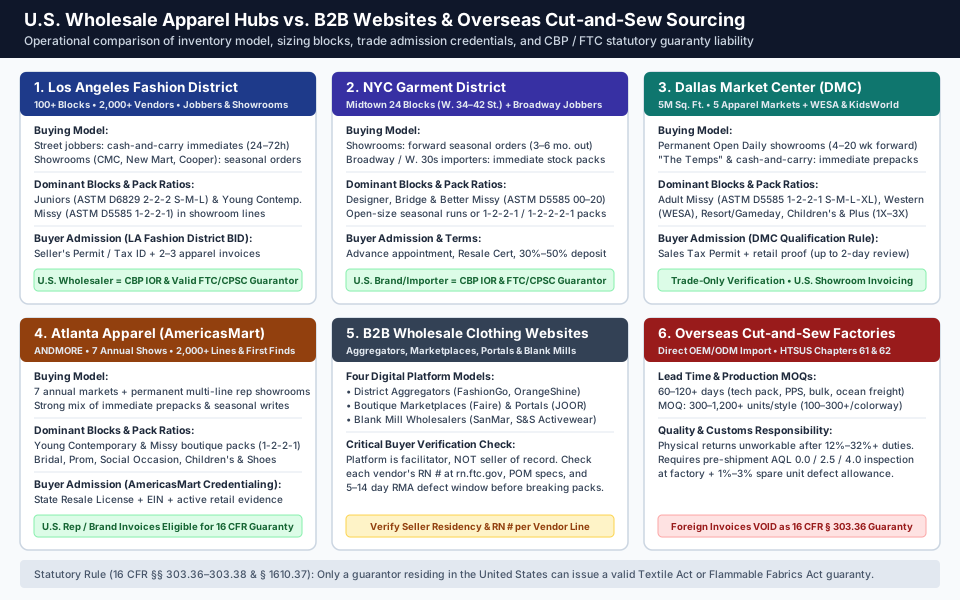
Domestic wholesale apparel trade concentrates in four institutional market centers, each serving distinct retail demographics, price tiers, and delivery calendars. Understanding how inventory moves through each hub prevents buyers from arriving at a seasonal order-writing building expecting cash-and-carry prepacks—or travelling without required trade credentials.
1. Los Angeles Fashion District (Downtown Los Angeles, CA)
Spanning more than 100 blocks in Downtown Los Angeles under the LA Fashion District Business Improvement District (BID), Los Angeles is the largest concentration of immediate-delivery fashion jobbers and domestic fast-fashion manufacturers in North America, housing over 2,000 wholesale apparel businesses.
- Street-Level Open-Stock Jobbers vs. Showroom Buildings: The district operates on a bifurcated physical model. Street-level wholesale vendors and open-stock marts concentrated around the San Pedro Wholesale Mart, Towne Avenue, Crocker Street, and the Pico Boulevard corridor sell immediate-delivery (“cash-and-carry” / “immediates”) prepacks that are in stock and ready to ship or load within 24 to 72 hours. By contrast, the district’s four major contemporary showroom buildings—the California Market Center (
CMC), The New Mart, Cooper Design Space, and the Lady Liberty Building—house multi-line brand sales representatives who primarily write seasonal forward collection orders during scheduled LA Market Weeks (and by advance appointment outside market weeks). - Published Buyer Admission Requirements: Per the LA Fashion District BID’s official Wholesale Buyer Info, retail buyers shopping wholesale vendors, contemporary showrooms, or LA Market Weeks must present two core sets of credentials:
- A Business License or Seller’s Permit and/or Business Tax ID Number (see our guide to resale certificates for wholesale buying); and
- 2 to 3 industry-related purchase invoices proving active apparel trade purchasing. During LA Market Weeks, buyers must complete registration separately at each individual contemporary showroom building they enter.
2. New York City Garment District (Midtown Manhattan, NY)
Covering 24 blocks in Midtown Manhattan between West 34th and West 42nd Streets from Fifth to Ninth Avenue—served by the Garment District Alliance (established in 1993 as the Fashion Center BID)—alongside the adjacent Broadway and West 28th–39th Street wholesale importer corridor, New York City anchors designer, bridge, better Missy (ASTM D5585), tailored outerwear, careerwear, eveningwear, and domestic sample development.
- Showroom Order-Writing vs. Broadway Importers: Corporate fashion headquarters and multi-line showrooms along Seventh Avenue, Fashion Avenue, and West 35th–39th Streets operate strictly by advance trade appointment around New York Market Weeks and designated trade exhibitions. Orders written in Midtown showrooms are predominantly seasonal forward contracts scheduled for delivery 3 to 6 months out, requiring a verified state Resale Certificate (such as New York Form
ST-120or a multistate certificate), trade credit references, or an opening order deposit of30%–50%. Meanwhile, walk-in wholesale showrooms along Broadway and the West 30s operate closer to the Los Angeles importer model, selling immediate-delivery prepacks of women’s trendy separates, resortwear, accessories, and off-price department-store closeouts.
3. Dallas Market Center (Dallas, TX)
Located at 2100 Stemmons Freeway, Dallas Market Center (DMC) operates a 5-million-square-foot, strictly trade-only wholesale campus serving boutiques and department stores across the Southwest, Midwest, Rockies, and nationwide.
- Permanent Showrooms, “The Temps,” and Specialized Western/Children’s Markets: DMC combines hundreds of permanent Open Daily apparel and accessories showrooms inside the World Trade Center and Trade Mart buildings with temporary juried booth exhibits (“The Temps”) during five annual Dallas Apparel & Accessories Markets. Dallas is also the premier national wholesale venue for Western and equestrian fashion—hosting WESA’s International Western/English Apparel & Equipment Market—as well as KidsWorld and the Dallas Men’s Show. Because Dallas permanent lines cater heavily to independent suburban and regional women’s boutiques, assortments strongly favor true Adult Female Misses (
ASTM D5585-21)1-2-2-1(S-M-L-XL) prepacks and open-stock Missy sizing alongside cash-and-carry boutique immediates. - Published Attendee Qualification Policy: Under DMC’s Become an Attendee qualification policy, the campus is closed to the general public. Every applying business must submit a valid Sales Tax Permit, 501(c)(3) Permit, or International Business License along with category-specific supporting documentation (such as a retail lease, active storefront photos, or apparel vendor invoices; see wholesale account requirements). New buyer applications require up to 2 business days to process, and newly registered accounts are granted a 90-calendar-day window to finalize all qualification documents.
4. Atlanta Apparel at AmericasMart (Downtown Atlanta, GA)
Operated by ANDMORE in Downtown Atlanta, Atlanta Apparel at AmericasMart hosts 7 yearly wholesale apparel tradeshows uniting permanent multi-line sales representative showrooms and temporary “First Finds” collections across more than 2,000 lines.
- Category Specialization: Atlanta Apparel is the dominant wholesale hub for the Southeast and East Coast across two flagship segments:
- Young Contemporary and Missy Boutique Apparel: Offering a high-velocity blend of immediate-delivery prepacks, near-term (
2–6 week) replenishment packs, and seasonal forward lines tailored to independent resort, college-town, and suburban boutiques. - Bridal, Prom, Pageant, and Social Occasion: AmericasMart hosts specialized formalwear and vows markets that serve as the primary North American order-writing hub for bridal salons and formalwear retailers.
- Young Contemporary and Missy Boutique Apparel: Offering a high-velocity blend of immediate-delivery prepacks, near-term (
| U.S. Apparel Wholesale Hub | Institutional Operator & Location | Primary Apparel & Sizing Focus | Order-Writing vs. Immediate Stock Split | Published Trade Admission Credentials |
|---|---|---|---|---|
| Los Angeles Fashion District | LA Fashion District BID (Downtown LA, 100+ blocks, 2,000+ vendors) | Juniors / Young Contemporary (ASTM D6829), Missy (ASTM D5585), denim, basics, plus (1X–3X) |
Street jobbers (San Pedro Mart): 100% Immediates (2-2-2 prepacks). Showrooms (CMC, New Mart, Cooper): Seasonal Forward. |
Business License or Seller’s Permit and/or Tax ID + 2–3 industry purchase invoices; separate registration per showroom building during Market Weeks. |
| NYC Garment District | Garment District Alliance (Midtown W. 34th–42nd St., 24 blocks + Broadway corridor) | Designer, bridge, better Missy (ASTM D5585), outerwear, eveningwear, domestic sample/cut-and-sew |
Midtown showrooms: 85%+ Seasonal Forward (3–6 mo. lead time). Broadway/W. 30s importers: Immediates & Closeouts. |
Advance showroom appointment, state Resale Certificate (e.g., NY ST-120), trade references, and 30%–50% seasonal deposit. |
| Dallas Market Center (DMC) | Dallas Market Center (2100 Stemmons Fwy, Dallas, TX; 5M sq. ft.) | Adult Missy (ASTM D5585 1-2-2-1), Western/Equestrian (WESA), resort, gameday, children’s (KidsWorld) |
5 annual Apparel Markets + Open Daily showrooms. Balanced mix of Seasonal Forward and Immediate Temps. | Strictly trade-only (DMC Attendee Policy): Sales Tax Permit / Business License + retail proof; up to 2 business days processing (90-day doc window). |
| Atlanta Apparel (AmericasMart) | ANDMORE / AmericasMart (Downtown Atlanta, GA; 2,000+ lines) | Young Contemporary, Missy boutique ready-to-wear, Bridal / Prom / Social Occasion, children’s, footwear | 7 annual apparel shows + permanent rep showrooms; heavy Immediate / Near-Term Young Contemporary + Forward Formalwear. | State Retail Sales Tax / Resale License, federal EIN, and verified proof of active retail apparel operation. |
Evaluating Wholesale Clothing Websites Without Ranked-List Traps
Buyers searching for wholesale clothing websites or comparing the best wholesale clothing vendors in the USA frequently encounter generic “Top 10” directories that mix multi-vendor software platforms, print-on-demand dropshippers, and blank t-shirt distributors in a single list. As explained in our U.S. wholesale supplier evaluation framework and online wholesale marketplaces guide, a website is an ordering interface—not a guarantee of garment fit, domestic warehousing, or statutory labeling compliance.
Rather than relying on subjective rankings, classify any B2B apparel website into one of four operational models and verify the actual invoicing entity before placing an order:
- Multi-Vendor Apparel District Aggregators (e.g., FashionGo, LA Showroom, OrangeShine):
- Commercial Structure: Digital portals that aggregate hundreds of independent Los Angeles Fashion District and New York City importers/jobbers into a single checkout cart with consolidated freight options.
- What Buyers Must Verify: Under platform terms (such as the FASHIONGO Buyer Services Agreement documented in our apparel channel guide), the platform facilitates the transaction but is not the seller of record. Each vendor sets its own dollar minimum (
typically $100–$300), ships its own fixed 6-piece prepacks (2-2-2or1-2-2-1), and adjudicates its own RMA defect requests. Always verify the individual vendor’sRN #atrn.ftc.gov/rnsand request flat garment measurements before ordering.
- Cross-Category Boutique Marketplaces (e.g., Faire):
- Commercial Structure: Connects independent apparel brands, domestic importers, and small-batch makers with retail stores, offering both fixed prepacks and open-size assortments alongside platform-underwritten net payment terms for qualifying buyers.
- What Buyers Must Verify: While first-order return programs may cover qualifying opening orders with a brand, published marketplace exclusions typically bar returns on final-sale items, seasonal merchandise, and individual units separated from a bundled prepack. Confirm also whether the brand dispatches from a cleared U.S. warehouse or drop-ships cross-border.
- Digital Brand Showroom & Line-Sheet Portals (e.g., JOOR, NuOrder, Brandboom):
- Commercial Structure: B2B order-writing software used by contemporary, bridge, and designer brands (and their NYC, LA, Dallas, and Atlanta showroom reps) to share digital line sheets.
- What Buyers Must Verify: Separate Available-to-Sell (
ATS) immediate inventory from future seasonal production line sheets. On forward orders, verify the writtenStart Shipdate,Cancel Date(the date after which the retailer can cancel unshipped late seasonal goods without penalty), and deposit requirements.
- Blank / Imprintable Apparel Mill Distributors (e.g., SanMar, S&S Activewear, AlphaBroder):
- Commercial Structure: Large national merchant wholesalers operating multi-state U.S. distribution centers that sell open-stock knit and woven blanks (t-shirts, fleece hoodies, polos, outerwear, caps) by the individual piece, dozen, or full case across standardized alpha sizes (
XSthrough4XL–6XL). - What Buyers Must Verify: Blank distributors are built for screen printers, embroiderers, uniform decorators, and private-label brands. If you remove or replace a mill’s tear-away neck label to attach your own private-label brand tag,
16 CFR § 303.39(b)requires you to retain records showing the original manufacturer’s fiber content, country of origin, and identity for at least 3 years.
- Commercial Structure: Large national merchant wholesalers operating multi-state U.S. distribution centers that sell open-stock knit and woven blanks (t-shirts, fleece hoodies, polos, outerwear, caps) by the individual piece, dozen, or full case across standardized alpha sizes (
Apparel Sizing Blocks (ASTM D5585 Missy vs. ASTM D6829 Junior) and Prepack Ratio Math
The single largest preventable source of dead retail inventory and customer fit returns in boutique apparel is confusing Junior (ASTM D6829), Misses / “Missy” (ASTM D5585-21), and unadjusted overseas Asian factory grading when purchasing fixed wholesale prepacks.
1. Commercial Convention vs. Voluntary Consensus Standards (ASTM D5585-21 vs. ASTM D6829)
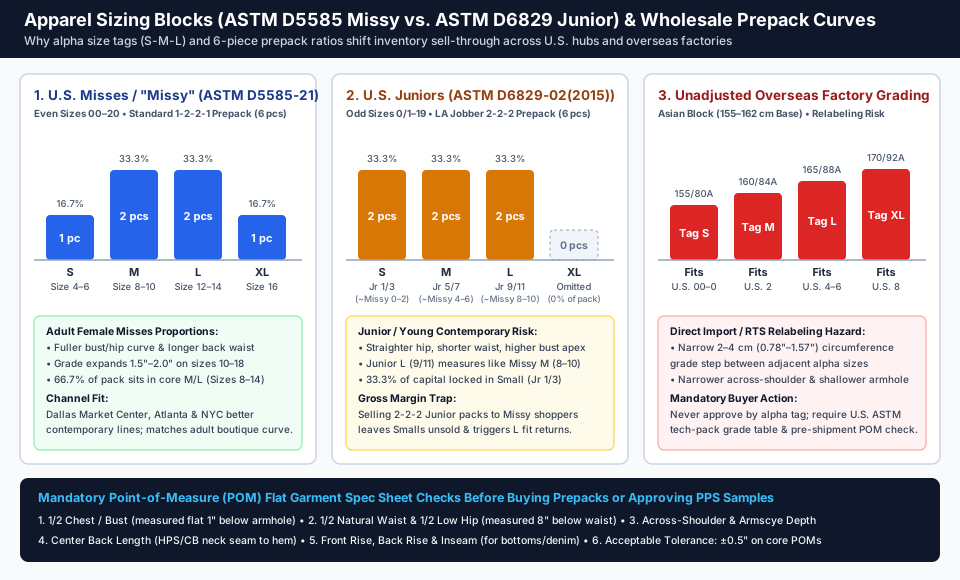
Federal law does not mandate garment dimensions for an alpha size tag (S, M, L, XL). Instead, U.S. wholesale pattern blocks follow voluntary consensus body-measurement tables maintained by ASTM International Subcommittee D13.55:
- U.S. Adult Female Misses / “Missy” Block (
ASTM D5585-21): Covers even-numbered numeric sizes00through20(XXS–XXL). Drafted for a fully developed adult female figure with fuller bust-to-waist-to-hip curvature, a lower bust apex, a longer back waist length, and broader grade increments (1.0"from size2→4→6→8, expanding to1.5"to2.0"across Bust, Waist, and Hip from size10→12→14→16→18). In a Missy alpha scale, Small (S) =4–6, Medium (M) =8–10, Large (L) =12–14, and Extra Large (XL) =16(or16–18). - U.S. Juniors / “Young Contemporary” Block (
ASTM D6829-02(2015)): Covers odd-numbered numeric sizes0/1through19. Drafted for a younger, straighter, less-curvy silhouette with a higher bust point, narrower hip-to-waist ratio, shorter torso/waist length, and slimmer bicep and thigh specs. In Los Angeles Fashion District fast-fashion jobbers, a Junior alpha scale typically maps Small (S) =1/3(fits ~Missy0–2), Medium (M) =5/7(fits ~Missy4–6), and Large (L) =9/11(fits ~Missy8–10). - Unadjusted Overseas / Asian Factory Grading: Ready-to-ship (
RTS) catalogs from overseas factories are frequently drafted on an East/Southeast Asian domestic block (155–162 cmbase height, narrower across-shoulder width, shallower armscye, and uniform2 cmto4 cm[0.78"–1.57"] circumference grade steps). When an unvetted seller sews U.S.S-M-L-XLneck tags into an unadjusted Asian-graded run, theLargefits like a U.S. Missy4–6and theXLfits like a U.S. Missy8.
2. Prepack Ratio Math (1-2-2-1 vs. 2-2-2) and Gross Margin Impact
As covered in our analysis of minimum order quantity mechanics, U.S. stocking apparel vendors sell almost exclusively in sealed prepacks (one style and one colorway per pack, divided into a fixed size ratio, usually 6 pieces per pack):
| Wholesale Prepack Ratio | Pack Size | Unit Breakdown by Alpha Size | Underlying Size Block | Retail Sell-Through & Gross Margin Impact |
|---|---|---|---|---|
1-2-2-1 (S-M-L-XL) |
6 pcs | 1 S (16.7%), 2 M (33.3%), 2 L (33.3%), 1 XL (16.7%) |
U.S. Missy (ASTM D5585-21) (S=4–6, M=8–10, L=12–14, XL=16) |
Bell-curve distribution: Places 66.7% of inventory in core adult sizes M and L (8–14) while serving XL (16) buyers. Protects full-price sell-through in adult women’s boutiques. |
2-2-2 (S-M-L) |
6 pcs | 2 S (33.3%), 2 M (33.3%), 2 L (33.3%), 0 XL (0%) |
U.S. Juniors (ASTM D6829) (S=1/3, M=5/7, L=9/11) |
High markdown risk for Missy stores: Allocates 33.3% of capital to Small (Jr 1/3), includes zero XL units, and caps Large at Jr 9/11 (~Missy 8–10). If sold to adult Missy shoppers, M/L sell out while S requires deep clearance markdowns. |
1-2-3 (S-M-L) |
6 pcs | 1 S (16.7%), 2 M (33.3%), 3 L (50.0%) |
Slim Contemporary / Resort | Offsets slim-fitting contemporary cuts by concentrating 83.3% of units in M and L. |
1-2-2-2-1 (XS–XL) |
8 pcs | 1 XS, 2 S, 2 M, 2 L, 1 XL |
Better Contemporary / Woven & Denim | Covers full 0–16 Missy range but increases per-colorway capital commitment by 33.3% (8 units vs. 6 units). |
2-2-2 Plus (1X-2X-3X) |
6 pcs | 2 (1X), 2 (2X), 2 (3X) |
Women’s Plus / Curve (ASTM D5586) |
Sold under a separate style suffix (e.g., #4020X) with a typical $1.50–$4.00/unit fabric yardage upcharge over standard packs. |
Worked Margin Example (
2-2-2Junior vs.1-2-2-1Missy Pack): Suppose a boutique buys a 6-piece dress prepack at$18.00/unit($108.00pack cost) for a$48.00retail price ($288.00potential revenue,62.5%initial markup). If an adult Missy boutique accidentally buys a2-2-2Junior-cut pack, the2 Large(Jr 9/11) and2 Medium(Jr 5/7) units sell at$48.00($192.00), but the2 Small(Jr 1/3, fitting Missy0–2) units sit unsold and must be liquidated at$15.00($30.00recovery), dropping realized gross margin from62.5%to51.4%while turning away every customer needing a true Missy12–16. Always demand a flat Point-of-Measure (POM) spec sheet (1/2 Chest 1" below armhole,1/2 Natural Waist,1/2 Low Hip 8" below waist,Center Back Length, andFront Rise/Inseamwith±0.5"tolerance) before ordering.
Defective Merchandise Credits, RMA Windows, and Overseas AQL Inspections
Commercial remedies for sewing flaws, dye crocking/shading, broken zippers, or mislabeled size runs operate under completely different rules depending on whether you purchase from a domestic U.S. wholesaler or an overseas cut-and-sew factory.
1. U.S. Showrooms and B2B Apparel Websites: 5–14 Day RMA Windows & Prepack Integrity
- Final Sale on Unsold Seasonal Stock: Across LA Fashion District jobbers, NYC/Dallas/Atlanta showrooms, and B2B platforms like FashionGo, non-defective wholesale apparel is final sale. Buyers cannot return seasonal prepacks because a colorway underperformed at retail. Even on boutique marketplaces offering first-order return trials (such as Faire), published exclusions bar returns on seasonal items, final-sale listings, and individual pieces separated from a prepack bundle.
- Short Inspection Clock (
5 to 14 Calendar Days): Domestic apparel vendors require the receiving team (see dock receiving and carton inspection procedures) to open cartons immediately upon carrier delivery and submit a written Return Merchandise Authorization (RMA) claim within 5 to 7 business days (or up to 14 calendar days on select marketplace vendor policies). Claims must attach clear photos of: (1) the physical defect, (2) the unremoved original neck and hang tags, and (3) the vendor’s packing slip/invoice. - Per-Piece Credit Memo vs. Full-Pack Return Rule: When 1 garment inside a 6-piece
1-2-2-1pack arrives with an open seam or oil stain, domestic vendors either issue a pro-rata per-piece credit memo (1/6thof the pack price) or issue a prepaid return label for the defective piece. However, if an entire pack is mislabeled or cut in the wrong shade, do not put any pieces from that pack onto the retail floor—breaking a prepack voids a full-pack RMA return. Shipping goods back without a pre-approved RMA number triggers dock refusal or a15%–25%restocking fee.
2. Overseas Cut-and-Sew Factories: Pre-Shipment AQL 2.5 / 4.0 Inspections & Defect Allowances
As detailed in our domestic vs. overseas wholesale supplier comparison, returning defective garments physically to a factory in China, Vietnam, Bangladesh, or India after U.S. arrival is economically unworkable. Once a shipment clears U.S. Customs under HTSUS Chapters 61 or 62, the importer has already paid international freight, brokerage, and 12%–32%+ textile import duties; re-exporting defects triggers foreign customs blocks and complex CBP duty drawback filings (19 CFR Part 190).
Instead, professional apparel importers protect their capital through two contractual mechanisms written directly into the Purchase Order:
- Pre-Shipment Third-Party Final Random Inspection (
FRI) underISO 2859-1/ANSI/ASQ Z1.4(AQL): Conducted at the overseas factory when80%–100%of bulk production is finished and packed into export cartons, prior to releasing the final70%balance payment:AQL 0.0(Critical Defects): Broken sewing needles left in garments (verified via 100% calibrated needle/metal-detection logs), sharp metal hardware edges, or mandatory labeling violations. Zero tolerance—a single critical defect fails the entire lot.AQL 2.5(Major Defects): Open seams, fabric holes/runs, visible oil or dye stains> 3 mm, noticeable shade variation within a prepack, broken zippers, or core POM dimensions (Chest,Waist,Hip,Inseam) out of tolerance by more than±0.5".AQL 4.0(Minor Defects): Untrimmed loose threads> 1 cm, minor inside-seam puckering, or slightly skewed polybag stickers.- If the shipment fails
AQL 2.5 / 4.0, the factory must perform a 100% rework/re-sort at its own expense and pass a re-inspection before vessel booking.
- Contractual Defective Allowance (
1%–3%Free Spare Units or Credit Holdback): Because statistical sampling leaves a small fraction of undetected minor flaws, overseas contracts require either1%–3%free overrun units (shipped at no charge in core sizesMandL) or a wire holdback / credit memo clause allowing the buyer to deduct documented post-arrival defects (reported within15–30 daysof port receipt) from the holdback or next PO.
Federal & State Apparel Compliance: FTC Labeling (16 CFR 303 & 423), CPSC Flammability (16 CFR 1610), and California Prop 65
Every garment offered for wholesale or retail sale in the United States must comply with federal labeling and flammability statutes enforced by the FTC and CPSC, plus California Proposition 65 chemical exposure rules whenever sold into California (including via e-commerce websites).
Gate 1: FTC Textile Fiber Products Identification Act (16 CFR Part 303) & RN Verification
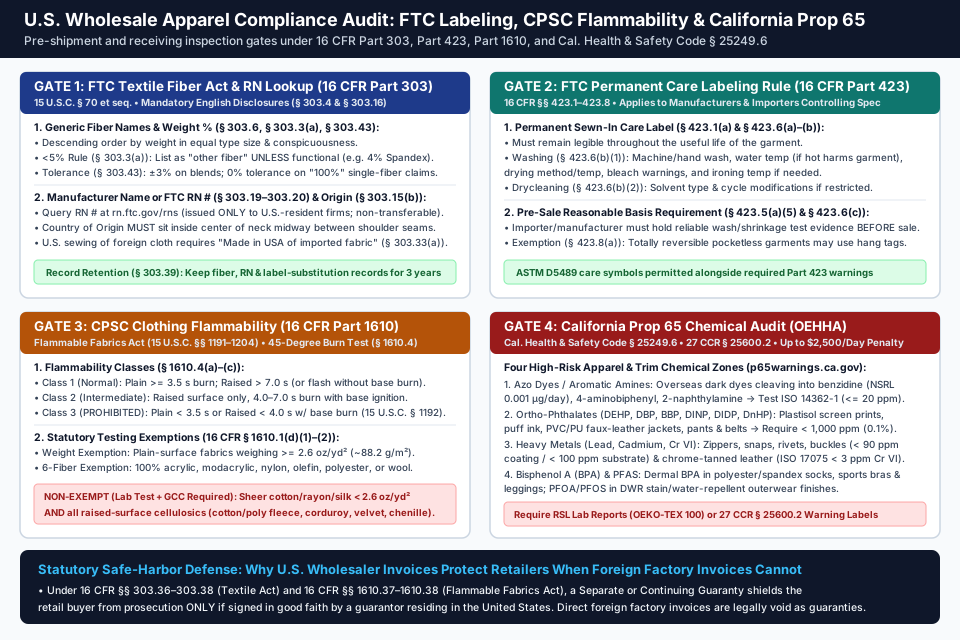
Under the Textile Fiber Products Identification Act (15 U.S.C. § 70 et seq.) and 16 CFR Part 303, every textile wearing apparel item must carry conspicuous, durable English labels (16 CFR § 303.4) disclosing three required elements (16 CFR § 303.16(a)(1)–(3)) in lettering of equal size and conspicuousness (§ 303.16(b)):
- Generic Fiber Names and Percentages by Weight (
16 CFR §§ 303.3, 303.6, 303.7, 303.16, 303.43):- Fibers must be identified by their FTC-recognized generic names (
§ 303.6/§ 303.7, such as cotton, polyester, rayon/viscose, lyocell, nylon, spandex/elastane, acrylic, wool) in descending order of predominance by weight. Fiber trademarks (e.g., Lycra®, Tencel®) may accompany—but never substitute for—the generic fiber name (§ 303.17). - The 5% Fiber Disclosure Rule (
16 CFR § 303.3(a)): No fiber present in an amount of less than 5% of total fiber weight may be designated by its generic name (it must be listed last as "other fiber"or"other fibers"in the aggregate), unless that fiber has a “clearly established and definite functional significance” at that low percentage—most notably"96% Cotton, 4% Spandex", where 4% spandex delivers elastic recovery. - The
±3%Fiber Content Tolerance Rule (16 CFR § 303.43(a)–(c)): For multi-fiber blends, a garment is not misbranded if the actual weight percentage of each constituent fiber deviates by no more than±3%of total fiber weight from the labeled figure (e.g., a"60% Cotton / 40% Polyester"label permits57%–63%cotton). However, under§ 303.43(c)and§ 303.27, zero tolerance (0%) applies to"100%"or"All"single-fiber claims (excluding up to 5% visible ornamentation labeled “Exclusive of Ornamentation” under§ 303.26).
- Fibers must be identified by their FTC-recognized generic names (
- Manufacturer Name or FTC
RNNumber (16 CFR §§ 303.19–303.20):- The garment must state either the full legal business name (
§ 303.19) or the FTC-issued Registered Identification Number (RN) (§ 303.20) of the manufacturer or a U.S. wholesaler/importer/retailer marketing the product. - Live Due Diligence via
rn.ftc.gov/rns: Under16 CFR § 303.20(a)–(b), the FTC issuesRNnumbers only to businesses residing in the United States, and RNs are strictly non-transferable. Querying theRN #printed on a sample garment’s neck or care tag athttps://rn.ftc.gov/rnsimmediately confirms the legal U.S. corporate name, physical street address, and importer identity behind the garment.
- The garment must state either the full legal business name (
- Country of Origin & Mandatory Center-Neck Placement (
16 CFR § 303.15(b)&§ 303.33):- Under
16 CFR § 303.15(b), any garment with a neck must have its country-of-origin disclosure affixed to the inside center of the neck midway between the shoulder seams (or on a conspicuous label immediately adjacent to the center-neck label), whereas fiber content and theRN #may appear on either the neck label or a conspicuous side-seam care label. - Under
16 CFR § 303.33(a)(2)–(4), garments sewn in Los Angeles or New York from imported fabric cannot carry an unqualified"Made in U.S.A."tag; they must disclose the imported material (e.g., "Made in USA of imported fabric"or"Sewn in USA of imported components").
- Under
Gate 2: FTC Care Labeling Rule (16 CFR Part 423)
Under 16 CFR Part 423, manufacturers and importers of textile wearing apparel (§ 423.4) must attach a permanent care label (§ 423.1(a)) before sale that remains legible for the useful life of the garment:
- Required Elements (
16 CFR § 423.6(b)(1)–(2)): Must state either a washing instruction (machine or hand wash, water temperature if hot water would harm the garment, drying method and temperature, bleaching warnings, and ironing temperature if needed) or a drycleaning instruction (including solvent restrictions and cycle modifications), plus warnings against any part of the prescribed procedure that would damage the garment or other garments cleaned with it. - Pre-Sale Reasonable Basis (
16 CFR § 423.5(a)(5)&§ 423.6(c)): The manufacturer or importer must possess reliable evidence (from washing/drycleaning tests on garments or components) supporting the care instructions before offering the garment for sale.ASTM D5489care symbols may accompany the instructions provided all Part 423 warnings are satisfied. Totally reversible garments without pockets (§ 423.8(a)) may place care instructions on a temporary hang tag.
Gate 3: CPSC Clothing Flammability Standard (16 CFR Part 1610)
Enforced by the U.S. Consumer Product Safety Commission under the Flammable Fabrics Act (15 U.S.C. §§ 1191–1204), 16 CFR Part 1610 classifies general wearing apparel tested at a 45-degree angle into three classes (16 CFR § 1610.4(a)–(c)):
- Class 1 (Normal Flammability — Acceptable): Plain-surface textiles with an average burn time of
>= 3.5 seconds, or raised-surface textiles with an average burn time> 7.0 seconds(or a rapid surface flash<= 7.0 secondsthat does not ignite or fuse the base fabric). - Class 2 (Intermediate Flammability — Raised-Surface Only): Raised-fiber surface textiles with an average burn time of
4.0 to 7.0 secondsinclusive where the base fabric ignites or fuses. - Class 3 (Rapid and Intense Burning — Strictly Prohibited): Plain-surface textiles burning in
< 3.5 seconds, or raised-surface textiles burning in< 4.0 secondswith base fabric ignition/fusing. Class 3 garments are dangerously flammable and illegal to import, wholesale, or sell under15 U.S.C. § 1192. - The Two Statutory Testing Exemptions (
16 CFR § 1610.1(d)(1)–(2)):- Weight Exemption (
§ 1610.1(d)(1)): Plain-surface fabrics (no nap, pile, tufting, flock, or brushed surface), regardless of fiber content, weighing2.6 ounces per square yard(~88.2 g/m²) or more are exempt from mandatory flammability testing. - Six-Fiber Exemption (
§ 1610.1(d)(2)): All fabrics (both plain-surface and raised-surface), regardless of weight, made entirely fromacrylic, modacrylic, nylon, olefin, polyester, or wool(or any combination solely of those six fibers) are exempt from testing.
- Weight Exemption (
- Garments Requiring Lab Testing & a General Certificate of Conformity (
GCC): Any sheer/lightweight plain-surface cellulosic or silk garment weighing under2.6 oz/yd²(such as sheer cotton voile, cotton gauze, rayon challis, viscose chiffon, or silk organza) AND every raised-surface fabric containing cotton, rayon, modal, lyocell, linen, or silk regardless of weight (such as brushed cotton or cotton/polyester fleece hoodies and sweatpants, cotton corduroy, cotton chenille knitwear, and rayon/cotton velvet) are not exempt under§ 1610.1(d)and require16 CFR Part 1610lab test reports plus a CPSIA § 102 General Certificate of Conformity (15 U.S.C. § 2063(a)(1)).
Gate 4: California Proposition 65 Chemical Compliance (Cal. Health & Safety Code § 25249.6 / 27 CCR § 25600 et seq.)
Administered by the California Office of Environmental Health Hazard Assessment (OEHHA), the Safe Drinking Water and Toxic Enforcement Act of 1986 (California Proposition 65) requires businesses with 10 or more employees (Cal. Health & Safety Code § 25249.6) to provide a “clear and reasonable warning” (27 CCR § 25600.2) before knowingly and intentionally exposing any individual in California to a listed carcinogen or reproductive toxicant above its safe-harbor threshold (No Significant Risk Level [NSRL] or Maximum Allowable Dose Level [MADL]). Violations carry civil penalties up to $2,500 per day per violation (Cal. Health & Safety Code § 25249.7(b)).
Per OEHHA’s official Apparel and Footwear Exposure Guidance, wholesale buyers sourcing from overseas factories or domestic importers must audit four primary chemical risk zones:
| Prop 65 Chemical Category | Specific Regulated Substances | High-Risk Apparel, Print & Trim Components | Technical Verification Standard / Safe-Harbor Action |
|---|---|---|---|
| 1. Azo Dyes Cleaving into Carcinogenic Aromatic Amines | Benzidine and benzidine-based dyes (NSRL: 0.001 µg/day), 4-Aminobiphenyl, 2-Naphthylamine, o-Toluidine, 4-Chloro-o-toluidine, and 20+ restricted arylamines |
Direct-dyed and disperse-dyed overseas textiles and leather (saturated reds, navies, blacks, browns, and overdyed denim from unvetted dye houses) | Require third-party lab testing under ISO 14362-1 (textiles) / ISO 14362-3 (4-aminoazobenzene) / ISO 17234-1 (leather) confirming restricted aromatic amines are <= 20 mg/kg (ppm) (or active OEKO-TEX® Standard 100 certification). |
| 2. Ortho-Phthalates (Plasticizers) | DEHP, DBP, BBP, DINP, DIDP, DnHP | Plastisol screen-printed graphic tees/hoodies, puff inks, heat transfers, PVC / polyurethane (PU) faux-leather jackets, pants, and belts, and vinyl trims | Specify phthalate-free plastisol or water-based screen printing inks and verify each regulated ortho-phthalate is < 1,000 ppm (0.1% by weight) per component. |
3. Heavy Metals (Lead, Cadmium, Hexavalent Chromium) |
Lead (Pb) (MADL: 0.5 µg/day), Cadmium (Cd), Hexavalent Chromium (Cr VI) |
Metal zippers, snaps, grommets, rivets, belt buckles, painted hardware, rhinestone studs, and chrome-tanned leather garments/belts | Require < 90 ppm lead in surface coatings (16 CFR Part 1303), < 100 ppm lead in metal/vinyl substrates, and ISO 17075 < 3 ppm Cr VI on leather components. |
4. Bisphenol A (BPA) & PFAS (PFOA / PFOS) |
Bisphenol A (BPA) (listed for female reproductive toxicity; high dermal 60-Day Notice volume), PFOA / PFOS |
Polyester/spandex athletic socks, sports bras, and compression leggings (where BPA is used in synthetic fiber spinning/dye-fixing); DWR water-repellent outerwear | Demand explicit BPA-free (< 1 ppm extraction) and PFAS-free Restricted Substances List (RSL) lab declarations—or attach 27 CCR § 25600.2 compliant on-product and e-commerce checkout warnings before selling into California. |
Why Statutory Guaranties (16 CFR §§ 303.36–303.38 & 16 CFR § 1610.37) Favor Vetted U.S. Wholesalers
Both the Textile Fiber Products Identification Act (15 U.S.C. § 70h; 16 CFR §§ 303.36–303.38) and the Flammable Fabrics Act (15 U.S.C. § 1197(a); 16 CFR §§ 1610.37–1610.38) provide a statutory safe harbor that shields a wholesale buyer or retailer from misbranding or flammability prosecution if the buyer holds in good faith a Separate Guaranty printed on the vendor’s invoice (§ 303.36) or a Continuing Guaranty (§§ 303.37–303.38).
- The U.S. Residency Requirement: Both regulations explicitly state that a valid guaranty may only be issued by a person residing in the United States (
16 CFR § 303.36(a),§ 303.38(a)(1),16 CFR § 1610.37(b)). - Commercial Consequence: When a retailer buys from an established U.S. wholesaler in Los Angeles, New York, Dallas, or Atlanta whose invoice carries its U.S. corporate address,
RN #, and statutory guaranty statement, the domestic vendor provides a legally recognized compliance shield. When a retailer imports directly from an overseas cut-and-sew factory or buys from a foreign cross-border seller, any guaranty statement printed on the foreign invoice is void as a matter of federal law.
Pre-Commitment Apparel Vendor & Lot Verification Scorecard
Before approving a purchase order with a physical showroom, a B2B wholesale clothing website vendor, or an overseas cut-and-sew manufacturer, complete the verification record below for the specific style and lot:
| Verification Gate | Exact Evidence to Request | Statutory / Technical Benchmark | Buyer Pass / Fail Decision Rule |
|---|---|---|---|
1. Seller Identity & U.S. RN Residency |
Photo of inside neck label + side-seam label; vendor invoice header | 16 CFR § 303.20 & rn.ftc.gov/rns |
Confirm RN # resolves to an active U.S.-resident business matching the invoicing entity (or confirm full legal U.S. business name on tag). |
| 2. Sizing Block & Prepack Ratio | Written pack ratio (1-2-2-1 vs. 2-2-2) + flat POM measurement table |
ASTM D5585-21 (Missy 00–20) vs. ASTM D6829 (Junior 0/1–19) |
Reject unmeasured 2-2-2 S-M-L packs for adult Missy stores unless flat 1/2 Bust, 1/2 Waist, and 1/2 Hip specs match your target customer block. |
| 3. Fiber Content & Neck Origin Tag | Physical sample or high-resolution label proof | 16 CFR § 303.3(a) (5% rule), § 303.43 (±3% blend / 0% on 100%), § 303.15(b) (center neck) |
Country of origin must sit at inside center of neck; non-functional fibers < 5% must read "other fiber"; U.S.-sewn imported cloth must state "Made in USA of imported fabric" (§ 303.33(a)). |
| 4. Permanent Care Label | Sewn-in care label text/symbols + wash test basis | 16 CFR § 423.6(b)–(c) |
Must state washing or drycleaning method, temperature, drying, and bleach/iron warnings supported by a pre-sale reasonable basis. |
| 5. CPSC Flammability Status | Fabric weight (oz/yd² or g/m²), surface type (plain vs. raised), and fiber blend |
16 CFR § 1610.1(d)(1)–(2) & § 1610.4 |
Exempt if plain surface >= 2.6 oz/yd² (88.2 g/m²) OR 100% acrylic/modacrylic/nylon/olefin/polyester/wool. Require 16 CFR 1610 Class 1/2 test report + GCC for sheer cellulosics/silk < 2.6 oz/yd² and all raised-surface cotton/rayon fleece, velvet, corduroy, or chenille. |
| 6. California Prop 65 Chemical Audit | RSL test reports (ISO 14362-1, phthalate/lead screen, BPA declaration) or 27 CCR § 25600.2 notice |
Cal. Health & Safety Code § 25249.6 & OEHHA Apparel Guidance |
Verify azo aromatic amines <= 20 ppm, plastisol/faux-leather phthalates < 1,000 ppm, hardware lead < 90/100 ppm, and BPA-free spandex/polyester blends (or affix compliant Prop 65 warnings). |
| 7. Defect Remedy & Statutory Guaranty | Written RMA policy (5–14 days) or overseas FRI clause (AQL 0.0/2.5/4.0) + invoice guaranty text |
16 CFR §§ 303.36–303.38 & 16 CFR § 1610.37 |
For domestic stock, confirm U.S.-resident Separate/Continuing Guaranty on invoice and inspect before breaking packs. For overseas factories, hold final 70% balance until AQL 2.5/4.0 FRI passes. |
Scope Boundary: When This Guide Does Not Apply
This technical guide governs new commercial wearing apparel procured from U.S. wholesale hubs, B2B websites, and overseas cut-and-sew factories. Two specialized apparel categories require separate regulatory and commercial procedures:
- Secondhand, Rag-House, and Vintage Clothing Bundles: Used garments bought by the pound, bale, or graded vintage mix are not sold in
ASTM D5585/D6829size prepacks and carry distinct grading and contamination risks; use our wholesale vintage clothing mixed-bundle verification guide. - Children’s Sleepwear (
16 CFR Parts 1615 & 1616) and General Children’s Products (12 Years and Under): Children’s apparel is subject to strict CPSC third-party testing by a CPSC-accepted laboratory, Children’s Product Certificate (CPC) issuance (16 CFR Part 1110), permanent tracking labels (CPSIA § 103), small-parts choke testing (16 CFR Part 1501), and tight-fitting or flame-resistant sleepwear standards (16 CFR Parts 1615/1616) that exceed general adult16 CFR Part 1610exemptions.
Frequently asked questions
What documents are required to buy from U.S. wholesale clothing hubs in Los Angeles, Dallas, and Atlanta?
Published trade admission rules require proof of a registered retail business before entering showrooms or purchasing tax-exempt inventory. Under the LA Fashion District BID's published Buyer Info, wholesale buyers must present a Business License or Seller's Permit and/or Business Tax ID Number plus 2 to 3 industry-related purchase invoices, and register separately with each showroom building during LA Market Weeks. Dallas Market Center requires a Sales Tax Permit, 501(c)(3) Permit, or International Business License plus category-specific business documentation (processed within 2 business days). Atlanta Apparel at AmericasMart requires a state Resale License, federal EIN, and active retail store or e-commerce documentation.
Why does a 2-2-2 S-M-L wholesale clothing prepack often cause sizing returns for adult women's boutiques?
Many immediate-delivery vendors in the Los Angeles Fashion District and on multi-vendor B2B apparel websites cut 'Young Contemporary' styles on the ASTM D6829 Juniors figure block (odd sizes 0/1 to 19) rather than the ASTM D5585-21 Adult Female Misses ('Missy') block (even sizes 00 to 20). In a 6-piece 2-2-2 (2 Small, 2 Medium, 2 Large) Junior prepack, Small maps to Junior 1/3, Medium to 5/7, and Large to 9/11—meaning the Junior Large measures closer to a Missy Medium (8–10) and no XL is included. Adult boutiques serving a Missy customer base should prioritize 1-2-2-1 (S-M-L-XL) Missy prepacks and verify flat Point-of-Measure (POM) garment specifications before ordering.
How can a retail buyer verify whether a wholesale clothing website vendor is a genuine U.S. importer or manufacturer?
Request a clear photograph of the garment's inside neck label and side-seam care label, locate the FTC Registered Identification Number (RN #), and query it in the official Federal Trade Commission database at https://rn.ftc.gov/rns. Under 16 CFR § 303.20(a)–(b), the FTC issues RN numbers exclusively to businesses residing in the United States that manufacture, import, distribute, or market textile, wool, or fur products, and RN numbers are non-transferable. The database lookup reveals the exact U.S. legal entity, street address, and business activity behind the garment.
Which clothing fabrics are exempt from mandatory CPSC 16 CFR Part 1610 flammability testing?
Under 16 CFR § 1610.1(d)(1)–(2), two categories of clothing textiles are statutorily exempt from mandatory testing to support a flammability guaranty: (1) plain-surface fabrics (containing no nap, pile, tufting, flock, or brushed surface), regardless of fiber content, weighing 2.6 ounces per square yard (approximately 88.2 g/m²) or more; and (2) all fabrics (both plain-surface and raised-surface), regardless of weight, made entirely from acrylic, modacrylic, nylon, olefin, polyester, or wool, or any combination solely of those six fibers. Sheer cellulosic or silk fabrics under 2.6 oz/yd² and any raised-surface fabric containing cotton or rayon (such as brushed cotton/polyester fleece hoodies, corduroy, velvet, or chenille) are not exempt and require 16 CFR Part 1610 lab test reports and a General Certificate of Conformity (GCC).
Does a guaranty printed on an overseas clothing factory's invoice protect a U.S. retailer from FTC or CPSC enforcement?
No. Under both the Textile Fiber Products Identification Act (15 U.S.C. § 70h; 16 CFR §§ 303.36–303.38) and the Flammable Fabrics Act (15 U.S.C. § 1197(a); 16 CFR § 1610.37(b)), a Separate or Continuing Guaranty shields a wholesale buyer from prosecution only when signed in good faith by a guarantor residing in the United States. When a U.S. boutique imports directly from an overseas cut-and-sew factory or buys from a non-resident cross-border seller, any guaranty statement on the foreign invoice is legally void, and the U.S. buyer assumes primary strict liability for labeling, flammability, and California Proposition 65 compliance.
Which chemicals trigger California Proposition 65 enforcement actions in wholesale apparel and accessories?
Under California Health & Safety Code § 25249.6 and OEHHA's Apparel and Footwear guidance (p65warnings.ca.gov), private and public Proposition 65 enforcement (carrying statutory penalties up to $2,500 per day per violation) focuses on four primary apparel chemical exposures: (1) synthetic azo dyes that reductively cleave into carcinogenic aromatic amines such as benzidine (NSRL: 0.001 µg/day), 4-aminobiphenyl, and 2-naphthylamine; (2) ortho-phthalates (DEHP, DBP, BBP, DINP, DIDP, DnHP) used as plasticizers in plastisol screen prints and PVC/polyurethane faux leather; (3) heavy metals (lead, cadmium, and hexavalent chromium) in metal zippers, snaps, rivets, buckles, and chrome-tanned leather; and (4) bisphenol A (BPA) in polyester/spandex socks, sports bras, and activewear leggings.
Sources
- eCFR Title 16, Chapter I, Subchapter C, Part 303 — Rules and Regulations Under the Textile Fiber Products Identification Act (16 CFR §§ 303.1–303.45) — National Archives and Records Administration (NARA) & Federal Trade Commission (FTC) Accessed October 25, 2026.
- Registered Identification Number (RN) Database and Lookup Portal — Federal Trade Commission (FTC) Accessed October 25, 2026.
- eCFR Title 16, Chapter I, Subchapter D, Part 423 — Care Labeling of Textile Wearing Apparel and Certain Piece Goods as Amended — National Archives and Records Administration (NARA) & Federal Trade Commission (FTC) Accessed October 25, 2026.
- eCFR Title 16, Chapter II, Subchapter D, Part 1610 — Standard for the Flammability of Clothing Textiles (16 CFR §§ 1610.1–1610.61) — National Archives and Records Administration (NARA) & U.S. Consumer Product Safety Commission (CPSC) Accessed October 25, 2026.
- About Proposition 65 & The Proposition 65 Chemical List (Safe Drinking Water and Toxic Enforcement Act of 1986) — California Office of Environmental Health Hazard Assessment (OEHHA) Accessed October 25, 2026.
- Proposition 65 Warnings: Apparel and Footwear Exposure Fact Sheet — California Office of Environmental Health Hazard Assessment (OEHHA) Accessed October 25, 2026.
- ASTM D5585-21 — Standard Tables of Body Measurements for Adult Female Misses Figure Type, Size Range 00–20 — ASTM International (Committee D13 on Textiles) Accessed October 25, 2026.
- ASTM D6829-02(2015) — Standard Tables of Body Measurements for Juniors, Sizes 0 to 19 — ASTM International (Committee D13 on Textiles) Accessed October 25, 2026.
- Wholesale Buyer Info & How to Buy Wholesale Fashion Online — LA Fashion District Business Improvement District (BID) Accessed October 25, 2026.
- Apparel & Accessories Wholesale Market & Registered Attendee Qualification Policy — Dallas Market Center (DMC) Accessed October 25, 2026.
- Atlanta Apparel Wholesale Tradeshows & Showrooms at AmericasMart — ANDMORE / AmericasMart Atlanta Accessed October 25, 2026.
- Garment District Neighborhood Profile & CBP Priority Trade Issue: Textiles and Wearing Apparel — Garment District Alliance & U.S. Customs and Border Protection (CBP) Accessed October 25, 2026.